Free shipping — the threshold depends on the destination country, confirmed at checkout.
Research Use Only (RUO). For laboratory research only. Not for human or veterinary use.
Research Use Only (RUO):Research classification with product and batch documentation where available.
Weight & Metabolism
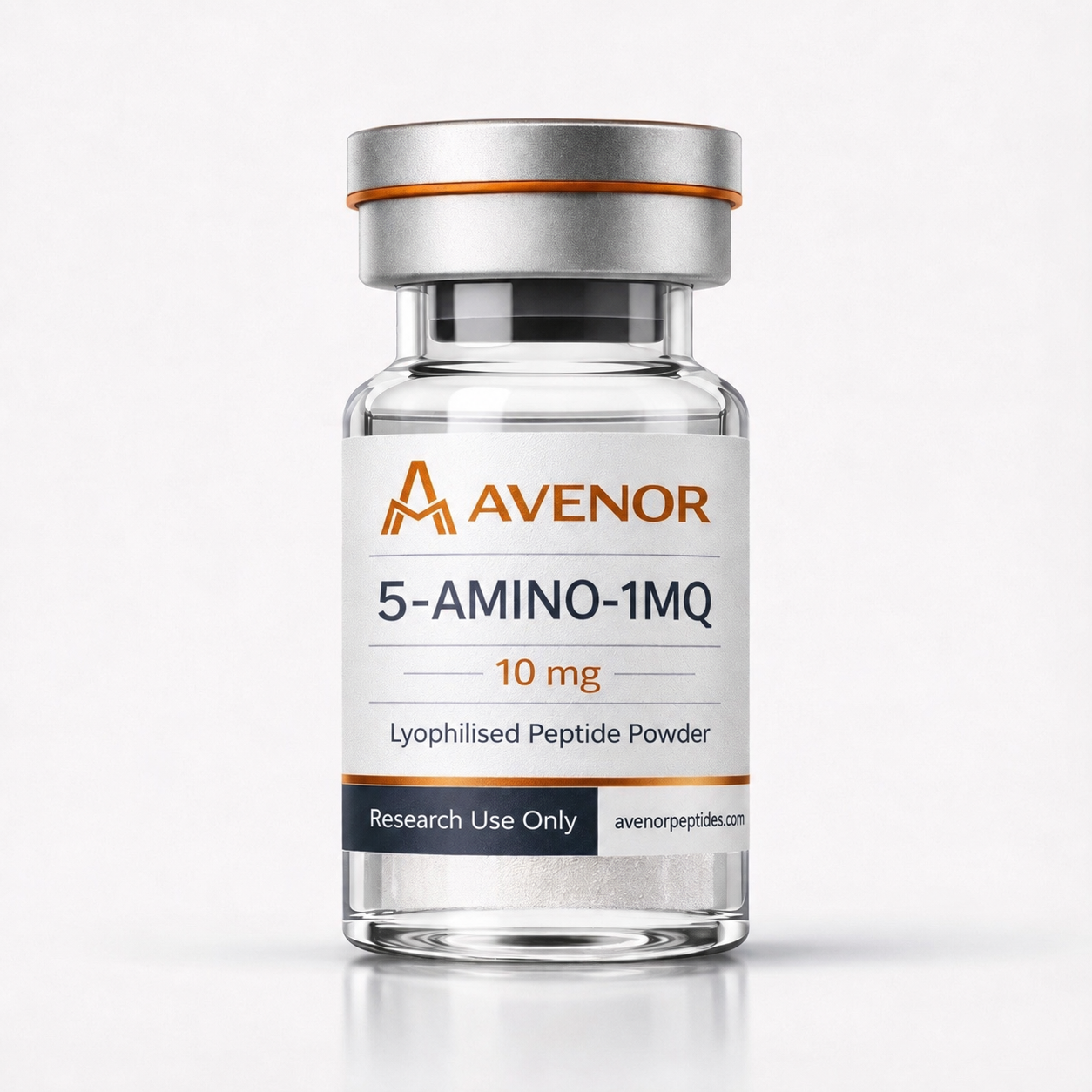
5-AMINO-1MQ
Strength: 10 mg
5-Amino-1MQ is not a peptide but a small molecule. It blocks an enzyme that acts as a "brake" on burning inside fat cells, and is studied mainly around metabolism and body fat.
Free shipping: Greece from €50, Cyprus and Bulgaria from €100, France, Germany, Italy, Belgium, Netherlands and Spain from €200. Details
This product is intended exclusively for laboratory research use. It is not intended for human consumption, diagnosis, treatment, or prevention of disease.
Product information
FormResearch product
Strength10 mg
SKUAVR-5AMINO1MQS-10MG
Stock statusIn stock
COA / BatchSee the documentation state below
StorageRefer to the label and available documentation details.
Packaging / shippingControlled shipping preparation according to the available SKU variant.
Documentation on request
There is no published document for this specific SKU variant at the moment.
The GLP-1 compounds next to it press a hormonal "switch". 5-Amino-1MQ works differently: it releases a brake inside the fat cell itself. This listing is the vial, not the pill.
Documentation & COA
Batch documentation and COA, where available, are linked to the specific product batch and SKU.
This product is intended exclusively for laboratory research use. It is not intended for human consumption, diagnosis, treatment, or prevention of disease.
clinical trials in humans — none, for any NNMT inhibitor
2017
year of the first characterization paper on the methylquinolinium series
≥98%
purity by HPLC
Research context
01
What it is
5-amino-1MQ is not a peptide. It is a small molecule, a chemical inhibitor.
Its target is a single enzyme, NNMT.
In the fat cells of people with obesity, this enzyme is overactive.
The technical detail
Named 5-amino-1-methylquinolinium. It inhibits nicotinamide N-methyltransferase (NNMT). The role of NNMT in energy metabolism was established by Kraus et al. (Nature, 2014).
02
How it works
The target enzyme burns two valuable molecules to do its job.
One is a precursor of NAD+, the core fuel of every cell. The other carries methyl groups, a tool for countless reactions.
When the enzyme runs too hard, both run low.
The inhibitor slows it down — and the reserves refill.
The technical detail
NNMT methylates nicotinamide using S-adenosylmethionine (SAM) as the donor. Inhibition raises intracellular NAD+ and SAM and suppresses lipogenesis (Neelakantan et al., Biochem Pharmacol, 2017).
03
Where it stands today
This is where it differs from appetite drugs. It does not curb hunger.
It changes how the fat cell handles energy.
In 2026, a review ranked NNMT inhibition among the most promising new metabolic targets moving toward the clinic.
The technical detail
Puleo et al., Trends in Pharmacological Sciences, 2026. Efficacy data so far remain mostly preclinical.
04
What the studies showed
In diet-induced obese mice, the inhibitor reduced body weight and white fat mass, and shrank the fat cells.
2014
Nature — the NNMT target
2017
obesity reversed in mice
2022
combined with diet, Sci Rep
The most unusual finding: the fat loss came without any drop in food intake. Weight fell while the animals ate the same.
Laboratory use
Used in a controlled laboratory setting as a chemical probe for in vitro studies of NNMT inhibition, for quantification of the reaction product 1-methylnicotinamide (MNA) as a marker of enzymatic activity, for measurement of intracellular NAD+ and SAM levels in cell lines, for selectivity studies against related SAM-dependent methyltransferases and NAD salvage pathway enzymes, for membrane permeability assays (PAMPA, Caco-2), and as a reference standard in analytical chemistry and enzyme assay development.
Research Use Only. For laboratory research exclusively. 5-amino-1MQ is an early-stage preclinical research compound. It holds NO approval from any regulatory authority, in any country, for any indication — not as a medicine, not as a dietary supplement, not as a food. There is NO clinical trial in humans for 5-amino-1MQ or for any other NNMT inhibitor, and there is ZERO human safety data. It is not intended for human or veterinary use, diagnosis, treatment or disease prevention, nor for consumption in any form. The capsule format relates solely to packaging and laboratory handling and neither constitutes nor implies an instruction to ingest. All findings referenced derive from cell culture and laboratory animals and do not transfer to humans. No dosing or administration protocols are provided.
Structural data
Molecule class
Synthetic small molecule — NOT a peptide, and it has no amino acid chain whatsoever
Chemical scaffold
A methylquinolinium bearing a primary amine — a permanently charged quaternary nitrogen
Molecular target
NNMT (nicotinamide N-methyltransferase) — a cytosolic methyltransferase enzyme
Mode of inhibition
Competitive inhibition at the substrate (nicotinamide) binding site, not at the SAM cofactor site (Neelakantan et al., 2017)
Selectivity
Does not inhibit related SAM-dependent methyltransferases or enzymes of the NAD salvage pathway (Neelakantan et al., 2017)
Membrane permeability
High permeability in PAMPA and Caco-2 cell assays (Neelakantan et al., 2017)
Origin
Developed in the group of Stanley J. Watowich (University of Texas Medical Branch) with Harshini Neelakantan; the same series was carried forward at Ridgeline Therapeutics
Development stage
Preclinical. Used in the literature as a chemical probe for NNMT inhibition
Regulatory status
No approval from the FDA, EMA, the Greek NOM or any other authority, for any indication in any country
Product form
Oral capsule, in sealed packaging
Purity
≥98% (HPLC) — supplied with CoA
Comparison
Feature comparison
Feature
5-AMINO-1MQ (this product)
SLU-PP-332
MOTS-c
Molecule type
Synthetic small molecule — not a peptide
Synthetic small molecule — not a peptide
A 16-amino-acid peptide encoded by mitochondrial DNA
Molecular target
The NNMT enzyme — inhibition
The ERRα/β/γ nuclear receptors — activation
No single defined receptor target
Level of action
Enzymatic — it blocks one specific enzymatic reaction in the cytosol
Transcriptional — it regulates which genes are expressed
Metabolic signalling
Direction of the intervention
Inhibition — it removes an activity
Agonism — it adds an activity
Signalling
Where the research stands
Preclinical — zero clinical trials in humans
Early preclinical — zero human data
Preclinical, with limited human investigation
Maturity of the literature
The NNMT target has been studied since 2014; this specific series since 2017
A few dozen publications, all from 2023 onward
A larger body of literature
Product form
Oral capsule
Dry powder
Lyophilized powder
Storage & handling
Capsules are stored at room temperature in sealed packaging, away from light and moisture.
Refrigeration is not required; storage in a refrigerator should in fact be avoided, as condensation can affect the capsule shell.
Keep in the original packaging until the point of laboratory use.
Avoid exposure to elevated temperature and to direct sunlight.
Reseal the packaging immediately after use so the remaining capsules are not exposed to ambient humidity.
Handle using standard laboratory practice and appropriate personal protective equipment; this is a compound with no human toxicology data whatsoever and should be treated accordingly.
Keep away from children and out of food preparation areas.
Documentation
Certificate of Analysis (CoA) per batch, with date and lot number.
Purity analysis by HPLC — specification ≥98%.
Identity confirmation by mass spectrometry.
Research Use Only (RUO) declaration on the packaging.
Documents available on request for the specific batch.
No. 5-amino-1MQ is a synthetic small molecule, an organic compound built on a methylquinolinium scaffold, with no amino acid chain of any kind. That separates it from most materials in this catalogue category and affects everything — from its mechanism of action to the form of the product and how it is stored.
What is NNMT?
NNMT (nicotinamide N-methyltransferase) is a cytosolic enzyme. Its job is to take a methyl group from SAM (S-adenosylmethionine, the cell's central methyl-donor molecule) and attach it to nicotinamide, a form of vitamin B3. The product is called 1-methylnicotinamide, or MNA. The reaction is one-way: methylated nicotinamide does not return to the pool. NNMT is expressed in many tissues, with the highest enzymatic activity measured in mouse subcutaneous white fat (Rudolphi et al., 2017).
Why is NNMT inhibition studied?
Because nicotinamide is a precursor of NAD+. Cells continuously recycle it back into NAD+ through the salvage pathway, but every molecule NNMT gets to and methylates is permanently lost from that cycle. So the logic of inhibition is simple: block the enzyme and more nicotinamide stays available for recycling into NAD+, while less SAM is consumed in that one reaction. It is the difference between adding water to a bucket and plugging one of its holes. In the work of Kraus and colleagues (2014, Nature), suppressing Nnmt in mice was indeed accompanied by elevated SAM and NAD+ levels in adipose tissue.
Is there any human data?
No. No clinical trial, at any stage, anywhere — and that holds not only for 5-amino-1MQ but for the entire class of NNMT inhibitors. There is no Phase I study, no tolerability study, no pharmacokinetics in a human body and no human safety data at all. Every published finding comes from cell culture and from mice.
How does it differ from NAD+ supplements such as NMN or NR?
They work from opposite sides of the same equation. NMN, NR and nicotinamide supplements add precursor molecules from outside, feeding NAD+ synthesis. NNMT inhibition adds nothing; it reduces a route by which nicotinamide is removed from within. There is a second, substantive difference: NNMT also consumes SAM, so inhibiting it touches the cell's methyl group availability, not just NAD+. It is a different biochemical intervention with different consequences — and that very effect on SAM remains uninvestigated in humans.
How exactly does it bind to the enzyme?
At the substrate site, not the cofactor site. That is, it occupies the pocket where nicotinamide normally sits, rather than the one where SAM binds. Neelakantan and colleagues (2017, J Med Chem) documented this binding mode computationally, finding a robust correlation between ligand-enzyme interaction docking scores and experimentally measured inhibition values.
Is it selective, or does it inhibit other enzymes too?
In the published assays it appeared selective. Neelakantan and colleagues (2017, Biochem Pharmacol) reported that the methylquinolinium analogues did not inhibit related SAM-dependent methyltransferases or enzymes of the NAD salvage pathway. That matters, because non-selective methyltransferase inhibition would carry far broader consequences inside the cell.
What exactly did the animal studies show?
Kraus and colleagues (2014, Nature) showed that suppressing Nnmt in adipose tissue and liver protected mice against diet-induced obesity, with elevated SAM and NAD+ levels. Babula and colleagues (2024) administered 5A1MQ to obese mice for 28 days and recorded improved glucose tolerance and attenuated hepatic steatosis. Kannt and colleagues (2018) and Ruf and colleagues (2022), working with entirely different chemical series, reached corresponding findings in mice. These are exclusively animal findings and they do not transfer to humans.
Who developed the molecule, and when?
The methylquinolinium inhibitor series was developed in the group of Stanley J. Watowich at the University of Texas Medical Branch, with Harshini Neelakantan as lead author. The two foundational papers were published in 2017, in the Journal of Medicinal Chemistry and in Biochemical Pharmacology. NNMT itself had emerged as a target earlier, through the 2014 Nature paper by Kraus and colleagues.
Has it been approved anywhere?
No, nowhere. There is no approval from the FDA, EMA, the Greek NOM or any other regulatory authority, for any indication in any country. It is not a medicine, not a dietary supplement, and not even a drug candidate in clinical trials, since none has begun. It is a research chemical tool.
Can it be used by humans or animals?
No. The product is supplied exclusively for laboratory research. It is not intended for human or veterinary use, nor for in vivo application outside a controlled laboratory setting. No administration or dosing guidance of any kind is provided. The capsule format relates to packaging and laboratory handling of the material and neither constitutes nor implies an instruction to ingest.