Free shipping: Greece from €50, Cyprus and Bulgaria from €100, France, Germany, Italy, Belgium, Netherlands and Spain from €200. Details
This product is intended exclusively for laboratory research use. It is not intended for human consumption, diagnosis, treatment, or prevention of disease.
Product information
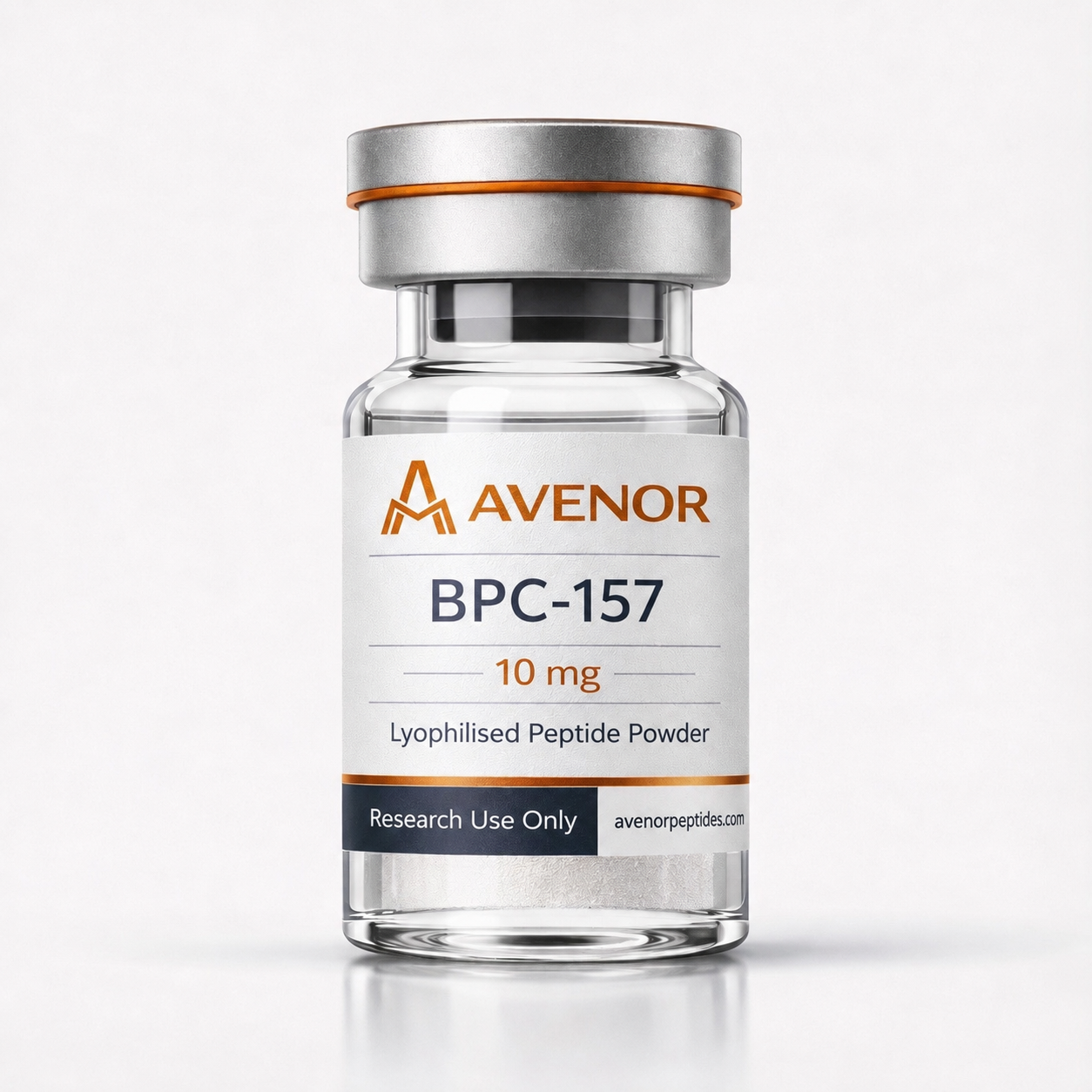
FormResearch product
Strength10 mg
SKUAVR-BPC157-10MG
Stock statusIn stock
COA / BatchSee the documentation state below
StorageRefer to the label and available documentation details.
Packaging / shippingControlled shipping preparation according to the available SKU variant.
Documentation on request
There is no published document for this specific SKU variant at the moment.
The GLP-1 peptides next to it are studied around weight and blood sugar. BPC-157 belongs to a different family: repair. It is also available blended with TB-500.
Documentation & COA
Batch documentation and COA, where available, are linked to the specific product batch and SKU.
This product is intended exclusively for laboratory research use. It is not intended for human consumption, diagnosis, treatment, or prevention of disease.
Product profile
15
amino acids — hence "pentadecapeptide"
≈1419 Da
molecular weight — among the smallest research peptides
>24 hours
remains stable in human gastric juice
Phase II
the analogue PL 14736 reached a Phase II clinical trial
Research context
01
What it is
BPC-157 is a stable peptide — a chain of 15 amino acids.
It was not designed in a lab from scratch.
It copies a fragment of a protein found naturally in human gastric juice.
The technical detail
Called Body Protection Compound-157, a stable gastric pentadecapeptide. It derives from a fragment of a human stomach protein (Sikiric et al., Pharmaceuticals, 2025).
02
How it works
Its main action is on blood vessels.
It supports the formation of new microvessels and regulates nitric oxide — the molecule that relaxes their walls.
More vessels means more blood, oxygen and nutrients at the spot that needs repair.
The rest is built on that base: collagen, fibroblasts, healing.
The technical detail
It acts through angiogenesis and the NO system, with broad cytoprotective effects across many tissues (Yuan et al., Int J Mol Sci, 2026).
03
Safety and status
Unlike many molecules, studies report very few adverse effects.
This unusually 'quiet' profile is one reason it draws attention.
Still, it remains a research compound. It has not been approved as a medicine.
The technical detail
Jozwiak et al., Pharmaceuticals, 2025. BPC-157 falls under WADA category S0, non-approved substances, which covers any pharmacological substance lacking approval from a governmental health regulatory authority; it is prohibited at all times in organised sport (Vasireddi et al., HSS Journal, 2025).
04
The turn toward humans
For years the data were almost entirely in animals. In 2026 something shifted.
12
human artery samples (2026)
24
rats, ischemia (2026)
15
amino acids in the molecule
In rings of human mammary artery, the peptide produced endothelium-mediated relaxation of the vessel — the first functional evidence in human arterial tissue.
05
Three peptides that get confused
BPC-157, TB-500 and GHK-Cu turn up together in searches, but they belong to different families and are studied for different things.
BPC-157 is a pentadecapeptide of 15 amino acids, ≈1419 Da, derived from a fragment of a human gastric protein. Research focuses on blood vessels — angiogenesis and the nitric oxide pathway.
TB-500 is a synthetic fragment of thymosin β4, ≈889 Da. Research focuses on actin regulation and cell motility.
GHK-Cu is a copper-binding tripeptide, ≈340 Da, a naturally occurring plasma complex. Research focuses on skin and collagen synthesis.
The substantive difference: BPC-157 is studied in relation to the route that delivers blood and oxygen; TB-500 in relation to the cell's internal scaffolding; GHK-Cu in relation to the material built around cells. Different points in the same process — which is why the first two are often studied together.
Fields of research — not a promise of outcome. None of the three is approved as a medicine.
The technical detail
Molecular weights approximate. BPC-157 is the only one of the three with a completed Phase 1 clinical trial in humans.
06
What the research shows, by tissue
The literature is not uniform. It divides into distinct lines of research that are frequently presented as if they were one.
Musculoskeletal tissue. The largest line. A 2025 systematic review identified 544 papers from 1993 to 2024 and included 36 after screening. In preclinical models it recorded improvements in functional, structural and biomechanical measures across muscle, tendon, ligament and bone, alongside increased growth hormone receptor expression and reduced inflammatory cytokines.
The vascular mechanism — why everything converges here. Activation of the VEGFR2 receptor and nitric oxide synthesis via the Akt–eNOS axis, with ERK1/2 signalling. The described result is angiogenesis, fibroblast activity and neuromuscular stabilisation, particularly in poorly vascularised tissue such as tendons and myotendinous junctions. This explains why one molecule appears across such different fields: the common denominator is the blood vessel.
Digestive tract. A separate line, with a history predating the sports medicine interest. It examines stabilisation of intestinal epithelial permeability and cytoprotection against damage from non-steroidal anti-inflammatory drugs.
Nervous system. The newest and least mature line, in preclinical models, emphasising the relationship with the nitric oxide system.
Stability of the molecule. It remains intact for more than 24 hours in human gastric juice, where most peptides degrade rapidly in an acidic environment.
The technical detail
Vasireddi et al., HSS Journal, 2025 (doi 10.1177/15563316251355551); McGuire et al., Curr Rev Musculoskelet Med, 2025 (doi 10.1007/s12178-025-09990-7); Park et al., Curr Pharm Des, 2020 (doi 10.2174/1381612826666200523180301); Vukojević et al., Neural Regen Res, 2022 (doi 10.4103/1673-5374.320969); Sikirić et al., World J Gastroenterol, 2022 (doi 10.3748/wjg.v28.i1.23). Data from PubMed, verified 30/08/2026.
07
What we do not know
Of the 36 studies included in the 2025 systematic review, 35 were preclinical and one was clinical.
The same literature that assembles the positive findings concludes that only three pilot studies have examined the molecule in humans, and that it should be considered investigational until well-designed clinical trials are conducted.
Human research is at an early stage and the studies are small. There are no large-scale clinical safety data.
This is not a footnote. It is the frame within which everything above is read.
The technical detail
Vasireddi et al., HSS Journal, 2025; McGuire et al., Curr Rev Musculoskelet Med, 2025.
08
Regulatory status in Greece and the EU
BPC-157 holds no marketing authorisation from the Greek EOF, the EMA or the FDA. Nor is it a prohibited substance. It sits in a transitional regulatory position and is supplied as laboratory research material.
What changed in 2026. In April it was removed from the FDA's Category 2. In July the PCAC committee voted 8–6 in favour of its inclusion in 503A compounding. A final decision is pending.
Pages can be found calling it approved and others calling it banned. Both are wrong.
In practice. It is supplied lawfully as research material. It is not available in pharmacies, is not prescribed, and is not reimbursed.
Shipping. Avenor ships from Greece. No customs step is involved and delivery times are domestic, unlike orders placed from third countries.
The technical detail
Regulatory position as of August 2026. Status changes — verify before relying on any reference.
09
How to read a COA
A Certificate of Analysis is the only document that connects a specific vial to an actual laboratory measurement.
A batch number that matches the product. The most important element, and the one most often missing. A COA with no batch number — or with a number that does not appear on the product — verifies nothing.
Identity of the molecule, not only purity. Purity states that 99% of the contents is a single substance. It does not state which one. Identity is established by mass spectrometry, which measures molecular weight — for BPC-157, approximately 1419 Da.
Method of measurement. Typically HPLC for purity and mass spectrometry for identity. A figure without a method is not verifiable.
Date and laboratory. An analysis without a date does not correspond to a batch.
And one thing that must not appear: any medical indication, condition or promise of outcome. If a COA carries them, that is not a sign of rigour — it is a red flag, because the document was written to sell rather than to measure.
Avenor's position. Where a COA exists it is published and linked to the SKU. Where none exists, this is stated explicitly. Not every batch carries an analysis, and we say so rather than leaving it ambiguous.
The technical detail
Applies to any research material, not only BPC-157.
10
Research timeline
1990s — isolated from human gastric juice; first papers from 1993.
226 published papers on PubMed, and just three pilot studies in humans. Both figures are true at once.
The technical detail
ClinicalTrials.gov and PubMed. Verified 30/08/2026.
Laboratory use
Used in a controlled laboratory setting for stability studies in simulated gastric and intestinal fluid, for in vitro angiogenesis work (tube formation assay, VEGFR2 expression and internalization, the Akt–eNOS axis), for analysis of the FAK–paxillin pathway in cell migration and adhesion assays, for intestinal epithelial permeability studies in cell models, and for identity and purity confirmation by HPLC and mass spectrometry.
Research Use Only. For laboratory research exclusively. Not intended for human or veterinary use, diagnosis, treatment, or disease prevention. This is not a dietary supplement, food, or medicinal product, and the capsule format does not imply suitability for human intake. The data referenced derive from published preclinical studies and limited pilot studies, and do not transfer to research-grade material.
Structural data
Class
Synthetic pentadecapeptide — a partial sequence of the Body Protection Compound (BPC) protein
Chain length
15 amino acids
Sequence
GEPPPGKPADDAGLV
Molecular weight
≈1419 Da
Sequence origin
A fragment of a protein isolated from human gastric juice
Development codes
PL 10, PLD 116 and PL 14736 (Pliva, Croatia)
Distinguishing property
Does not degrade in human gastric juice for more than 24 hours
Plasma half-life
Under 30 minutes in rats and beagle dogs (He et al., 2022)
Product form
Oral capsule — ready to use, no reconstitution
Purity
≥98% (HPLC) — supplied with CoA
Comparison
Feature comparison
Feature
BPC-157 capsule (this product)
BPC-157 injectable vial
Form
Capsule containing peptide powder, metered per unit
Lyophilized powder in a sealed vial
Preparation before use
None — the product is ready as supplied
Reconstitution with a suitable diluent is required
Why is this peptide studied as a capsule when almost every other one requires injection?
Because it does not break down in the acidic environment of the stomach. Most peptides are short amino acid chains that digestive enzymes degrade within minutes, which is why they are studied only in injectable form. In the literature, the Sikirić group reports repeatedly that BPC-157 remains stable in human gastric juice for more than 24 hours (Current Medicinal Chemistry, 2012; World Journal of Gastroenterology, 2022). That single property is the reason the capsule form exists.
What is PL 14736?
It is the development code for the same sequence at the pharmaceutical company Pliva in Croatia — alongside the codes PL 10 and PLD 116. According to reviews by Sikirić and colleagues (2006, 2012), PL 14736 entered a clinical programme for inflammatory bowel disease and reached a Phase II trial in ulcerative colitis, with no side effects reported and LD1 not reached in toxicology studies.
How does it differ from the injectable BPC-157 in the catalogue?
The sequence is the same; the form and the research context differ. The capsule is ready as supplied, stores at room temperature and requires no reconstitution, diluent or consumables. The injectable vial contains lyophilized powder, requires reconstitution and refrigerated storage. See the comparison table above.
What does "pentadecapeptide" mean?
Simply that the molecule is built from fifteen amino acids. The sequence is GEPPPGKPADDAGLV and the molecular weight is roughly 1419 Da — among the smallest in this category.
Where does the sequence come from?
It is a partial sequence of a larger protein named Body Protection Compound, isolated from human gastric juice. So it is not a molecule designed from scratch but a fragment of a protein already present in stomach fluid.
What do the angiogenesis studies show?
Hsieh and colleagues (Journal of Molecular Medicine, 2017) recorded increased vessel density in a chorioallantoic membrane assay and in a tube formation assay. The mechanistic finding was that expression of the VEGFR2 receptor rises, but VEGF-A itself does not, and the VEGFR2–Akt–eNOS axis is activated. Blocking endocytosis with dynasore abolished the effect.
What is the FAK–paxillin pathway?
FAK and paxillin are focal adhesion proteins — the points at which a cell grips its surface in order to move. Chang and colleagues (Journal of Applied Physiology, 2010) found that BPC-157 dose-dependently increases their phosphorylation without changing their total amounts, while cell proliferation in the MTT assay was unaffected.
Why is it studied in relation to intestinal permeability?
Because the oral form places the molecule exactly where the phenomenon is studied. Park, Lee, Sikirić and Hahm (Current Pharmaceutical Design, 2020) reviewed the experimental data around stabilization of intestinal epithelial permeability following administration of non-steroidal anti-inflammatory drugs.
How extensive is the human data?
Limited, and that should be stated plainly. The review by McGuire and colleagues (2025) identifies only three pilot studies in humans, while the biopharmaceutical review by Mateescu and colleagues (Pharmaceutics, 2026) counts fewer than 30 subjects in total, across uncontrolled studies with no standardized preparation.
Is there anything unexplained in the pharmacokinetics?
Yes. The study by He and colleagues (Frontiers in Pharmacology, 2022) in rats and beagle dogs measured a plasma half-life of under 30 minutes, with linear pharmacokinetics. Yet the biological effects described in animal models last hours to days. That mismatch remains unexplained and is explicitly flagged in the literature.
Can it be used by humans or animals?
No. The product is supplied exclusively for laboratory research. It is not intended for human or veterinary use, nor for in vivo application outside a controlled laboratory setting. No administration or dosing guidance is provided.
Is it legal in Greece?
It is supplied as laboratory research material, not as a medicine and not as a supplement. The distinction is not wording — it defines what a supplier is permitted to say and do. It holds no marketing authorisation from EOF or the EMA, as no research substance does.
Has it been approved as a medicine?
No. It sits in a transitional regulatory position: neither approved nor prohibited. In April 2026 it was removed from the FDA's Category 2, and in July 2026 the PCAC committee voted 8–6 in favour of its inclusion in 503A compounding. A final decision is pending.
Are there studies in humans?
Yes, and this is what separates it from most research peptides. Phase 1 completed in 2016 with 42 healthy volunteers (NCT02637284). Phase 2 is currently recruiting 120 participants (NCT07437547), randomised, double-blind and placebo-controlled. That said, a 2025 systematic review found that of 36 studies, 35 were preclinical — clinical research remains at an early stage.
Is it on the WADA prohibited list?
Yes. WADA category S0, non-approved substances, covers any pharmacological substance without approval from a governmental health regulatory authority, and BPC-157 has none. It applies at all times, in and out of competition. A 2025 sports medicine review states explicitly that it is banned in professional sport (Vasireddi et al., HSS Journal).
How does it differ from TB-500?
Different family, different mechanism. Research on BPC-157 focuses on blood vessels — angiogenesis and the nitric oxide pathway. Research on TB-500 focuses on actin regulation and cell motility. They are often studied together because they concern different stages of the same process.
What does Research Use Only mean?
That the material is intended solely for laboratory research and is not intended for human or veterinary use, diagnosis, treatment or prevention of disease. It is not boilerplate: it defines the frame within which information about the product may be given.
What is a COA and what does it show?
A Certificate of Analysis connects a specific batch to a laboratory measurement: identity of the molecule, purity, and the method by which both were measured — typically HPLC and mass spectrometry. The critical point: it applies to one batch, not to the product in general. A COA without a batch number matching the product verifies nothing.
Does every batch have a COA?
Not every batch. Where one exists it is published and linked to the corresponding SKU. Where none exists, we state so explicitly on the page rather than leaving it ambiguous.