Free shipping — the threshold depends on the destination country, confirmed at checkout.

    Research Use Only (RUO). For laboratory research only. Not for human or veterinary use.

    Research Use Only (RUO):Research classification with product and batch documentation where available.
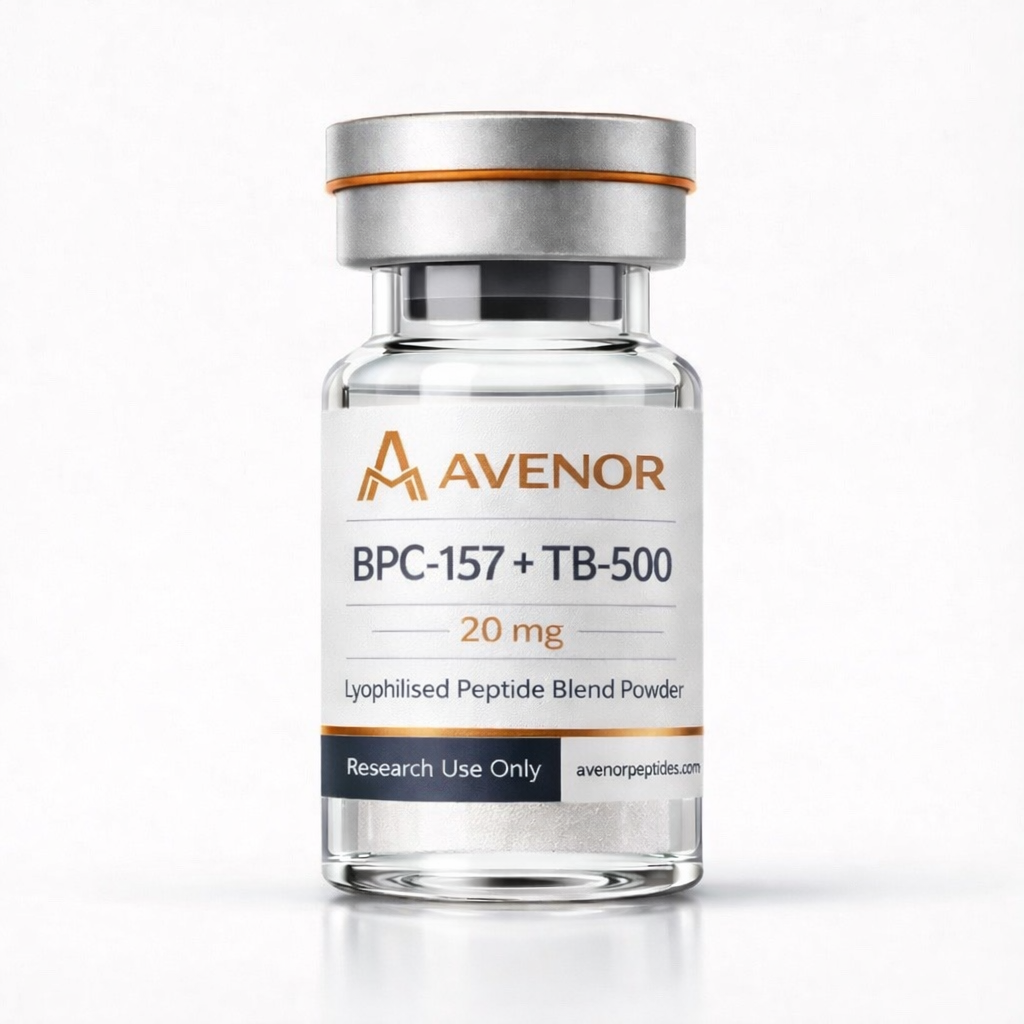
    BPC157 + TB500 Blend 10 mg + 10 mg - Avenor Peptides

    Recovery & Repair

    BPC157 + TB500 Blend

    Strength: 10 mg + 10 mg

    BPC157 + TB500 Blend is a research-use catalogue item organized around product identity, SKU traceability and available documentation.

    €120,00
    In stock

    Published independent analysis for this batch
    1

    The more products, the bigger the discount

    2 → −5%
    3 → −8%
    4 → −11%
    5+ → −15%
    across your whole basket, automatically
    Batch documentationShips from Greece

    Free shipping: Greece from €50, Cyprus and Bulgaria from €100, France, Germany, Italy, Belgium, Netherlands and Spain from €200. Details

    This product is intended exclusively for laboratory research use. It is not intended for human consumption, diagnosis, treatment, or prevention of disease.

    Product information

    FormResearch product
    Strength10 mg + 10 mg
    SKUAV-BB20-20MG
    Stock statusIn stock
    COA / BatchSee the documentation state below
    StorageIn powder form: freezer (−20°C).
    Packaging / shippingProtective professional shipping packaging with clear labelling.

    Independent Avenor testing

    Published documentation for this specific SKU variant.

    View document
    Batch
    Not set
    Test date
    Not set
    Method
    COA

    Research overview

    Documentation & COA

    Batch documentation and COA, where available, are linked to the specific product batch and SKU.

    This product is intended exclusively for laboratory research use. It is not intended for human consumption, diagnosis, treatment, or prevention of disease.

    Product profile

    2

    peptides in a single lyophilized vial

    15 + 43

    amino acids — BPC-157 and thymosin β4 respectively

    70-80%

    share of thymosin β4 among all β-thymosins in the human body

    ≥98%

    purity by HPLC for each component

    Research context

    What it is

    It is a pairing of two repair peptides that act in different ways.

    BPC-157 has 15 amino acids and works mainly on blood vessels.

    TB-500 copies a 43-amino-acid protein that every cell uses to move.

    The technical detail

    TB-500 is a synthetic fragment of thymosin β4 (Tβ4). BPC-157 is the stable gastric pentadecapeptide.

    How it works

    Two different jobs in the same wound.

    One builds new vessels and brings blood where it is needed.

    The other helps cells migrate to the site and rebuild the tissue.

    The technical detail

    BPC-157 acts through angiogenesis and NO. Tβ4 regulates actin, cell migration and integrin-mediated remodeling of the extracellular matrix (Rahman et al., 2026).

    Why together

    The reason for the pairing is complementarity.

    One opens the road for blood. The other moves the cells that rebuild the tissue.

    They cover different stages of the same process.

    The technical detail

    A 2026 review groups BPC-157, TB-500 and GHK-Cu as wound-healing peptides acting on angiogenesis, integrins and fibroblasts (Rahman et al., J Am Acad Orthop Surg Glob, 2026).

    What recent studies showed

    TB-500 and its derivatives were recently tested beyond simple wound healing.

    43

    amino acids in thymosin β4

    15

    amino acids in BPC-157

    2025

    new wave of studies

    In 2025, Tβ4 derivatives reduced neuronal atrophy in an Alzheimer's model, while engineered Tβ4 nanovesicles reversed cell senescence in diabetic wounds.

    Laboratory use

    Used in a controlled laboratory setting for comparative in vitro studies of the two mechanisms, for identity and purity confirmation of each component by HPLC and mass spectrometry, for stability studies of both the lyophilized material and the reconstituted solution, and for cell culture research on cell migration, tube formation, and actin cytoskeleton organization.

    Research Use Only. Lyophilized material for laboratory use exclusively. Not intended for human or veterinary use, nor for in vivo application outside a controlled laboratory setting. No therapeutic claim is made.

    Structural data

    Component 1 — Name
    BPC-157 (Body Protection Compound 157)
    BPC-157 — Sequence
    Gly-Glu-Pro-Pro-Pro-Gly-Lys-Pro-Ala-Asp-Asp-Ala-Gly-Leu-Val
    BPC-157 — Molecular formula
    C62H98N16O22
    BPC-157 — Molecular weight
    1419.5 g/mol
    BPC-157 — CAS number
    137525-51-0
    BPC-157 — Origin
    A fragment of the BPC protein found in human gastric juice
    Component 2 — Name
    TB-500 / thymosin β4 (Tβ4)
    Tβ4 — Chain length
    43 amino acids
    Tβ4 — Molecular weight
    ≈4963 g/mol
    Tβ4 — CAS number
    77591-33-4
    Tβ4 — Actin-binding region
    The LKKTETQ motif, at residues 17-23 of the chain
    Tβ4 — Origin
    A naturally occurring peptide in mammalian cells, of the β-thymosin family
    Product form
    Lyophilized (freeze-dried) powder in a vial — requires reconstitution before laboratory use
    Purity
    ≥98% (HPLC) — supplied with a per-batch CoA

    Comparison

    Feature comparison

    FeatureBPC-157 + TB-500 blend (this product)BPC-157 alone (capsule or injectable)
    Active componentsTwo peptides in the same vialOne peptide
    FormLyophilized powderCapsule or lyophilized powder
    PreparationReconstitution with bacteriostatic waterNone (capsule) or reconstitution (injectable)
    Mechanisms under studyAngiogenesis (BPC-157) and actin regulation (Tβ4)Mainly angiogenesis and the FAK–paxillin pathway
    Research focusCombination protocols, side-by-side comparison of two mechanismsIsolated action of a single molecule — cleaner data interpretation
    Molecule size1419.5 and ≈4963 g/mol — a large difference1419.5 g/mol
    Storage before reconstitutionRefrigerated or frozenRoom temperature (capsule) or refrigerated (injectable)
    Storage after reconstitutionRefrigeration mandatoryRefrigeration (injectable form only)
    Consumables requiredBacteriostatic water, syringes, sterile vialsNone (capsule) or the same (injectable)
    Suitability for a controlled single-mechanism experimentLower — the two actions cannot be separatedHigher

    Storage & handling

    • Before reconstitution: store the sealed lyophilized vial refrigerated (2-8 °C). For long-term storage, freezing at -20 °C is preferred.
    • This product is not stored at room temperature, unlike the capsule forms in the catalog.
    • Reconstitution: performed with bacteriostatic water for injection, on a clean laboratory bench, using aseptic technique. Disinfect the stopper with an alcohol wipe before each needle entry.
    • Add the diluent slowly, down the inner wall of the vial. Swirl the vial gently until dissolved — do not shake vigorously, as agitation can denature the peptides.
    • After reconstitution: refrigeration at 2-8 °C is mandatory. Do not leave the reconstituted solution outside the refrigerator.
    • Avoid repeated freeze-thaw cycles, which degrade peptide integrity.
    • Protect the material from direct sunlight and humidity at every stage.
    • Inspect the reconstituted solution visually before each use; cloudiness, precipitate, or colour change are grounds for discarding it.
    • Keep away from children, out of food preparation areas, and in a space clearly marked as holding laboratory material.
    • Dispose of needles and vials in an appropriate sharps container, in line with laboratory regulations.

    Documentation

    • Certificate of Analysis (CoA) per batch, with date and lot number.
    • HPLC purity analysis for each of the two components separately — specification ≥98%.
    • Identity confirmation by mass spectrometry for both molecules.
    • The quantity of each component in the vial is stated.
    • Research Use Only (RUO) declaration on the packaging.
    • Documents available on request for the specific batch you received.

    References

    References & documentation

    1. 1.Brcic L. et al. (2009). Modulatory effect of gastric pentadecapeptide BPC 157 on angiogenesis in muscle and tendon healing. J Physiol Pharmacol, 60 Suppl 7, 191-196.
    2. 2.Chang C-H. et al. (2011). The promoting effect of pentadecapeptide BPC 157 on tendon healing involves tendon outgrowth, cell survival, and cell migration. J Appl Physiol, 110(3), 774-780.
    3. 3.Gwyer D., Wragg N.M., Wilson S.L. (2019). Gastric pentadecapeptide body protection compound BPC 157 and its role in accelerating musculoskeletal soft tissue healing. Cell Tissue Res, 377(2), 153-159.
    4. 4.Yuan C. et al. (2026). From Regeneration to Analgesia: The Role of BPC-157 in Tissue Repair and Pain Management. Int J Mol Sci, 27(6), 2876.
    5. 5.Bubb M.R. (2003). Thymosin beta 4 interactions. Vitam Horm, 66, 297-316.
    6. 6.Ying Y. et al. (2023). Thymosin β4 and Actin: Binding Modes, Biological Functions and Clinical Applications. Curr Protein Pept Sci, 24(1), 78-88.
    7. 7.Lv S. et al. (2020). Thymosin-β4 induces angiogenesis in critical limb ischemia mice via regulating Notch/NF-κB pathway. Int J Mol Med, 46(4), 1347-1358.
    8. 8.Yuan J. et al. (2017). Thymosin β4 alleviates renal fibrosis and tubular cell apoptosis through TGF-β pathway inhibition in UUO rat models. BMC Nephrol, 18(1), 314.

    Product information

    Frequently asked questions

    Why a blend rather than the two peptides separately?
    Because the two mechanisms under study are complementary: BPC-157 is examined mainly for angiogenesis via VEGF, thymosin β4 for actin regulation and cell migration. A pre-blended vial removes a weighing and transfer step from the protocol. The trade-off is that you can no longer attribute a finding to just one of the two molecules — if that is what your experiment is asking, separate vials are the right choice.
    What exactly is TB-500 in relation to thymosin β4?
    TB-500 is the name under which synthetic thymosin β4 circulates in the research peptide market. It is a forty-three amino acid peptide that occurs naturally inside mammalian cells and makes up 70-80% of all β-thymosins in the human body.
    How does thymosin β4 work, in plain terms?
    It binds actin, the protein from which a cell's internal skeleton is built. According to the review by Ying et al. (2023), it binds monomeric actin at a one-to-one ratio and thereby controls the balance between assembly and disassembly of that skeleton — something that directly affects a cell's ability to move.
    Are there studies that examined the two peptides together?
    No, and we say so plainly. All published data comes from studies of each molecule separately. The idea that their effects add up or reinforce one another is a hypothesis to be tested, not an established finding.
    Why does this product require refrigeration when the BPC-157 capsule does not?
    Because it is a lyophilized powder in a vial. Lyophilized material is stored refrigerated or frozen before reconstitution, and once reconstituted with bacteriostatic water, refrigeration is mandatory. See the storage section above.
    Is there human data for either of them?
    Very limited. The overwhelming majority of the literature for both molecules is preclinical, in rodents and cell lines. The review by Yuan et al. (2026) concludes that for BPC-157 human research is confined to small pilot studies and that rigorous controlled trials are required before any clinical conclusion.
    What is the size of each molecule and why does it matter?
    BPC-157 weighs 1419.5 g/mol, while thymosin β4 is approximately 4963 g/mol — roughly three and a half times heavier. The size difference matters practically in analytical protocols, since the two molecules separate readily by HPLC and mass spectrometry.
    Do I receive a certificate of analysis for both components?
    Yes. Each batch CoA includes separate HPLC analysis and identity confirmation for each of the two peptides, along with the quantity of each in the vial. It is available on request for the specific batch you received.
    Can it be used by humans or animals?
    No. The product is supplied exclusively for laboratory research. It is not intended for human or veterinary use, nor for in vivo application outside a controlled laboratory setting, and it is not accompanied by administration instructions.