Free shipping — the threshold depends on the destination country, confirmed at checkout.

    Research Use Only (RUO). For laboratory research only. Not for human or veterinary use.

    Research Use Only (RUO):Research classification with product and batch documentation where available.
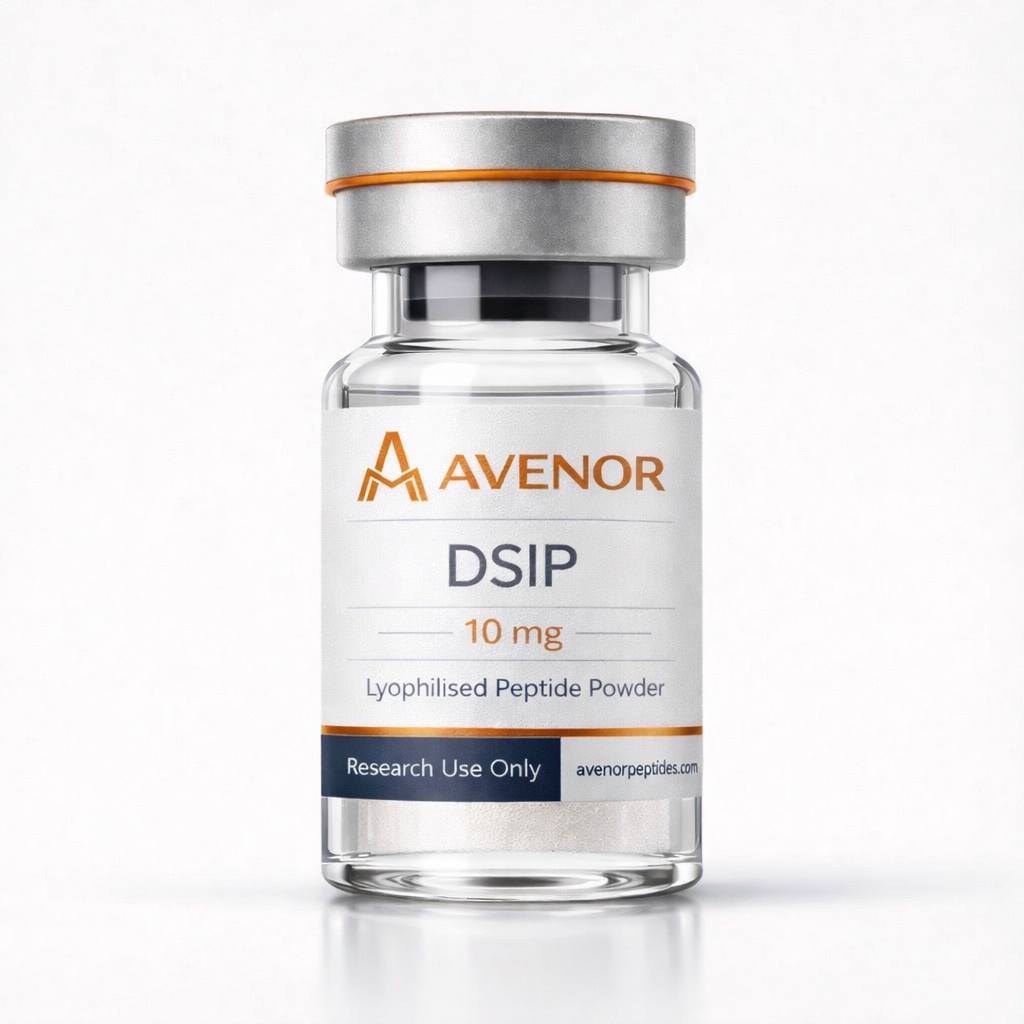
    DSIP 10 mg - Avenor Peptides

    Energy & Mind

    DSIP

    Strength: 10 mg

    DSIP is a research-use catalogue item organized around product identity, SKU traceability and available documentation.

    €39,00€44,00
    -11% off
    In stock
    1

    The more products, the bigger the discount

    2 → −5%
    3 → −8%
    4 → −11%
    5+ → −15%
    across your whole basket, automatically
    Batch documentationShips from Greece

    Free shipping: Greece from €50, Cyprus and Bulgaria from €100, France, Germany, Italy, Belgium, Netherlands and Spain from €200. Details

    This product is intended exclusively for laboratory research use. It is not intended for human consumption, diagnosis, treatment, or prevention of disease.

    Product information

    FormResearch product
    Strength10 mg
    SKUAV-DSIP-10MG
    Stock statusIn stock
    COA / BatchSee the documentation state below
    StorageIn powder form: freezer (−20°C).
    Packaging / shippingProtective professional shipping packaging with clear labelling.

    Documentation on request

    There is no published document for this specific SKU variant at the moment.

    Contact us about documentation

    Research overview

    Documentation & COA

    Batch documentation and COA, where available, are linked to the specific product batch and SKU.

    This product is intended exclusively for laboratory research use. It is not intended for human consumption, diagnosis, treatment, or prevention of disease.

    Product profile

    9

    amino acids — one of the smallest neuropeptides ever studied

    1977

    year of isolation, from the blood of rabbits in delta sleep

    ≈849 Da

    molecular weight — about one sixth that of a GLP-1 peptide

    0

    receptors identified — the mechanism remains unknown

    Research context

    What it is

    DSIP is a small peptide — nine amino acids.

    Its name means 'delta sleep-inducing peptide'.

    Delta sleep is the deep sleep of slow brain waves.

    The technical detail

    Delta Sleep-Inducing Peptide. It was isolated in 1977 from the cerebral venous blood of sleeping rabbits, by Schoenenberger and Monnier.

    How it works

    Despite its name, it does not act like a sedative.

    It seems to work as a regulator — balancing neurotransmitters rather than 'switching off' the brain.

    It does not force sleep; it seems to nudge the signals back to where they belong.

    It also crosses the blood-brain barrier, the brain's natural shield.

    The technical detail

    In experimental models it affects serotonin (5-HT), glutamate, dopamine and melatonin (Mu et al., Front Pharmacol, 2024).

    Beyond sleep

    Half a century after its isolation, research interest has shifted.

    It is now studied for stress handling and neuroprotection, not only for sleep.

    Same molecule, new questions.

    The technical detail

    A 2026 review groups it, alongside epithalon, among recovery peptides targeting circadian and mitochondrial regulators (Rahman et al., 2026).

    What the studies showed

    Recent studies look beyond sleep, in experimental models.

    1977

    year of isolation

    9

    amino acids (nonapeptide)

    2024

    insomnia-model study

    In an insomnia model, a form of DSIP corrected the neurotransmitter imbalance. In another model, intranasal delivery aided motor recovery after stroke.

    Laboratory use

    Used in a controlled laboratory setting for in vitro stability and proteolytic degradation studies of the nonapeptide, for comparative work against the phosphorylated analogue P-DSIP and against shorter fragments of the sequence, for immunochemical applications (raising and calibrating antibodies against DSIP-like immunoreactivity), for transport studies in in vitro barrier models, and for identity and purity confirmation by HPLC and mass spectrometry.

    Research Use Only. For laboratory research exclusively. Not intended for human or veterinary use, diagnosis, treatment, or disease prevention. There is no indication for sleep, insomnia, or any other condition. DSIP is not an approved medicine in any jurisdiction and no dosing or administration protocols are provided. The research data referenced come from published studies and are described as a record of the literature — they are not a claim of efficacy and, as the text sets out, they contradict one another.

    Structural data

    Class
    Endogenous neuropeptide — a nonapeptide (nine-amino-acid peptide)
    Amino acid sequence
    Trp-Ala-Gly-Gly-Asp-Ala-Ser-Gly-Glu (WAGGDASGE)
    Chain length
    9 amino acids
    Molecular weight
    ≈849 Da (as reported in the review by Graf et al., 1984)
    Receptor
    No specific receptor has been identified to date
    Gene
    No gene or precursor protein has been isolated (Kovalzon, 2006)
    Known analogue
    P-DSIP — phosphorylated at the serine in position 7; studied as a separate molecule in the literature
    Dose–response curve
    Parabolic (bell-shaped) across experimental studies — meaning the effect does not scale linearly with quantity
    Barrier passage
    Passage across the blood-brain barrier has been documented in dogs (Banks et al., 1982) and across the blood-cerebrospinal fluid barrier in sheep (Zlokovic et al., 1988)
    In vitro stability
    Half-life of roughly 15 minutes for proteolytic cleavage of the tryptophan residue in brain homogenates (Schoenenberger, 1984)
    Product form
    Lyophilized powder in a sealed vial, 10 mg
    Purity
    ≥98% (HPLC) — supplied with CoA

    Comparison

    Feature comparison

    FeatureDSIP (this product)SelankSemax
    Chain length9 amino acids7 amino acids7 amino acids
    Origin of the moleculeEndogenous — isolated in 1977 from rabbit bloodSynthetic analogue of the endogenous peptide tuftsinSynthetic — based on the ACTH(4-7) fragment with a Pro-Gly-Pro extension
    Identified receptorNONE — neither a receptor nor a gene has been foundNo dedicated receptor identified; the literature links its action to GABAergic pathwaysNo dedicated receptor identified; associated with melanocortin pathways
    Main research fieldDelta EEG activity, stress, neuroprotectionAnxiety, memory, BDNF in rodentsIschaemic stroke, neuroprotection, BDNF
    Consistency of findingsCONTRADICTORY — several studies find no effect (see text)Limited data, mostly preclinical and in Russian-language literatureClinical studies largely in Russian-language literature, small samples
    Age of the literatureBulk from 1977-1995, with sporadic later workMostly from the 2000s onwardMostly from the 2000s onward
    Product formLyophilized powderLyophilized powderLyophilized powder

    Storage & handling

    • The sealed vial of lyophilized powder is stored frozen and protected from light.
    • Keep in the original packaging until the point of laboratory use.
    • Reconstitution is performed with an appropriate sterile laboratory-grade solvent, handled gently — vigorous agitation stresses the peptide chain and is avoided.
    • Once reconstituted, the solution is kept refrigerated and protected from light.
    • Avoid repeated freeze–thaw cycles, which degrade peptide integrity.
    • Avoid prolonged exposure to room temperature and to direct sunlight.
    • Handle using standard laboratory practice and appropriate personal protective equipment.
    • Keep away from children and out of food preparation areas.

    Documentation

    • Certificate of Analysis (CoA) per batch, with date and lot number.
    • Purity analysis by HPLC — specification ≥98%.
    • Identity and molecular weight confirmation by mass spectrometry.
    • Research Use Only (RUO) declaration on the packaging.
    • Documents available on request for the specific batch you received.

    References

    References & documentation

    1. 1.Schoenenberger G.A. & Monnier M. (1977). Characterization of a delta-electroencephalogram (-sleep)-inducing peptide. Proc Natl Acad Sci U S A, 74(3), 1282-1286.
    2. 2.Schoenenberger G.A. et al. (1978). The delta EEG (sleep)-inducing peptide (DSIP). XI. Amino-acid analysis, sequence, synthesis and activity of the nonapeptide. Pflugers Arch, 376(2), 119-129.
    3. 3.Schneider-Helmert D. et al. (1981). Synthetic delta-sleep-inducing peptide improves sleep in insomniacs. Lancet, 1(8232), 1256-1257.
    4. 4.Schneider-Helmert D. (1981). The influence of synthetic DSIP (delta-sleep-inducing-peptide) on disturbed human sleep. Experientia, 37(9), 913-917.
    5. 5.Graf M.V. et al. (1984). Delta-sleep-inducing peptide (DSIP): a review. Neurosci Biobehav Rev, 8(1), 83-93.
    6. 6.Banks W.A. et al. (1982). Delta sleep-inducing peptide crosses the blood-brain-barrier in dogs: some correlations with protein binding. Pharmacol Biochem Behav, 17(5), 1009-1014.
    7. 7.Monti J.M. et al. (1987). Study of delta sleep-inducing peptide efficacy in improving sleep on short-term administration to chronic insomniacs. Int J Clin Pharmacol Res, 7(2), 105-110. — NEGATIVE FINDING
    8. 8.Schneider-Helmert D. (1987). Effects of delta-sleep-inducing peptide on 24-hour sleep-wake behaviour in severe chronic insomnia. Eur Neurol, 27(2), 120-129.
    9. 9.Susić V. et al. (1987). The effects of delta-sleep-inducing peptide (DSIP) on wakefulness and sleep patterns in the cat. Brain Res, 414(2), 262-270.
    10. 10.Zlokovic B.V. et al. (1988). Passage of delta sleep-inducing peptide (DSIP) across the blood-cerebrospinal fluid barrier. Peptides, 9(3), 533-538.
    11. 11.Bes F. et al. (1992). Effects of delta sleep-inducing peptide on sleep of chronic insomniac patients. A double-blind study. Neuropsychobiology, 26(4), 193-197. — NEGATIVE FINDING
    12. 12.Giusti M. et al. (1993). Delta sleep-inducing peptide administration does not influence growth hormone and prolactin secretion in normal women. Psychoneuroendocrinology, 18(1), 79-84. — NEGATIVE FINDING
    13. 13.Späth-Schwalbe E. et al. (1995). Delta-sleep-inducing peptide does not affect CRH and meal-induced ACTH and cortisol secretion. Psychoneuroendocrinology, 20(3), 231-237. — NEGATIVE FINDING
    14. 14.Steiger A. & Holsboer F. (1997). Neuropeptides and human sleep. Sleep, 20(11), 1038-1052.
    15. 15.Kovalzon V.M. et al. (2006). Delta sleep-inducing peptide (DSIP): a still unresolved riddle. J Neurochem, 97(2), 303-309.
    16. 16.Stanojlović O. et al. (2004). Delta sleep-inducing peptide and its tetrapeptide analogue alleviate severity of metaphit seizures. Pharmacol Biochem Behav, 77(2), 227-234.
    17. 17.Tukhovskaya E.A. et al. (2021). Delta Sleep-Inducing Peptide Recovers Motor Function in SD Rats after Focal Stroke. Molecules, 26(17), 5173.

    Product information

    Frequently asked questions

    What exactly is DSIP and where does the name come from?
    It is a nonapeptide — a chain of nine amino acids — isolated in 1977 by Schoenenberger and Monnier in Basel from the cerebral venous blood of rabbits in deep sleep. It was named after the finding that, when given to other rabbits, it increased delta activity on their electroencephalogram. The name describes the original 1977 observation, not a proven function.
    Why is the data on DSIP contradictory?
    Because different research groups, asking the same question with careful double-blind designs, reached opposite conclusions. Schneider-Helmert (1981, 1987) reported clear improvement in sleep parameters, while Monti and colleagues (1987) concluded the effect was "of little clinical significance" and Bes and colleagues (1992) found their results weak and possibly attributable to an incidental change in the placebo group. The parabolic dose–response curve, very small sample sizes and species differences all contribute.
    Has its receptor been found?
    No. Fifty years after isolation, no specific receptor has been identified, and neither the gene nor any precursor protein has been isolated. Kovalzon (2006) treats precisely this gap as the core reason the "sleep factor" hypothesis remains weak.
    What is its structure?
    The sequence is Trp-Ala-Gly-Gly-Asp-Ala-Ser-Gly-Glu, with a molecular weight of around 849 Da. The 1978 paper in Pflügers Archiv showed that only the pure alpha-aspartyl isomer is active — the beta isomer, differing at a single bond position, produced no effect at all. That is unusually high structural specificity for such a small molecule.
    What does "parabolic dose–response curve" mean?
    It means the effect does not grow as the quantity grows. Across the experimental studies summarised by Graf and colleagues (1984, 1986) and Scherschlicht and colleagues (1984), an intermediate quantity produced a larger effect than a larger one. This is unusual for a pharmacological agent and is one candidate explanation for why findings have been hard to reproduce between laboratories.
    Does it cross the blood-brain barrier?
    Yes, this has been documented. Banks and colleagues (1982) showed in dogs that the intact molecule appears in cerebrospinal fluid after peripheral administration. Zlokovic and colleagues (1988) described a saturable transport mechanism of high affinity but very low capacity at the sheep choroid plexus.
    What have studies outside the sleep field shown?
    That field is smaller and just as uneven. Stanojlović and colleagues (2004) reported reduced severity of experimentally induced seizures in rats. Tukhovskaya and colleagues (2021) found improved motor performance in rats after experimental stroke, but the reduction in infarct volume did not reach statistical significance. Conversely, Späth-Schwalbe and colleagues (1995) and Giusti and colleagues (1993) found no effect on hormonal parameters in humans.
    How does it compare with Selank and Semax?
    All three are small neuropeptides without an exclusively identified receptor, but they arrived by different routes: DSIP is endogenous and was isolated from blood, whereas Selank and Semax were designed synthetically as heptapeptides, the first as a tuftsin analogue and the second from an ACTH fragment. See the comparison table above.
    Can it be used by humans or animals?
    No. The product is supplied exclusively for laboratory research. It is not intended for human or veterinary use, nor for in vivo application outside a controlled laboratory setting. No administration or dosing guidance is provided, and there is no indication for sleep or for any condition.
    Do I receive a certificate of analysis?
    Yes. Every batch is accompanied by a CoA with HPLC analysis and mass spectrometry identity confirmation. It is available on request for the specific batch you received.