Free shipping — the threshold depends on the destination country, confirmed at checkout.

    Research Use Only (RUO). For laboratory research only. Not for human or veterinary use.

    Research Use Only (RUO):Research classification with product and batch documentation where available.
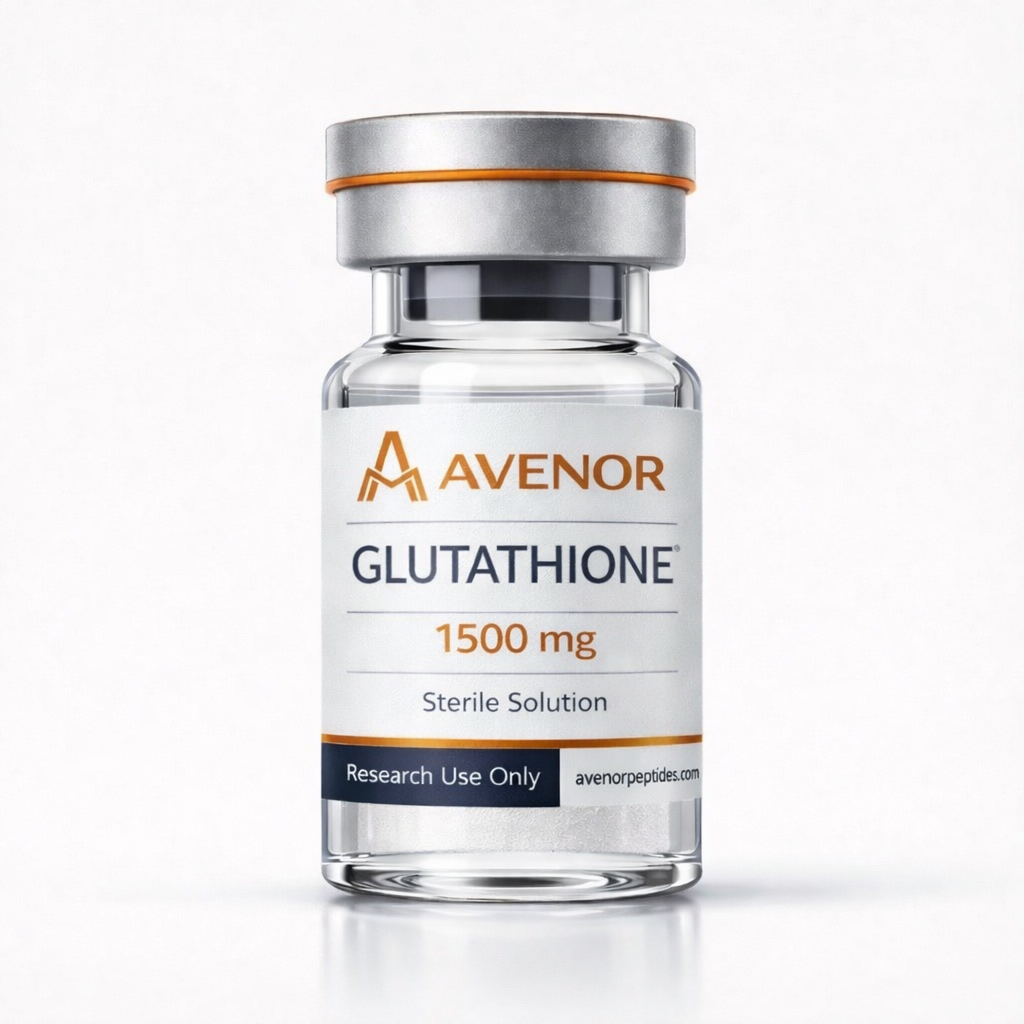
    Glutathione 1500 mg - Avenor Peptides

    Body composition

    Glutathione

    Strength: 1500 mg

    Glutathione is a research-use catalogue item organized around product identity, SKU traceability and available documentation.

    €40,00
    In stock
    1

    The more products, the bigger the discount

    2 → −5%
    3 → −8%
    4 → −11%
    5+ → −15%
    across your whole basket, automatically
    Batch documentationShips from Greece

    Free shipping: Greece from €50, Cyprus and Bulgaria from €100, France, Germany, Italy, Belgium, Netherlands and Spain from €200. Details

    This product is intended exclusively for laboratory research use. It is not intended for human consumption, diagnosis, treatment, or prevention of disease.

    Product information

    FormResearch product
    Strength1500 mg
    SKUAV-GLU-1500MG
    Stock statusIn stock
    COA / BatchSee the documentation state below
    StorageIn powder form: freezer (−20°C).
    Packaging / shippingProtective professional shipping packaging with clear labelling.

    Documentation on request

    There is no published document for this specific SKU variant at the moment.

    Contact us about documentation

    Research overview

    Documentation & COA

    Batch documentation and COA, where available, are linked to the specific product batch and SKU.

    This product is intended exclusively for laboratory research use. It is not intended for human consumption, diagnosis, treatment, or prevention of disease.

    Product profile

    3

    amino acids — glutamate, cysteine, glycine

    γ

    unusual gamma-peptide bond at position 1

    6.2 µmol/L

    basal plasma concentration in healthy volunteers (Witschi et al., 1992)

    ≥98%

    purity by HPLC

    Research context

    What it is

    Glutathione is the body's main antioxidant.

    It is a tripeptide — three amino acids joined together — and it sits inside every cell.

    It is not an exotic substance. It is something the body makes on its own, every moment.

    The technical detail

    A tripeptide of glutamate–cysteine–glycine (GSH), the primary intracellular antioxidant system.

    How it works

    Think of it as the cell's cleanup crew.

    It neutralises free radicals — the unstable molecules that wear cells down from the inside.

    At the same time it recycles other antioxidants and supports the cells of the immune system.

    The technical detail

    It neutralises free radicals and regulates redox balance; the ratio of oxidised to reduced form is a marker of oxidative stress.

    What the studies showed

    The core question was simple: does taking it by mouth actually raise the body's stores?

    A six-month randomised, placebo-controlled trial answered it.

    54

    adults, 6 months

    +30–35%

    stores in blood

    +260%

    mucosal cells

    ×2

    NK cell activity

    Oral glutathione raised its own levels across blood, plasma, and immune cells, and doubled natural killer cell activity. The oxidised-to-reduced ratio fell — a sign of less oxidative stress.

    How it compares

    For years the doubt was that glutathione breaks down in the gut before it can act.

    The six-month trial showed the opposite: tissue stores genuinely rose.

    More recent research widens the interest: a 2025 trial in skin and 2026 work in aging examine where raised glutathione matters most.

    The technical detail

    Richie et al., 2015: the first demonstration that daily oral intake increases body stores; Mawu et al. (2025, acne) and Ramos-Hernández et al. (2026, aging redox) extend the picture.

    Laboratory use

    Used in a controlled laboratory setting as a reference standard for GSH/GSSG ratio determination in cell extracts, as a substrate in glutathione S-transferase (GST) and glutathione reductase enzyme assays, for conjugation studies with electrophilic substrates, for protein S-glutathionylation experiments, and for calibration of HPLC and mass spectrometry analytical methods.

    Research Use Only. For laboratory research exclusively. Not intended for human or veterinary use, diagnosis, treatment, or disease prevention. The literature referenced concerns published scientific research; it does not transfer to research-grade material and does not constitute a claim of benefit. It is stated explicitly that, per Sonthalia and colleagues (2016), there is no evidence establishing the efficacy of intravenous glutathione injections, and that a public regulatory warning has been issued by the Food and Drug Administration of the Philippines against its use for off-label indications.

    Structural data

    Class
    Endogenous thiol tripeptide — the principal intracellular non-protein thiol antioxidant
    Sequence
    γ-L-Glu-L-Cys-Gly (gamma-glutamyl-cysteinyl-glycine)
    Chain length
    3 amino acids
    Molecular formula
    C10H17N3O6S
    Molecular weight
    ≈307.32 g/mol (reduced form, GSH)
    CAS number
    70-18-8 (reduced glutathione)
    Structural peculiarity
    The glutamate–cysteine bond is formed from the side-chain gamma-carboxyl group rather than the alpha-carboxyl; this gamma linkage is not recognised by common peptidases
    Reactive group
    The cysteine thiol (–SH) — the chemical site where every redox and conjugation reaction takes place
    Oxidized form
    GSSG — two glutathione molecules joined by a disulfide bond
    Product form
    Lyophilized powder in a sealed vial, 1500 mg
    Purity
    ≥98% (HPLC) — supplied with CoA

    Comparison

    Feature comparison

    FeatureGlutathione (this product)SS-31GHK-Cu
    Molecule typeEndogenous thiol tripeptideSynthetic tetrapeptideTripeptide complexed with copper
    Sequenceγ-Glu-Cys-GlyD-Arg-Dmt-Lys-Phe-NH2Gly-His-Lys + Cu(II) ion
    Approach to oxidative stressDirect: the thiol itself reduces peroxides and conjugates electrophilesIndirect: targets the inner mitochondrial membrane by binding cardiolipinIndirect: a metallopeptide carrying copper, a cofactor of antioxidant enzymes
    Where it mainly actsCytosol, mitochondria, nucleus — across all compartmentsSelectively at the inner mitochondrial membraneExtracellular matrix and cell surface
    Role in enzymatic conjugationObligatory substrate for the glutathione S-transferases (GSTs)Not involved in conjugationNot involved in conjugation
    OriginSynthesized endogenously in two enzymatic steps (Lu, 2013)Fully synthetic moleculeNatural collagen fragment complexed with copper
    Principal bioavailability problemHydrolyzed by gamma-glutamyltransferase in gut and liver (Witschi et al., 1992)Peptidic — inactivated by peptidasesStability depends on keeping the copper complex intact
    Product formLyophilized powderLyophilized powderLyophilized powder

    Storage & handling

    • Glutathione is exceptionally sensitive to oxidation: the free thiol oxidizes spontaneously to GSSG on simple exposure to atmospheric oxygen.
    • The sealed vial of lyophilized powder is stored frozen, in its original packaging.
    • Strict light protection is required — keep the vial in the dark and do not leave it exposed to bench lighting or sunlight.
    • After reconstitution the solution is used immediately; the reduced form degrades rapidly in solution and the GSH/GSSG ratio shifts within a short interval.
    • Do not hold reconstituted solutions for later use if the experiment requires a known redox state.
    • Avoid repeated freeze–thaw cycles of the sealed vial.
    • Avoid contact with metal surfaces and trace transition metals, which catalyse thiol oxidation.
    • Handle using standard laboratory practice and appropriate personal protective equipment.
    • Keep away from children and out of food preparation areas.

    Documentation

    • Certificate of Analysis (CoA) per batch, with date and lot number.
    • Purity analysis by HPLC — specification ≥98%.
    • Identity and molecular weight confirmation by mass spectrometry.
    • Research Use Only (RUO) declaration on the packaging.
    • Documents available on request for the specific batch you received.

    References

    References & documentation

    1. 1.Witschi A. et al. (1992). The systemic availability of oral glutathione. Eur J Clin Pharmacol, 43(6), 667-669.
    2. 2.Forman H.J., Zhang H. & Rinna A. (2009). Glutathione: overview of its protective roles, measurement, and biosynthesis. Mol Aspects Med, 30(1-2), 1-12.
    3. 3.Lu S.C. (2013). Glutathione synthesis. Biochim Biophys Acta, 1830(5), 3143-3153.
    4. 4.Richie J.P. et al. (2015). Randomized controlled trial of oral glutathione supplementation on body stores of glutathione. Eur J Nutr, 54(2), 251-263.
    5. 5.Schmitt B. et al. (2015). Effects of N-acetylcysteine, oral glutathione (GSH) and a novel sublingual form of GSH on oxidative stress markers: A comparative crossover study. Redox Biol, 6, 198-205.
    6. 6.Gu F., Chauhan V. & Chauhan A. (2015). Glutathione redox imbalance in brain disorders. Curr Opin Clin Nutr Metab Care, 18(1), 89-95.
    7. 7.Sonthalia S., Daulatabad D. & Sarkar R. (2016). Glutathione as a skin whitening agent: Facts, myths, evidence and controversies. Indian J Dermatol Venereol Leprol, 82(3), 262-272.
    8. 8.Young A., Gill R. & Mailloux R.J. (2019). Protein S-glutathionylation: The linchpin for the transmission of regulatory information on redox buffering capacity in mitochondria. Chem Biol Interact, 299, 151-162.
    9. 9.Russell T.M. & Richardson D.R. (2022). The good Samaritan glutathione-S-transferase P1: An evolving relationship in nitric oxide metabolism mediated by the direct interactions between multiple effector molecules. Redox Biol, 59, 102568.

    Product information

    Frequently asked questions

    What exactly is glutathione?
    A tripeptide of three amino acids — glutamate, cysteine and glycine. In the literature it is written GSH. Forman and colleagues (2009) describe it as the most abundant non-protein thiol compound synthesized by mammalian cells.
    What is the gamma-peptide bond and why does it matter?
    In ordinary peptides amino acids join through the alpha-carboxyl group. In glutathione, glutamate links to cysteine through the gamma-carboxyl group of its side chain. Common peptidases recognise alpha bonds only, so they cannot cleave the molecule. This is why glutathione persists intracellularly at concentrations far above other small peptides.
    What does the GSH/GSSG ratio show?
    It is the ratio of the reduced to the oxidized form. Under normal conditions the reduced form dominates; as oxidative load rises, GSSG accumulates and the ratio falls. Gu and colleagues (2015) pooled data showing a decreased ratio across a range of neurodegenerative and neuropsychiatric conditions. It is used as a quantitative readout of redox state.
    Why does oral glutathione have a bioavailability problem?
    Because it is broken down before it can be absorbed. Witschi and colleagues (1992) gave oral glutathione to seven healthy volunteers and saw no significant rise in plasma glutathione, cysteine or glutamate over 270 minutes. They concluded that systemic availability is negligible in man, because of hydrolysis by gamma-glutamyltransferase in the gut and liver. This is precisely why research turned to other routes and formulations.
    Are there studies showing oral administration does eventually do something?
    Yes, but with sustained administration. Richie and colleagues (2015), in a randomised double-blind six-month trial in 54 participants, recorded a 30-35% increase in glutathione stores in erythrocytes, plasma and lymphocytes, with values returning to baseline one month after stopping. Schmitt and colleagues (2015) found a higher GSH/GSSG ratio with a sublingual form compared with the oral form and with N-acetylcysteine.
    How does glutathione relate to phase II enzymes?
    It is their obligatory substrate. The glutathione S-transferases (GSTs) conjugate it to xenobiotic electrophiles, converting them into more water-soluble conjugates. Russell and Richardson (2022) additionally describe how GSTP1 interacts with nitric oxide and participates in signalling pathways including JNK and NF-κB.
    How is it synthesized inside the cell?
    In two enzymatic steps. As Lu (2013) describes, glutamate-cysteine ligase (GCL) first joins glutamate to cysteine — the rate-limiting step — and glutathione synthetase then adds glycine. The limiting factor is almost always cysteine availability.
    How does it compare with SS-31 and GHK-Cu?
    All three relate to oxidative stress, but in entirely different ways. Glutathione acts directly — its own thiol reduces oxidants and conjugates electrophiles. SS-31 is a synthetic tetrapeptide that selectively targets the inner mitochondrial membrane. GHK-Cu is a tripeptide complexed with copper acting mainly extracellularly. See the comparison table above.
    Why does it require such strict storage conditions?
    Because the free thiol oxidizes spontaneously to GSSG on simple exposure to atmospheric oxygen, and light and trace transition metals accelerate the reaction. Hence frozen storage, light protection and immediate use after reconstitution — otherwise the GSH/GSSG ratio of the material is no longer known.
    What does the literature say about the commercial claims around glutathione?
    That there is a clear divergence between how it is promoted and what the evidence supports. Sonthalia and colleagues (2016) record explicitly that there is no evidence establishing the efficacy of intravenous glutathione injections, and that adverse effects recorded from intravenous administration led the Food and Drug Administration of the Philippines to issue a public warning against its use for off-label indications.
    Can it be used by humans or animals?
    No. The product is supplied exclusively for laboratory research. It is not intended for human or veterinary use, nor for in vivo application outside a controlled laboratory setting. No administration or dosing guidance is provided.
    Do I receive a certificate of analysis?
    Yes. Every batch is accompanied by a CoA with HPLC analysis and mass spectrometry identity confirmation. It is available on request for the specific batch you received.