Free shipping — the threshold depends on the destination country, confirmed at checkout.

    Research Use Only (RUO). For laboratory research only. Not for human or veterinary use.

    Research Use Only (RUO):Research classification with product and batch documentation where available.
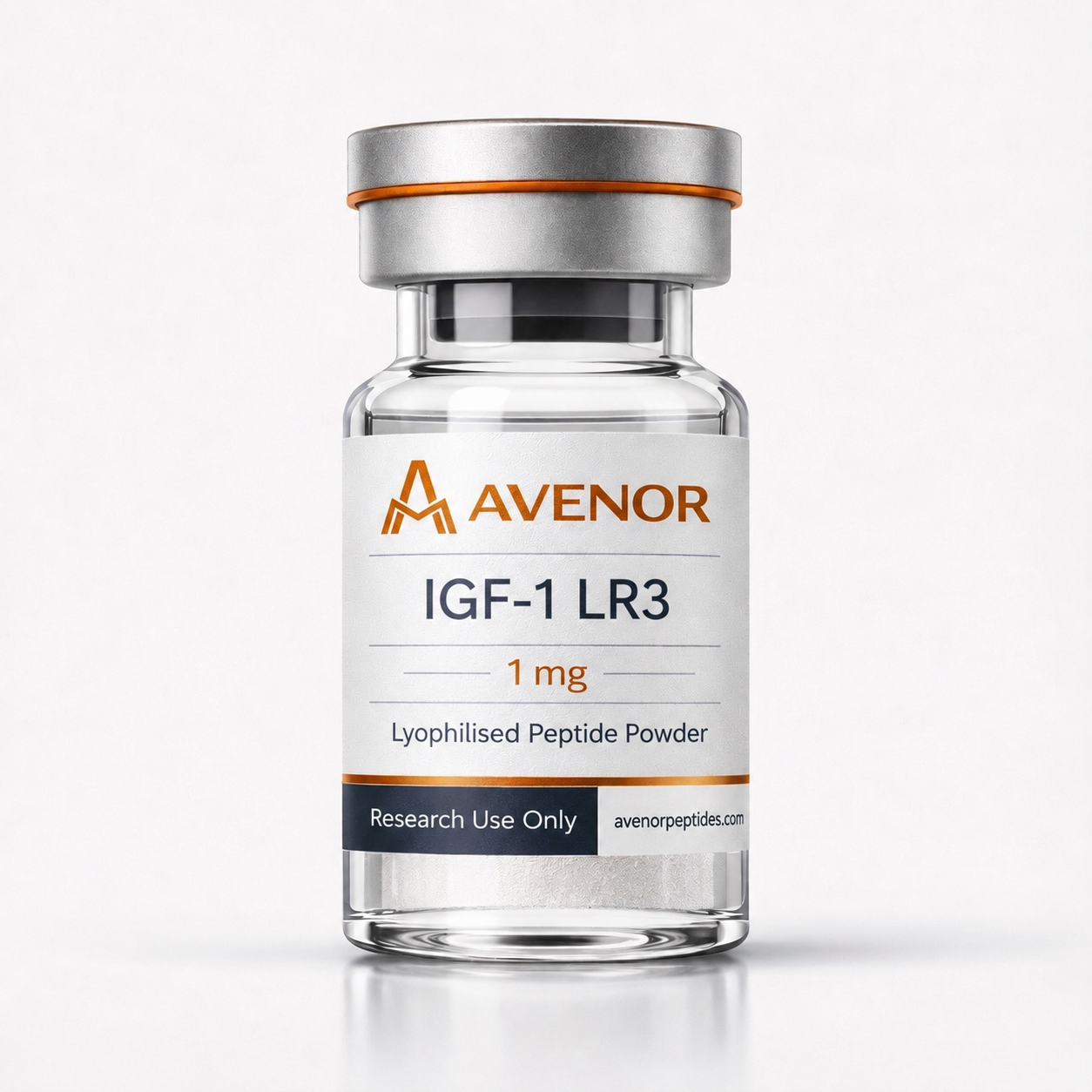
    IGF-1 LR3 1 mg - Avenor Peptides

    Muscle & Performance

    IGF-1 LR3

    Strength: 1 mg

    IGF-1 LR3 is a research-use catalogue item organized around product identity, SKU traceability and available documentation.

    €59,00
    In stock
    1

    The more products, the bigger the discount

    2 → −5%
    3 → −8%
    4 → −11%
    5+ → −15%
    across your whole basket, automatically
    Batch documentationShips from Greece

    Free shipping: Greece from €50, Cyprus and Bulgaria from €100, France, Germany, Italy, Belgium, Netherlands and Spain from €200. Details

    This product is intended exclusively for laboratory research use. It is not intended for human consumption, diagnosis, treatment, or prevention of disease.

    Product information

    FormResearch product
    Strength1 mg
    SKUAVR-IGF-1MG
    Stock statusIn stock
    COA / BatchSee the documentation state below
    StorageRefer to the label and available documentation details.
    Packaging / shippingControlled shipping preparation according to the available SKU variant.

    Documentation on request

    There is no published document for this specific SKU variant at the moment.

    Contact us about documentation

    Research overview

    Documentation & COA

    Batch documentation and COA, where available, are linked to the specific product batch and SKU.

    This product is intended exclusively for laboratory research use. It is not intended for human consumption, diagnosis, treatment, or prevention of disease.

    Product profile

    83

    amino acids in total — against 70 in native IGF-1

    13

    extra amino acids attached to one end of the molecule

    ~20×

    more potent than IGF-1 in human fibroblasts (Yateman et al., 1993)

    ≥98%

    purity by HPLC

    Research context

    What it is

    IGF-1 LR3 is a modified version of a natural growth factor the body makes.

    The change is not accidental: the molecule was designed to escape the proteins that normally bind and restrain it.

    The technical detail

    An IGF-1 analogue of 83 amino acids — an Arg substitution at position 3 and a 13-residue N-terminal extension. "LR3" stands for Long Arg3.

    How it works

    The natural growth factor usually circulates bound, as if held back.

    Because LR3 does not bind to those proteins, it stays free longer and sends the growth signal more strongly.

    That signal tells cells to grow and divide.

    The technical detail

    It acts on the IGF-1R receptor, activating the PI3K/AKT pathway. Not binding the IGFBPs raises its bioavailability and activity.

    What the research shows

    The LR3 version itself was historically studied mainly as a laboratory tool in cell culture.

    Newer research focuses on the broader GH/IGF-1 system and its role in muscle growth.

    83

    amino acids (LR3)

    70

    amino acids (native IGF-1)

    6

    binding proteins it bypasses

    Status and safety

    IGF-1 and its analogues are prohibited doping substances. They fall under the peptide hormones and growth factors category of the WADA list, banned at all times.

    Anti-doping laboratory methods in 2026 explicitly target the detection of IGF-1 in athletes.

    The same growth signal is also studied for its safety profile: activation of the IGF-1R receptor has been linked in research models to cell proliferation, which is why it remains strictly a research compound.

    The technical detail

    Zhang, microsampling and IGF-1 detection, Biomed Chromatogr 2026. Zhao et al., IGF-1R/PI3K/AKT axis in leukemia, Hematology 2026. Khamsi & Armstrong, LR3-IGF-I and IGFBP, 1997.

    Laboratory use

    Used in a controlled laboratory setting as a serum-free cell culture medium supplement, to sustain growth and viability in production cell lines (CHO among them), as an alternative to insulin in stem cell differentiation protocols, in in vitro oocyte maturation studies, as a control for separating IGF-dependent from IGF-independent actions of the IGF-binding proteins, in IGF-1R signalling studies, and for identity and purity confirmation by HPLC and mass spectrometry.

    Research Use Only. For laboratory and research use exclusively. Not intended for human or veterinary use, diagnosis, treatment or disease prevention, nor for any in vivo application outside a controlled laboratory setting. This molecule has never been approved for human use and is a prohibited substance in sport. The data cited come from cell culture and animal studies and do not transfer to any other use.

    Structural data

    Class
    Engineered analogue of human IGF-1 (insulin-like growth factor 1) with reduced affinity for the IGF-binding proteins
    Chain length
    83 amino acids — the 70-residue IGF-1 sequence plus a 13-residue extension
    Modification 1 — extension
    A 13-residue N-terminal extension: Met-Phe-Pro-Ala-Met-Pro-Leu-Ser-Ser-Leu-Phe-Val-Asn (derived from the first 11 amino acids of porcine growth hormone plus Val-Asn)
    Modification 2 — substitution
    Arginine (Arg) at position 3 of the IGF-1 sequence, replacing glutamic acid (Glu) — this is where the "R3" comes from
    Target
    Type 1 IGF receptor (IGF-1R) — binding to it is retained
    Production system
    Recombinant expression in Escherichia coli (Francis et al., 1992)
    Product form
    Lyophilized powder in a sealed vial
    Nature of the material
    A protein — heat-sensitive, prone to oxidation and to damage from freeze–thaw cycling
    Purity
    ≥98% (HPLC) — supplied with CoA

    Comparison

    Feature comparison

    FeatureIGF-1 LR3 (this product)CJC-1295 + IpamorelinHGH (somatropin)
    Position on the GH/IGF axisAt the bottom — acts directly on the IGF-1 receptorAt the top — acts on the pituitary so that growth hormone is releasedIn the middle — growth hormone itself, which drives the liver to make IGF-1
    Immediate molecular targetType 1 IGF receptor (IGF-1R)GHRH receptor (CJC-1295) and the GH-secretagogue / ghrelin receptor (ipamorelin)Growth hormone receptor (GHR)
    Molecule typeEngineered IGF-1 analogue, 83 amino acidsA 30-amino-acid GHRH analogue plus a pentapeptideRecombinant human protein of 191 amino acids
    Role of the binding proteinsAlmost entirely bypassed — this is the molecule's reason for existingNot directly involved; the effect runs through endogenous GH releaseThe IGF-1 that results is bound by IGFBPs in the normal way
    Main documented laboratory useCell culture medium supplement; a tool for separating IGF-dependent from IGF-independent effectsStudies of GH secretion physiologyAn approved medicine in specific indications; a widely used reference standard in endocrine research
    Maturity of human dataNo approval for human use — no clinical trials exist (Mongongu et al., 2021)Limited published dataDecades of clinical use in approved indications
    Status in sportProhibited substance — validated detection methods existProhibited class of substancesProhibited substance

    Storage & handling

    • The sealed vial of lyophilized powder is stored frozen and protected from light.
    • This is a protein rather than a small synthetic peptide — it is markedly more fragile and demands a stricter cold chain.
    • Repeated freeze–thaw cycles are strictly avoided; each cycle degrades the integrity and activity of the molecule.
    • Avoid prolonged exposure to room temperature, to direct sunlight, and to oxidizing conditions — oxidized forms of this molecule have been documented in the literature in poorly stored material.
    • Keep in the original packaging until the point of laboratory use.
    • Avoid vigorous vortexing or shaking, which can denature the protein.
    • Handle using standard laboratory practice and appropriate personal protective equipment.
    • Keep away from children and out of food preparation areas.

    Documentation

    • Certificate of Analysis (CoA) per batch, with date and lot number.
    • Purity analysis by HPLC — specification ≥98%.
    • Identity and molecular weight confirmation by mass spectrometry.
    • Research Use Only (RUO) declaration on the packaging.
    • Documents available on request for the specific batch you received.

    References

    References & documentation

    1. 1.Francis G.L. et al. (1992). Novel recombinant fusion protein analogues of insulin-like growth factor (IGF)-I indicate the relative importance of IGF-binding protein and receptor binding for enhanced biological potency. J Mol Endocrinol, 8(3), 213-223.
    2. 2.Zhao X. et al. (1993). Effects of insulin-like growth factor-I and its analogues on bovine hydrogen peroxide release by neutrophils and blastogenesis by mononuclear cells. J Endocrinol, 139(2), 259-265.
    3. 3.Yateman M.E. et al. (1993). Cytokines modulate the sensitivity of human fibroblasts to stimulation with insulin-like growth factor-I (IGF-I) by altering endogenous IGF-binding protein production. J Endocrinol, 137(1), 151-159.
    4. 4.Conlon M.A. et al. (1995). Long R3 insulin-like growth factor-I (IGF-I) infusion stimulates organ growth but reduces plasma IGF-I, IGF-II and IGF binding protein concentrations in the guinea pig. J Endocrinol, 146(2), 247-253.
    5. 5.Morris A.E. & Schmid J. (2000). Effects of insulin and LongR(3) on serum-free Chinese hamster ovary cell cultures expressing two recombinant proteins. Biotechnol Prog, 16(5), 693-697.
    6. 6.Dunaiski V. et al. (2002). Short-term infusion of LongR(3) insulin-like growth factor (IGF)-I decreases hepatic IGF-I mRNA but not IGF binding protein-3 mRNA expression in pigs. Gen Comp Endocrinol, 126(2), 221-228.
    7. 7.Pampusch M.S. et al. (2003). Effect of recombinant porcine IGF-binding protein-3 on proliferation of embryonic porcine myogenic cell cultures in the presence and absence of IGF-I. J Endocrinol, 176(2), 227-235.
    8. 8.Price W.A. (2004). Regulation of insulin-like growth factor (IGF)-binding protein expression by growth factors and cytokines alters IGF-mediated proliferation of postnatal lung fibroblasts. Exp Lung Res, 30(4), 261-283.
    9. 9.Bieberich E. (2005). Replacement of insulin by LongR3-IGF-1 allows for the differentiation of ES cells into neuroprogenitors and insulin-secreting cells. Anal Biochem, 346(1), 185-187.
    10. 10.Kamanga-Sollo E. et al. (2005). Insulin-like growth factor binding protein (IGFBP)-3 and IGFBP-5 mediate TGF-beta- and myostatin-induced suppression of proliferation in porcine embryonic myogenic cell cultures. Exp Cell Res, 311(1), 167-176.
    11. 11.Kohler M. et al. (2010). Detection of His-tagged Long-R³-IGF-I in a black market product. Growth Horm IGF Res, 20(5), 386-390.
    12. 12.Becker J. et al. (2014). Transcriptome analyses of CHO cells with the next-generation microarray CHO41K: development and validation by analysing the influence of the growth stimulating substance IGF-1 substitute LongR(3). J Biotechnol, 178, 23-31.
    13. 13.Araujo M.S. et al. (2020). Molecular and cellular effects of insulin-like growth factor-1 and LongR3-IGF-1 on in vitro maturation of bovine oocytes: comparative study. Growth Horm IGF Res, 55, 101357.
    14. 14.Mongongu C. et al. (2021). Detection of LongR-IGF-I, Des(1-3)-IGF-I, and R-IGF-I using immunopurification and high resolution mass spectrometry for antidoping purposes. Drug Test Anal, 13(7), 1256-1269.

    Product information

    Frequently asked questions

    What does "LR3" mean?
    It is shorthand for the molecule's two modifications. The "L" stands for Long and refers to the thirteen extra amino acids extending one end of the chain. The "R3" means that at position 3 of the IGF-1 sequence there is arginine (Arg) instead of the native glutamic acid. Together the two changes give a molecule of 83 amino acids rather than 70.
    What is the real difference from ordinary IGF-1?
    Native IGF-1 is almost always bound by a family of six proteins, the IGF-binding proteins, and while bound it is inactive. The two modifications in LR3 sharply reduce that binding without spoiling its engagement of the IGF-1R receptor. LR3 therefore stays free and active for far longer — that is its sole reason for existing.
    So is it a "stronger" molecule?
    Not in the sense usually meant. In the Francis and colleagues paper (1992), in chicken embryo fibroblasts — a line that secretes no detectable binding proteins — Long[Arg3]-IGF-I was less potent than native IGF-1. Its apparent superiority exists only where there are binding proteins to bypass.
    What is its main documented use?
    As a supplement in cell culture media for biotechnology manufacturing. Morris and Schmid (2000) compared it head-to-head with insulin in two serum-free CHO cell lines producing recombinant proteins, and under production conditions LongR3 sustained viability better. Becker and colleagues (2014) mapped what changes inside the cell using a microarray with 41,304 probes.
    Is it used in other kinds of culture?
    Yes. Bieberich (2005) showed that replacing insulin with LongR3-IGF-1 allows embryonic stem cells to differentiate into neuroprogenitors and into insulin-secreting cells. Araujo and colleagues (2020) tested it in the in vitro maturation of 739 bovine oocytes and concluded it can replace both IGF-1 and fetal bovine serum.
    Why do researchers use it as a "control"?
    Because it is not bound by IGFBPs, it lets you separate two things that otherwise get conflated: whether a binding protein affects a cell because it sequesters IGF, or because it has its own entirely independent action. If the effect still appears with LR3, sequestration is not the cause. The technique was applied systematically by Pampusch et al. (2003) and Kamanga-Sollo et al. (2005).
    Is there any clinical data in humans?
    No. Mongongu and colleagues (2021), of the French anti-doping agency, state explicitly that these analogues were never approved for use in humans. They are prohibited substances in sport, for which validated detection methods based on immunopurification and high-resolution mass spectrometry exist.
    What does the animal data show?
    Mainly that the exogenous molecule disrupts the axis itself. Dunaiski and colleagues (2002) recorded in pigs that infusing LongR3IGF-I lowered plasma growth hormone, IGF-1, IGFBP-3 and insulin, and decreased growth rate. Conlon and colleagues (1995) recorded a comparable fall in plasma IGF-1, IGF-II and binding proteins in guinea pigs.
    Why does it demand stricter storage than other peptides?
    Because it is an 83-amino-acid protein rather than a small synthetic peptide — it is more vulnerable to heat, oxidation, agitation and freeze-thaw cycling. The anti-doping literature (Mongongu et al., 2021) documents oxidized and degraded forms of this molecule in material of doubtful origin and storage.
    Can it be used by humans or animals?
    No. The product is supplied exclusively for laboratory research. It is not intended for human or veterinary use, nor for in vivo application outside a controlled laboratory setting. No administration or dosing guidance is provided.
    Do I receive a certificate of analysis?
    Yes. Every batch is accompanied by a CoA with HPLC analysis and mass spectrometry identity confirmation. It is available on request for the specific batch you received.