Free shipping — the threshold depends on the destination country, confirmed at checkout.

    Research Use Only (RUO). For laboratory research only. Not for human or veterinary use.

    Research Use Only (RUO):Research classification with product and batch documentation where available.
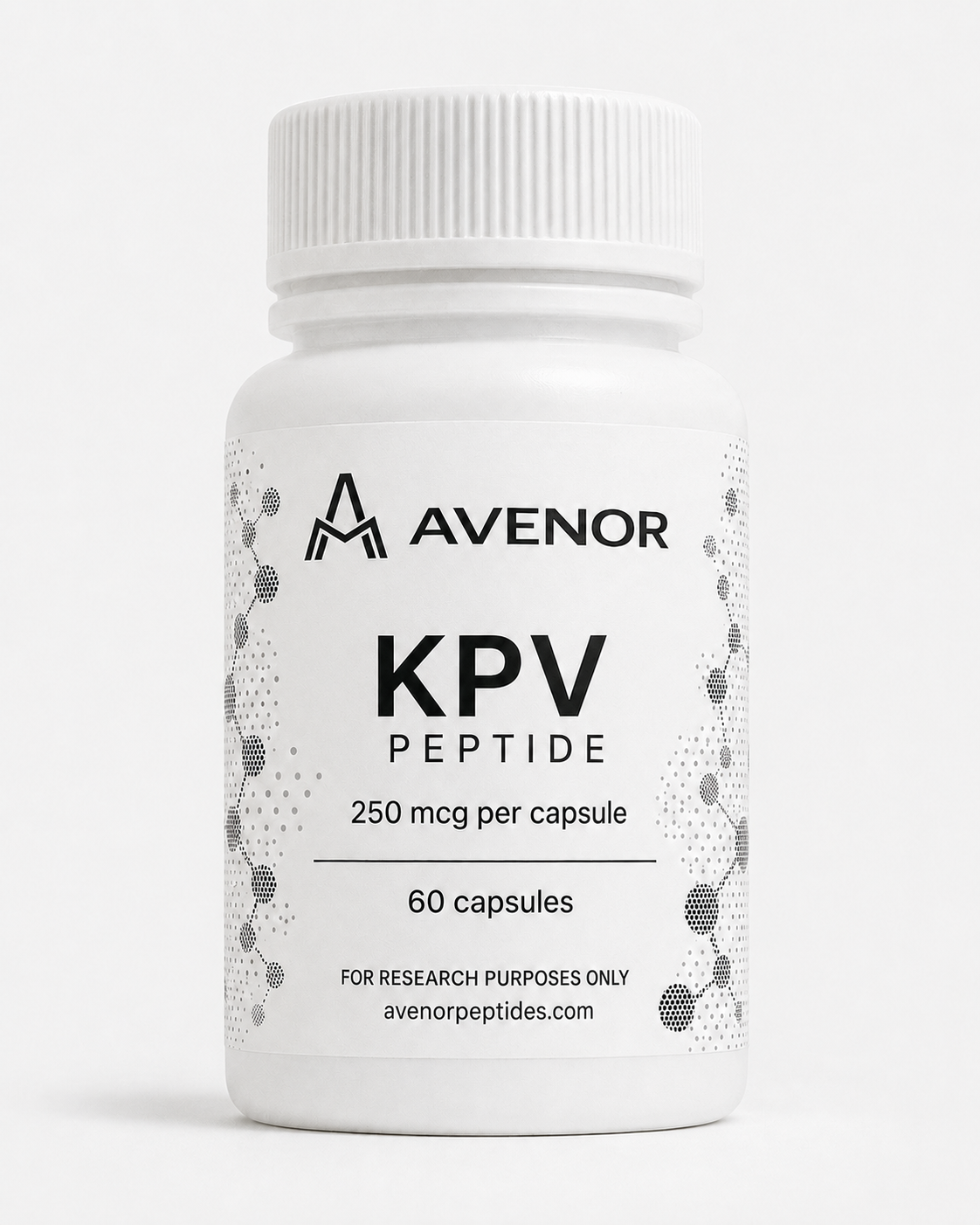
    KPV (PILL) 250 mcg - Avenor Peptides

    Recovery & Repair

    KPV (PILL)

    Strength: 250 mcg

    KPV is a small peptide studied mainly around inflammation — in the gut and in the skin. This one is the pill form.

    €94,00
    In stock
    1

    The more products, the bigger the discount

    2 → −5%
    3 → −8%
    4 → −11%
    5+ → −15%
    across your whole basket, automatically
    Batch documentationShips from Greece

    Free shipping: Greece from €50, Cyprus and Bulgaria from €100, France, Germany, Italy, Belgium, Netherlands and Spain from €200. Details

    This product is intended exclusively for laboratory research use. It is not intended for human consumption, diagnosis, treatment, or prevention of disease.

    Product information

    FormOral form
    Strength250 mcg
    SKUAVR-KPVPILLKP-250MCG
    Stock statusIn stock
    COA / BatchSee the documentation state below
    StorageRefer to the label and available documentation details.
    Packaging / shippingControlled shipping preparation according to the available SKU variant.

    Documentation on request

    There is no published document for this specific SKU variant at the moment.

    Contact us about documentation

    Research overview

    What it is researched for

    Research focuses on topics such as:

    • inflammation
    • the gut
    • the skin

    Areas of research — not a promise of results.

    How this category is positioned

    It is one of the smallest peptides in the catalogue. It is also available as a vial for reconstitution — this listing is the pill.

    Documentation & COA

    Batch documentation and COA, where available, are linked to the specific product batch and SKU.

    This product is intended exclusively for laboratory research use. It is not intended for human consumption, diagnosis, treatment, or prevention of disease.

    Product profile

    3

    amino acids — lysine, proline, valine

    11-13

    positions in the α-MSH sequence it derives from

    PepT1

    the transporter that carries it into intestinal cells

    ≥98%

    purity by HPLC

    Research context

    What it is

    KPV is a tripeptide — three amino acids: lysine, proline, valine.

    It is the tail of a natural hormone, α-MSH, and the smallest piece of it that keeps the anti-inflammatory action.

    In the oral form, the target is clear: the digestive system itself.

    The technical detail

    KPV (Lys-Pro-Val) is the C-terminal tripeptide of α-melanocyte-stimulating hormone (α-MSH).

    How it works

    It acts where it lands: the lining of the gut.

    Because it is so small, it enters the mucosal cells and turns down the inflammatory signals on the spot.

    At the same time it helps the gut barrier — the thin layer that keeps in what should stay in — to heal.

    The technical detail

    It lowers pro-inflammatory cytokines such as TNF-α in intestinal mucosal cells (Xiao et al., 2017).

    What the studies showed

    In 2017, a study engineered targeted oral delivery of KPV to the intestinal lining.

    The result was twofold: less inflammation and healing of the wall.

    3

    amino acids

    ↓ TNF-α

    gut inflammation, 2017

    gut barrier

    restored, 2024

    In a 2024 colitis study, KPV lowered IL-1β, IL-6, and TNF-α and rebuilt the tight-junction proteins that seal the gut wall.

    How it compares

    Large peptides struggle to survive digestion and to reach a target intact.

    KPV is small enough that the digestive system is its natural field of action.

    A 2026 study in liver cells showed KPV lowering oxidative load and fat buildup — extending interest from the gut to the gut–liver axis.

    The technical detail

    Lee et al., 2026: KPV lowered free radicals and regulated the PPARγ pathway in HepG2 liver cells; clinical evidence in humans remains early.

    Laboratory use

    Used in a controlled laboratory setting as a reference substrate in PepT1 uptake and kinetics studies, in competition experiments against other di- and tripeptides, in intestinal epithelial cell line culture (e.g. Caco-2), in NF-κB and MAP kinase signalling pathway analysis, and for identity and purity confirmation by HPLC and mass spectrometry.

    Research Use Only. For laboratory research exclusively. Not intended for human or veterinary use, diagnosis, treatment, or disease prevention. The capsule format describes the physical form of the material and does not constitute an indication for ingestion or any other use. The data referenced come from cell lines and laboratory animals and do not transfer to humans.

    Structural data

    Class
    Melanocortin-derived tripeptide — a substrate of the PepT1 transporter
    Sequence
    Lys-Pro-Val (lysine–proline–valine)
    Chain length
    3 amino acids
    Sequence origin
    C-terminal fragment of α-melanocyte-stimulating hormone (α-MSH), positions 11-13
    Molecular formula
    C16H30N4O4
    Molecular weight
    ≈342.4 g/mol
    Entry transporter
    PepT1 (SLC15A1), a proton-coupled di- and tripeptide transporter
    Product form
    Oral capsule — solid form, ready to use
    Reconstitution
    Not required — this is not a lyophilized powder in a vial
    Purity
    ≥98% (HPLC) — supplied with CoA

    Comparison

    Feature comparison

    FeatureKPV capsule (this product)KPV injectable (vial)
    Material formSolid capsule, ready to useLyophilized powder in a sealed vial
    Preparation before useNone — no reconstitution, no bacteriostatic waterReconstitution with a suitable solvent is required in the lab
    Cellular entry route under studyActive transport via PepT1 in the intestinal epitheliumThe intestinal epithelium is bypassed — distribution does not depend on GI absorption
    Focus of the literatureIntestinal inflammation models, Caco-2/HT29 cells, oral administration in rodentsSystemic exposure, models outside the digestive tract
    Stability in the GI environmentA critical parameter — much of the research concerns systems that protect the peptide (nanoparticles, hydrogels, prodrugs)Not a parameter
    StorageRoom temperature, dry place — no refrigerationRefrigerated; once reconstituted, stricter requirements
    Molecular sequenceLys-Pro-Val — identical in both formsLys-Pro-Val — identical in both forms

    Storage & handling

    • Capsules are stored at room temperature in a dry place — no refrigeration or freezing required.
    • No reconstitution is needed: the material is supplied in solid, ready-to-use form.
    • Keep in the original, well-closed packaging, protected from moisture and direct sunlight.
    • Avoid exposure to high temperatures and to humid environments.
    • Handle using standard laboratory practice and appropriate personal protective equipment.
    • Keep away from children and out of food preparation areas.

    Documentation

    • Certificate of Analysis (CoA) per batch, with date and lot number.
    • Purity analysis by HPLC — specification ≥98%.
    • Identity and molecular weight confirmation by mass spectrometry.
    • Research Use Only (RUO) declaration on the packaging.
    • Documents available on request for the specific batch you received.

    References

    References & documentation

    1. 1.Dalmasso G. et al. (2008). PepT1-mediated tripeptide KPV uptake reduces intestinal inflammation. Gastroenterology, 134(1), 166-178.
    2. 2.Kannengiesser K. et al. (2008). Melanocortin-derived tripeptide KPV has anti-inflammatory potential in murine models of inflammatory bowel disease. Inflamm Bowel Dis, 14(3), 324-331.
    3. 3.Brandsch M. (2009). Transport of drugs by proton-coupled peptide transporters: pearls and pitfalls. Expert Opin Drug Metab Toxicol, 5(8), 887-905.
    4. 4.Laroui H. et al. (2010). Drug-loaded nanoparticles targeted to the colon with polysaccharide hydrogel reduce colitis in a mouse model. Gastroenterology, 138(3), 843-853.e2.
    5. 5.Viennois E. et al. (2016). Critical role of PepT1 in promoting colitis-associated cancer and therapeutic benefits of the anti-inflammatory PepT1-mediated tripeptide KPV in a murine model. Cell Mol Gastroenterol Hepatol, 2(3), 340-357.
    6. 6.Xiao B. et al. (2017). Orally Targeted Delivery of Tripeptide KPV via Hyaluronic Acid-Functionalized Nanoparticles Efficiently Alleviates Ulcerative Colitis. Mol Ther, 25(7), 1628-1640.
    7. 7.Zeng M. et al. (2017). Peptide Receptor-Targeted Fluorescent Probe: Visualization and Discrimination between Chronic and Acute Ulcerative Colitis. ACS Appl Mater Interfaces, 9(15), 13029-13036.
    8. 8.Wu Y. et al. (2019). A PepT1 mediated medicinal nano-system for targeted delivery of cyclosporine A to alleviate acute severe ulcerative colitis. Biomater Sci, 7(10), 4299-4309.
    9. 9.Sun J. et al. (2021). Self-Cross-Linked Hydrogel of Cysteamine-Grafted γ-Polyglutamic Acid Stabilized Tripeptide KPV for Alleviating TNBS-Induced Ulcerative Colitis in Rats. ACS Biomater Sci Eng, 7(10), 4859-4869.
    10. 10.Cheng J. et al. (2026). Inflammation-triggered self-immolative conjugates enable oral peptide delivery by overcoming gastrointestinal barriers. Sci Adv, 12(3), eaea2989.

    Product information

    Frequently asked questions

    Why does this peptide exist as a capsule when most peptides require injection?
    Because it is exceptionally small. Most research peptides run to dozens of amino acids and cannot cross the intestinal wall, so they are supplied as powder for reconstitution. KPV is just three amino acids — precisely the size the intestinal PepT1 transporter recognizes. There is therefore a documented mechanistic reason to study the oral form, which is not the case for most other peptides in the catalogue.
    What exactly is PepT1?
    It is a transporter protein (gene SLC15A1) in the membrane of intestinal epithelial cells. Its job is to actively carry di- and tripeptides from the gut lumen into the cell using a proton gradient as its energy source — the mechanism by which the products of protein digestion are normally absorbed. As Brandsch (2009) describes, the same transporter also accepts drug molecules that structurally resemble peptides.
    How was it shown that KPV really passes through PepT1?
    Through two different approaches. Dalmasso and colleagues (2008) used radiolabelled KPV in human intestinal cell lines and measured uptake kinetics, alongside unlabelled KPV as a competitor for a known PepT1 substrate. Later, Viennois and colleagues (2016) showed in PepT1 knockout mice that KPV lost the effects it had in wild-type animals.
    When is one form studied and when the other?
    The oral form is studied when the research question concerns PepT1 itself, the intestinal epithelium, or intestinal inflammation models — that is, when the route of entry is part of the question. The injectable form is studied when the aim is systemic exposure independent of gastrointestinal absorption. The molecule is the same; what changes is what is being examined.
    What is the relationship to α-MSH, and does it affect melanin?
    KPV is the C-terminal fragment of α-MSH, positions 11-13. It is not the whole hormone and does not carry the portion that drives melanogenesis. Kannengiesser and colleagues (2008) studied KPV in mice with a non-functional MC1R receptor — the receptor associated with pigmentation — and the effects were retained, indicating they are at least partly independent of that signalling.
    What did the cell-level studies show?
    Dalmasso and colleagues (2008) reported that at nanomolar concentrations KPV inhibited activation of NF-κB and the MAP kinase pathways in Caco2-BBE and HT29-Cl.19A cell lines and in human Jurkat T cells, with a consequent reduction in pro-inflammatory cytokine secretion. These are findings in cell culture.
    Why do so many studies involve nanoparticles and hydrogels?
    Because the core technical problem is not entry into the cell but the peptide's survival on the way there. Laroui and colleagues (2010) reported comparable effect in a mouse model at a 12,000-fold lower concentration when KPV was loaded into nanoparticles, while Cheng and colleagues (2026) reported 3.8-fold greater colonic accumulation using a prodrug system. That simultaneously shows the promise and the limit of the free form.
    Does it need reconstitution or refrigeration?
    No. This is a solid capsule form, not lyophilized powder in a vial. No bacteriostatic water, syringes or solvent are required, and storage is at room temperature in a dry place. It is one of the few research peptide formats that does not presuppose refrigeration equipment.
    What is the real limit of the published data?
    All findings come from cell lines and laboratory animals. There are no controlled human clinical studies establishing any outcome, and the literature supports no use outside the laboratory. Beyond that, the existence of the transporter does not guarantee that free tripeptide arrives intact at the place where the transporter sits.
    Can it be used by humans or animals?
    No. The product is supplied exclusively for laboratory research. It is not intended for human or veterinary use, nor for in vivo application outside a controlled laboratory setting. No administration or dosing guidance is provided. The capsule format describes the form of the material, not a suggested use.
    Do I receive a certificate of analysis?
    Yes. Every batch is accompanied by a CoA with HPLC analysis and mass spectrometry identity confirmation. It is available on request for the specific batch you received.