Free shipping — the threshold depends on the destination country, confirmed at checkout.

    Research Use Only (RUO). For laboratory research only. Not for human or veterinary use.

    Research Use Only (RUO):Research classification with product and batch documentation where available.
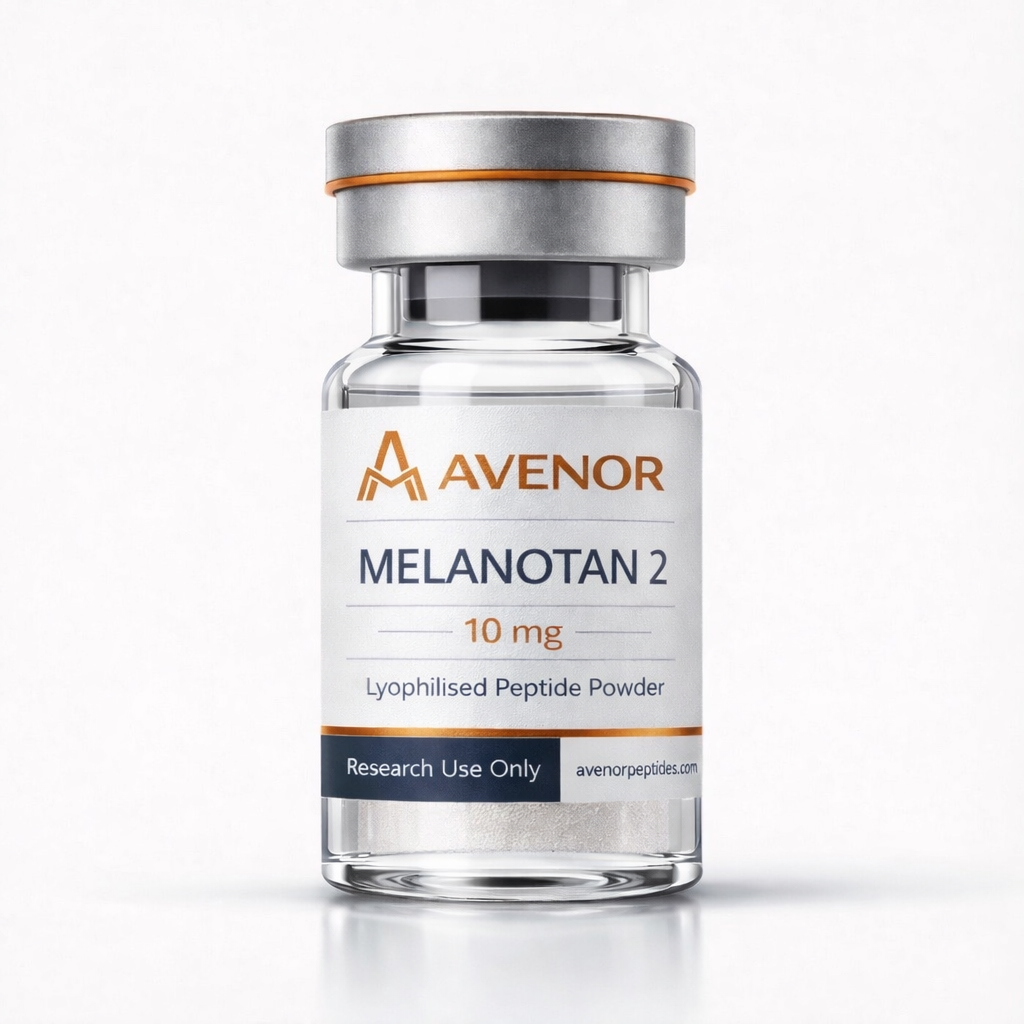
    Melatonan II 10 mg - Avenor Peptides

    Skin & Hair

    Melatonan II

    Strength: 10 mg

    Melatonan II is a research-use catalogue item organized around product identity, SKU traceability and available documentation.

    €30,00
    In stock
    1

    The more products, the bigger the discount

    2 → −5%
    3 → −8%
    4 → −11%
    5+ → −15%
    across your whole basket, automatically
    Batch documentationShips from Greece

    Free shipping: Greece from €50, Cyprus and Bulgaria from €100, France, Germany, Italy, Belgium, Netherlands and Spain from €200. Details

    This product is intended exclusively for laboratory research use. It is not intended for human consumption, diagnosis, treatment, or prevention of disease.

    Product information

    FormResearch product
    Strength10 mg
    SKUAV-MT2-10MG
    Stock statusIn stock
    COA / BatchSee the documentation state below
    StorageIn powder form: freezer (−20°C).
    Packaging / shippingProtective professional shipping packaging with clear mg labelling.

    Documentation on request

    There is no published document for this specific SKU variant at the moment.

    Contact us about documentation

    Research overview

    Documentation & COA

    Batch documentation and COA, where available, are linked to the specific product batch and SKU.

    This product is intended exclusively for laboratory research use. It is not intended for human consumption, diagnosis, treatment, or prevention of disease.

    Product profile

    7

    amino acids — a cyclic heptapeptide

    MC1R–MC5R

    non-selective — activates all five melanocortin receptors

    0

    regulatory approvals — none, in any jurisdiction

    ≥98%

    purity by HPLC

    Research context

    What it is

    Melanotan II is a synthetic cyclic peptide.

    It is built to mimic a natural hormone that controls skin color — but it acts far more strongly, and far more broadly, than that hormone does.

    The technical detail

    An analogue of α-MSH, an agonist at the melanocortin receptors. It is widely used as a research tool for studying these receptors.

    How it works

    It does not press one switch, but several at once.

    One controls melanin production — that is, tanning.

    Others, though, affect appetite, sexual behaviour and brain signals — which is why its action never stays in the skin.

    The technical detail

    It activates multiple subtypes: MC1R for epidermal melanogenesis, MC4R for appetite. It also induces central oxytocin release.

    What the research shows

    In science it is mostly used as a tool to understand how the melanocortin system works.

    In mice, by activating the appetite receptor, it reduced food intake and weight gain.

    5

    melanocortin receptors

    MC1R

    target for pigmentation

    MC4R

    target for appetite

    Other preclinical studies examined its effect on social behaviour through oxytocin, and an antidepressant-type effect in stress models.

    What you should know

    Melanotan II holds no marketing authorization as a medicine with any major regulator. It is an unregulated, unlicensed peptide.

    Injectable use has been linked in published reports to changes in skin and mucosal pigmentation.

    Because it directly stimulates melanocytes, monitoring changes in the skin is the point the literature repeatedly flags.

    The technical detail

    Bonchev, mucosal pigmentation after 64 days of self-administration, Life 2026. Weirath & Haskell-Luevano, review of MCR tool compounds, ACS Pharmacol Transl Sci 2024.

    Laboratory use

    Used in a controlled laboratory setting for identity and purity confirmation by HPLC and mass spectrometry, for stability studies of both the lyophilized and the reconstituted material across temperatures, and for in vitro binding and activation assays in cell lines expressing melanocortin receptors. Precisely because of its non-selectivity, it is frequently used as a single reference ligand for comparing MC1R, MC3R, MC4R and MC5R responses side by side, and as a comparator against more selective α-MSH analogs.

    Research Use Only — for laboratory research exclusively. This material is NOT intended for human or veterinary use, in any manner and under any circumstances. It is not a medicine, not a cosmetic, and not a supplement. It is not intended to diagnose, treat, cure, or prevent any disease or condition. It carries and implies no dermatological, cosmetic, or aesthetic indication of any kind. Melanotan II is NOT approved by the EMA, the FDA, the Greek National Organisation for Medicines (EOF), or any other regulatory authority, in any jurisdiction, for any indication. Multiple national health organizations have issued formal safety warnings regarding the unregulated use of α-MSH analogues, and the international literature documents serious adverse events including rhabdomyolysis, renal injury, encephalopathy, priapism, and changes in melanocytic nevi. No dosages, protocols, or administration instructions are provided. Purchase presumes that the buyer is a qualified researcher or institution and that the material will be used exclusively in a controlled laboratory setting, in accordance with applicable law.

    Structural data

    Sequence
    Ac-Nle-cyclo[Asp-His-D-Phe-Arg-Trp-Lys]-NH2
    Molecular weight
    ≈1024 g/mol
    CAS number
    121062-08-6
    Class
    Synthetic analog of α-MSH (melanocyte-stimulating hormone) — non-selective melanocortin receptor agonist
    Selectivity
    Non-selective: activates MC1R, MC3R, MC4R and MC5R (MC2R responds only to ACTH)
    Relationship to PT-141
    Parent molecule; PT-141 (bremelanotide) is its principal active metabolite
    Regulatory status
    Not approved by any regulatory authority for any indication
    Product form
    10 mg lyophilized powder in a sealed vial — requires reconstitution
    Purity
    ≥98% (HPLC) — supplied with CoA

    Comparison

    Feature comparison

    FeatureMelanotan II (this product)PT-141 / Bremelanotide
    Chemical familyCyclic heptapeptide, α-MSH analogCyclic heptapeptide, α-MSH analog
    Chemical relationshipParent moleculePrincipal active metabolite of Melanotan II
    Receptor selectivityNon-selective — activates MC1R, MC3R, MC4R and MC5RMore focused — relatively greater activity at MC3R and MC4R
    MC1R activity (pigmentation)Strong — melanogenesis is the principal described effectWeaker — pigmentation reported as rare and focal
    Breadth of reported effectsWide, a consequence of non-selectivity: dermatological, neurological, cardiovascular and renal reportsNarrower, focused on central melanocortin pathways
    Type of available evidencePreclinical work, small early studies, and predominantly case reports arising from unregulated useA completed clinical program including randomized Phase 3 trials
    Regulatory statusNot approved by any regulatory authority; safety warnings issued by multiple national health bodiesFDA-approved in 2019 as Vyleesi
    Catalog form10 mg lyophilized powder10 mg lyophilized powder

    Storage & handling

    • Store the sealed lyophilized vial at -20 °C for long-term storage; it is stable at room temperature for short shipping intervals.
    • Allow the vial to reach room temperature before opening, to prevent moisture condensing onto the powder.
    • Reconstitute with bacteriostatic or sterile water, adding it slowly down the wall of the vial; swirl gently and do not shake, as vigorous agitation can denature the peptide.
    • After reconstitution, store the solution at 2–8 °C (refrigerated) and protect it from light.
    • Avoid repeated freeze–thaw cycles; dividing into smaller aliquots before freezing is preferable.
    • Use aseptic technique when handling, with gloves and a clean surface or laminar flow hood.
    • Keep away from children, out of food preparation areas, and clearly labelled as research-use-only material.

    Documentation

    • Certificate of Analysis (CoA) per batch, with date and lot number.
    • Purity analysis by HPLC — specification ≥98%.
    • Identity and molecular weight confirmation by mass spectrometry.
    • Confirmation of peptide content per vial (nominally 10 mg).
    • Research Use Only (RUO) declaration on the packaging and accompanying documents.
    • Documents available on request for the specific batch you received.

    References

    References & documentation

    1. 1.Nelson M.E., Bryant S.M. and Aks S.E. (2012). Melanotan II injection resulting in systemic toxicity and rhabdomyolysis. Clin Toxicol (Phila), 50(10), 1169-1173.
    2. 2.Peters B. et al. (2020). Melanotan II: a possible cause of renal infarction: review of the literature and case report. CEN Case Rep, 9(2), 159-161.
    3. 3.Kaski D. et al. (2013). Melanotan and the posterior reversible encephalopathy syndrome. Ann Intern Med, 158(9), 707-708.
    4. 4.Mallory C.W., Lopategui D.M. and Cordon B.H. (2021). Melanotan Tanning Injection: A Rare Cause of Priapism. Sex Med, 9(1), 100298.
    5. 5.Dreyer B.A., Amer T. and Fraser M. (2019). Melanotan-induced priapism: a hard-earned tan. BMJ Case Rep, 12(2), e227644.
    6. 6.Habbema L. et al. (2017). Risks of unregulated use of alpha-melanocyte-stimulating hormone analogues: a review. Int J Dermatol, 56(10), 975-980.
    7. 7.Cardones A.R. and Grichnik J.M. (2009). alpha-Melanocyte-stimulating hormone-induced eruptive nevi. Arch Dermatol, 145(4), 441-444.
    8. 8.Burian E.A. and Jemec G.B.E. (2019). Eruptive Melanocytic Nevi: A Review. Am J Clin Dermatol, 20(5), 669-682.
    9. 9.Hjuler K.F. and Lorentzen H.F. (2013). Melanoma associated with the use of melanotan-II. Dermatology, 228(1), 34-36.
    10. 10.Ong S. and Bowling J. (2012). Melanotan-associated melanoma in situ. Australas J Dermatol, 53(4), 301-302.
    11. 11.Langan E.A. et al. (2009). Change in moles linked to use of unlicensed "sun tan jab". BMJ, 338, b277.
    12. 12.Gilhooley E., Daly S. and McKenna D. (2021). Melanotan II User Experience: A Qualitative Study of Online Discussion Forums. Dermatology, 237(6), 995-999.
    13. 13.Weirath N.A. and Haskell-Luevano C. (2024). Recommended Tool Compounds for the Melanocortin Receptor (MCR) G Protein-Coupled Receptors (GPCRs). ACS Pharmacol Transl Sci, 7(9), 2706-2724.
    14. 14.Eliason N.L. et al. (2022). Melanocortin receptor agonist melanotan-II microinjected in the nucleus accumbens decreases appetitive and consumptive responding for food. Neuropeptides, 96, 102289.
    15. 15.Li P. et al. (2012). Melanocortin 3/4 receptors in paraventricular nucleus modulate sympathetic outflow and blood pressure. Exp Physiol, 98(2), 435-443.
    16. 16.Hadley M.E. and Dorr R.T. (2006). Melanocortin peptide therapeutics: historical milestones, clinical studies and commercialization. Peptides, 27(4), 921-930.

    Product information

    Frequently asked questions

    What exactly is Melanotan II at the chemical level?
    It is a cyclic heptapeptide — seven amino acids joined into a ring — and a synthetic analog of the natural hormone α-MSH. Its molecular weight is approximately 1,024 g/mol and its CAS number is 121062-08-6. The cyclic structure makes it more resistant to enzymatic breakdown than a linear peptide would be.
    What does 'non-selective' mean and why does it matter?
    It means the molecule does not discriminate between melanocortin receptors: it activates MC1R, MC3R, MC4R and MC5R simultaneously. Because those receptors sit in different organs — skin, hypothalamus, autonomic nervous system, exocrine glands — its effects cannot be confined to a single system. This non-selectivity is the primary explanation for the breadth of adverse effects documented in the literature.
    What safety concerns are documented in the literature?
    The published reports are serious and varied. They include systemic toxicity with rhabdomyolysis and renal dysfunction (Nelson et al., 2012), renal infarction (Peters et al., 2020), posterior reversible encephalopathy syndrome (Kaski et al., 2013), acute ischemic priapism requiring emergency management (Dreyer et al., 2019; Mallory et al., 2021), and an extensive dermatological literature. Multiple national health organizations have issued formal safety warnings (Habbema et al., 2017).
    What do the dermatological reports show specifically?
    They document the appearance of multiple new melanocytic nevi, darkening and change in pre-existing nevi, and dysplastic nevi. Cardones and Grichnik (2009) concluded that synthetic α-MSH peptides can drive proliferation of neoplastic melanocytic cells in predisposed individuals. Cases of melanoma temporally associated with use have also been published (Ong and Bowling, 2012; Hjuler and Lorentzen, 2013), and the review by Burian and Jemec (2019) covering 179 patients found a dysplastic nevus in 16% and five associated melanoma cases.
    How does it differ from PT-141?
    They belong to the same family and are chemically linked: PT-141 (bremelanotide) is the principal active metabolite of Melanotan II. The substantive difference is selectivity. Melanotan II is a broad non-selective agonist across all five receptors, whereas PT-141 leans toward the central MC3 and MC4 receptors. They also differ radically in evidence: PT-141 passed through 43 studies and was FDA-approved in 2019, while Melanotan II is not approved anywhere.
    Are there Phase 3 clinical trials for Melanotan II?
    No. There is no completed, published Phase 3 trial program. Most human data come from individual case reports of unregulated use — the weakest tier of evidence. That means the true spectrum and frequency of adverse effects remain unknown; absence of data is not evidence of safety.
    What do the preclinical studies show?
    In animal models using direct central administration, the molecule reduced food intake and food-seeking motivation without altering metabolic rate (Eliason et al., 2022), and increased renal sympathetic nerve activity and arterial pressure via the cAMP–PKA pathway (Li et al., 2012). These findings concern animals and intracerebral administration and do not transfer to humans.
    How does storage differ from a capsule product?
    Substantially. This is a lyophilized powder in a vial, not a ready-to-use form. It requires storage at -20 °C before opening, reconstitution with bacteriostatic or sterile water, and refrigeration at 2–8 °C afterwards, protected from light. Repeated freeze–thaw cycles should be avoided.
    Can it be used by humans or animals?
    No. The product is supplied exclusively for laboratory research. It is not a pharmaceutical or cosmetic preparation, it is not intended for human or veterinary use, it carries no dermatological or aesthetic indication, and no dosages or administration instructions are provided. It has not been approved by any regulatory authority for any indication.