Free shipping — the threshold depends on the destination country, confirmed at checkout.
Research Use Only (RUO). For laboratory research only. Not for human or veterinary use.
Research Use Only (RUO):Research classification with product and batch documentation where available.
Weight & Metabolism
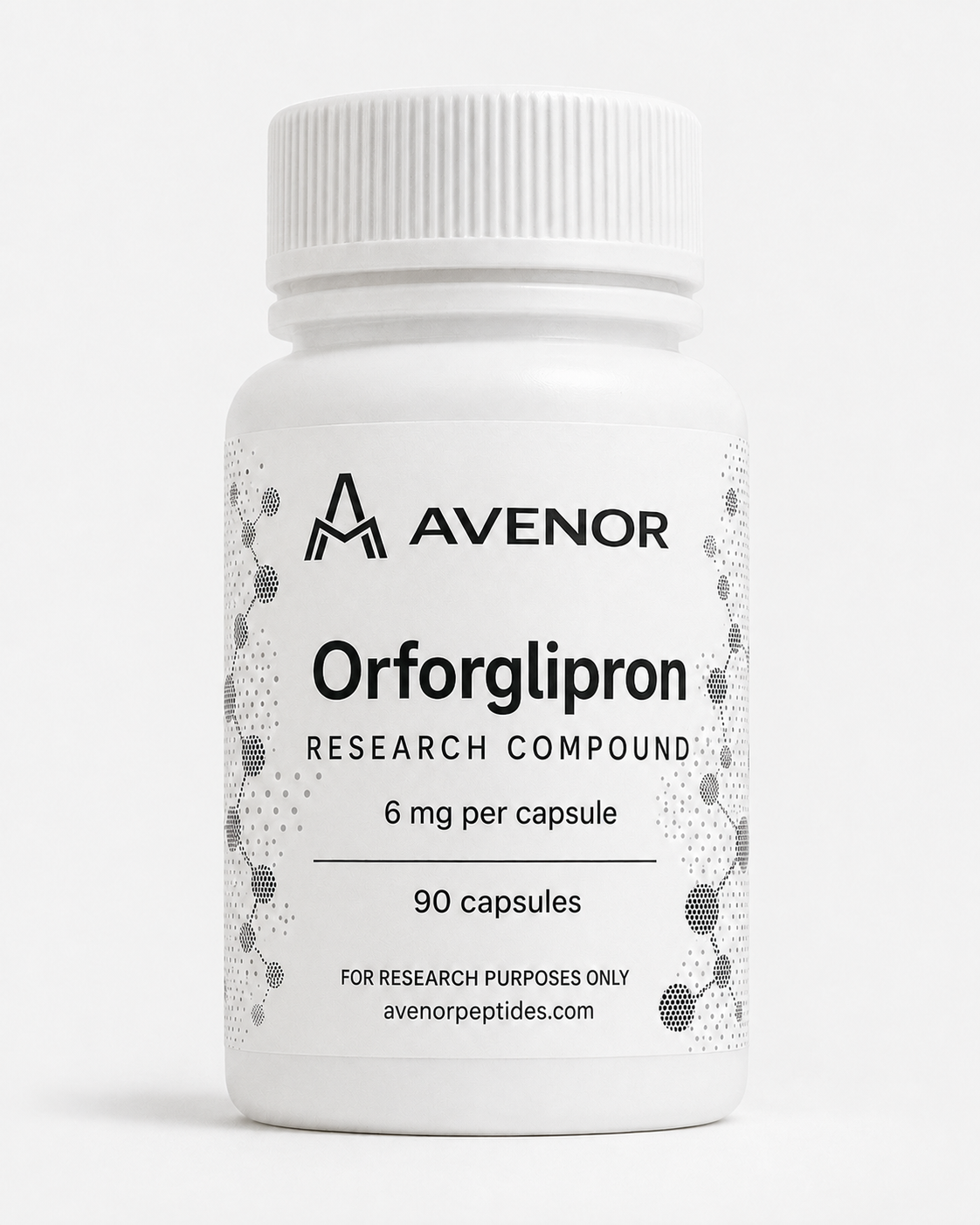
Orforglipron
Strength: 6 mg
Orforglipron is studied around body weight and blood sugar, like the GLP-1 peptides — with one difference: it is not a peptide and not an injection. It is a pill.
Free shipping: Greece from €50, Cyprus and Bulgaria from €100, France, Germany, Italy, Belgium, Netherlands and Spain from €200. Details
This product is intended exclusively for laboratory research use. It is not intended for human consumption, diagnosis, treatment, or prevention of disease.
Product information
FormOral form
Strength6 mg
SKUAVR-ORFORGLIPRON-6MG
Stock statusIn stock
COA / BatchSee the documentation state below
StorageRefer to the label and available documentation details.
Packaging / shippingControlled shipping preparation according to the available SKU variant.
Documentation on request
There is no published document for this specific SKU variant at the moment.
It presses the same "switch" as Semaglutide (GLP-1), but it is built differently: a small molecule instead of a peptide. That is why it is taken by mouth.
Documentation & COA
Batch documentation and COA, where available, are linked to the specific product batch and SKU.
This product is intended exclusively for laboratory research use. It is not intended for human consumption, diagnosis, treatment, or prevention of disease.
Product profile
1 nM
inhibition constant (Ki) at the human GLP-1 receptor
25-68 hours
half-life recorded in Phase 1 studies
3,127
participants in the ATTAIN-1 Phase 3 trial
≥98%
purity by HPLC
Research context
01
What it is
Orforglipron is not a peptide. It is a small synthetic molecule that mimics a gut hormone.
Every earlier molecule in this class was a peptide — large, fragile, hard to survive the stomach.
This one is taken by mouth, once a day.
The technical detail
A small-molecule, non-peptide agonist of the GLP-1 receptor, from Eli Lilly.
02
How it works
It presses the same switch as the injectable GLP-1 molecules.
It regulates insulin, slows how fast the stomach empties, and talks to the brain about fullness.
The difference is not the mechanism. It is that a small molecule survives digestion without an injection and without the strict rules that peptide pills demand.
The technical detail
Small-molecule agonism of GLP-1R allows oral bioavailability without the formulation constraints of a peptide.
03
What the studies showed
Two large phase 3 trials, in 2025 and 2026.
Both in adults with type 2 diabetes.
1,613
ATTAIN-2, Lancet 2025
−9.6%
weight at 72 weeks
962
ACHIEVE-2, Lancet 2026
−1.56%
HbA1c at 40 weeks
In ATTAIN-2, mean weight loss on the highest arm was −9.6% at 72 weeks, against −2.5% on placebo.
04
How it compares
The 2026 ACHIEVE-2 trial put it directly against dapagliflozin, an established oral drug for diabetes.
−1.56%
Orforglipron
vs
−0.81%
Dapagliflozin
The drop in HbA1c was nearly double in favour of orforglipron. That is a measurement from a direct comparison, not an estimate.
The technical detail
Welch et al., Lancet 2026 (ACHIEVE-2): non-inferiority was met and superiority shown; gastrointestinal events were more frequent than with dapagliflozin.
Laboratory use
Used in a controlled laboratory setting for in vitro binding and activation studies at the GLP-1 receptor, for biased-signalling analysis (cAMP generation versus beta-arrestin recruitment), for comparative work between non-peptide and peptide agonists, for selectivity profiling against other class B receptors, and for identity and purity confirmation by chromatographic and mass spectrometric methods.
Research Use Only. For laboratory research exclusively. Not intended for human or veterinary use, diagnosis, treatment, or disease prevention. The clinical data referenced concern a pharmaceutical product under development and do not constitute an indication for use of this material; they do not transfer to research-grade material and are not a claim of efficacy or safety for it. The mg figures cited serve solely as clinical trial arm labels and are not guidance.
Structural data
Class
Non-peptide (small-molecule) GLP-1 receptor agonist — not a peptide
Type of agonism
Partial agonist with biased signalling — favours G protein activation over beta-arrestin recruitment (Kawai et al., 2020)
Binding affinity
Ki = 1 nM at the human GLP-1 receptor (Sloop et al., 2024)
Development codes
LY3502970 and OWL833
Binding site
A distinct pocket in the upper helical bundle of the receptor — engaging the extracellular domain (ECD), extracellular loop 2, and transmembrane helices 1, 2, 3 and 7
Species selectivity
Interaction with Trp33 of the extracellular domain, present only in primates, determines species-selective activity
Receptor selectivity
Highly selective against other class B G protein-coupled receptors (GPCRs)
Half-life
25-68 hours in Phase 1 study participants — compatible with once-daily oral dosing
Food effect
AUC and Cmax fell by 17.6-23.7% in the fed versus fasted state — a difference the authors judged not clinically meaningful (Ma et al., 2024)
Product form
Oral capsule in sealed packaging — no reconstitution or solvent required
Purity
≥98% (HPLC) — supplied with CoA
Comparison
Feature comparison
Feature
Orforglipron (this product)
Semaglutide
Tirzepatide
Molecule type
Non-peptide small molecule
Synthetic 31-amino-acid peptide
Synthetic 39-amino-acid peptide
Route used in the trials
Oral, no injection
Subcutaneous injection (an oral form also exists, with water and food restrictions)
Subcutaneous injection
Catalogue product form
Capsule — no reconstitution needed
Lyophilized powder in a vial
Lyophilized powder in a vial
Receptors activated
ONE: GLP-1 (partial agonist)
ONE: GLP-1 (full agonist)
TWO: GIP + GLP-1
Food/water restrictions in the trials
No fasting requirement in the Phase 2 and Phase 3 protocols
The oral form requires fasting and limited water
Not applicable — injectable
Storage
Room temperature, dry environment
Refrigerated
Refrigerated
Head-to-head trial
Non-inferior and superior to oral semaglutide for HbA1c change in ACHIEVE-3 (Rosenstock et al., 2026)
The comparator in ACHIEVE-3
No published Phase 3 head-to-head against orforglipron
Maturity of the evidence
Completed Phase 3 trials (ATTAIN, ACHIEVE) — in regulatory development
Approved pharmaceutical product with a completed Phase 3 programme
Approved pharmaceutical product with a completed Phase 3 programme
Storage & handling
Capsules are stored at room temperature — no refrigeration or freezing required.
The product is ready as supplied: no reconstitution, solvent, bacteriostatic water, or any preparation step is involved.
Store in a dry environment, away from moisture and heat sources.
Keep in the original sealed packaging, protected from light, until the point of laboratory use.
No freeze–thaw cycles apply; the solid form does not require that kind of handling.
Handle using standard laboratory practice and appropriate personal protective equipment.
Keep away from children and out of food preparation areas.
Documentation
Certificate of Analysis (CoA) per batch, with date and lot number.
Purity analysis by HPLC — specification ≥98%.
Identity and molecular weight confirmation by mass spectrometry.
Research Use Only (RUO) declaration on the packaging.
Documents available on request for the specific batch of each order.
Because it is not a peptide. Peptides are amino acid chains that digestive enzymes break down before absorption can occur, which is why most molecules in this class are studied by subcutaneous injection. Orforglipron is a synthetic small molecule with no peptide backbone, so there is no chain for the stomach to degrade. The Phase 1 studies by Pratt and colleagues (2023) recorded a half-life of 25-68 hours after oral administration — long enough to support once-daily use.
How does it differ from the oral form of semaglutide?
Oral semaglutide is still a peptide and works around the absorption problem with an enhancer, which is why it requires an empty stomach and minimal water. Orforglipron does not face that constraint. Ma and colleagues (2024) measured a 17.6-23.7% drop in exposure in the fed state — a difference they judged not clinically meaningful — and the Phase 2 and Phase 3 protocols imposed no food or water restriction whatsoever.
What does "partial agonist with biased signalling" mean?
Partial means it switches the receptor on but not to the full extent the native GLP-1 hormone does. Biased signalling means that of the two pathways running from the receptor, it favours one: G protein activation over recruitment of beta-arrestin, the protein that normally withdraws the receptor from the cell surface. This was established by Kawai and colleagues (PNAS, 2020) and confirmed by Sloop and colleagues (2024).
What did the ATTAIN trials show?
ATTAIN-1 (Wharton et al., New England Journal of Medicine, 2025) enrolled 3,127 participants with obesity and without diabetes over 72 weeks: mean weight change of -11.2% in the highest arm against -2.1% on placebo, with 18.4% of that arm recording a reduction of 20% or more. ATTAIN-2 (Horn et al., Lancet, 2025), in 1,613 participants with both obesity and type 2 diabetes, recorded -9.6% versus -2.5%.
What did the ACHIEVE trials show?
ACHIEVE-1 (Rosenstock et al., New England Journal of Medicine, 2025) in 559 participants with early type 2 diabetes recorded glycated haemoglobin reductions of up to 1.48 percentage points at 40 weeks, with no episodes of severe hypoglycaemia. ACHIEVE-5 (Giorgino et al., JAMA, 2026) in 546 participants already receiving insulin glargine found no increase in clinically significant hypoglycaemia risk.
Is there a head-to-head against a peptide agonist?
Yes. ACHIEVE-3 (Rosenstock et al., Lancet, 2026) randomised 1,698 participants to orforglipron or oral semaglutide over 52 weeks. The non-peptide molecule met non-inferiority and then superiority, with glycated haemoglobin change of -1.91% in its highest arm against -1.47% for the peptide. Earlier, in Phase 2 (Frías et al., Lancet, 2023), the active comparator was injectable dulaglutide at -1.10% against up to -2.10%.
What negative findings appear in the literature?
Several, and they are not minor. In ACHIEVE-3, gastrointestinal events were more frequent with orforglipron (58-59%) than with oral semaglutide (37-45%), discontinuations due to adverse events roughly doubled (9-10% versus 4-5%), and the mean rise in pulse rate was larger (3.7-4.7 versus 1.0-1.5 bpm); four deaths were recorded, two in each treatment family. The meta-analysis by Karakasis and colleagues (Metabolism, 2023) found significantly raised odds of gastrointestinal events and of discontinuation, and in the Phase 2 obesity study discontinuation reached 17%.
What are the limits of the available data?
Three, mainly. Time horizon: the largest published trial ran 72 weeks and no cardiovascular outcomes study has reported. Trial design: ATTAIN-MAINTAIN (Aronne et al., Nature Medicine, 2026) explicitly lists the absence of a continued-injectable comparator arm and its one-year duration as limitations. And tolerability, as described above. The molecule is also still in regulatory development — this is not a compound with decades of clinical history behind it.
Can it be used by humans or animals?
No. The product is supplied exclusively for laboratory research. It is not intended for human or veterinary use, nor for in vivo application outside a controlled laboratory setting. No administration or dosing guidance is provided, and the fact that the form is a capsule changes nothing about that.
How is it stored, and does it need reconstitution?
No reconstitution is needed. Unlike the lyophilized peptides in the catalogue, which arrive as powder in a vial and require refrigeration and a solvent, the capsule is stored at room temperature in a dry environment, in its original sealed packaging. No freeze–thaw cycles apply.