
Free shipping — the threshold depends on the destination country, confirmed at checkout.

    Research Use Only (RUO). For laboratory research only. Not for human or veterinary use.

    Research Use Only (RUO):Research classification with product and batch documentation where available.
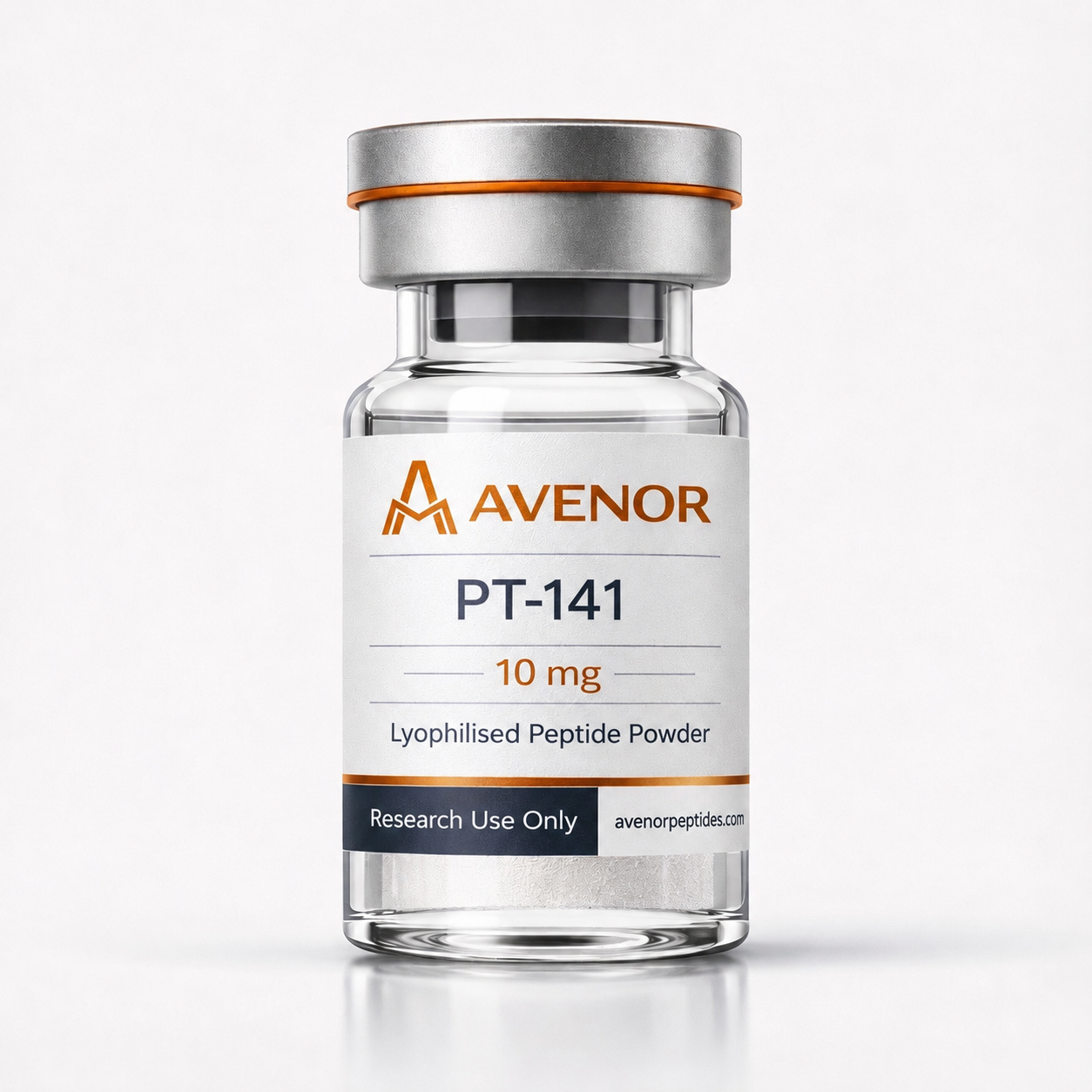
    PT-141 10 mg - Avenor Peptides

    Skin & Hair

    PT-141

    Strength: 10 mg

    PT-141 is a research-use catalogue item organized around product identity, SKU traceability and available documentation.

    €40,00
    In stock
    1

    The more products, the bigger the discount

    2 → −5%
    3 → −8%
    4 → −11%
    5+ → −15%
    across your whole basket, automatically
    Batch documentationShips from Greece

    Free shipping: Greece from €50, Cyprus and Bulgaria from €100, France, Germany, Italy, Belgium, Netherlands and Spain from €200. Details

    This product is intended exclusively for laboratory research use. It is not intended for human consumption, diagnosis, treatment, or prevention of disease.

    Product information

    FormResearch product
    Strength10 mg
    SKUAV-PT-10MG
    Stock statusIn stock
    COA / BatchSee the documentation state below
    StorageIn powder form: freezer (−20°C).
    Packaging / shippingProtective professional shipping packaging with clear labelling.

    Documentation on request

    There is no published document for this specific SKU variant at the moment.

    Contact us about documentation

    Research overview

    Documentation & COA

    Batch documentation and COA, where available, are linked to the specific product batch and SKU.

    This product is intended exclusively for laboratory research use. It is not intended for human consumption, diagnosis, treatment, or prevention of disease.

    Product profile

    7

    amino acids — a cyclic heptapeptide

    MC3R / MC4R

    principal melanocortin receptors activated

    2019

    year of FDA approval as Vyleesi (regulatory fact)

    ≥98%

    purity by HPLC

    Research context

    What it is

    PT-141, also known as bremelanotide, is a cyclic peptide of seven amino acids.

    It is derived from a natural hormone, α-MSH, modified to be stable and active.

    It is one of the few molecules in this class to reach formal approval.

    The technical detail

    A cyclic heptapeptide, analogue of α-MSH; trade name Vyleesi, approved by the FDA in 2019 for low sexual desire.

    How it works

    Most familiar molecules for sexual function work on blood flow.

    This one works somewhere else: the brain.

    It activates melanocortin receptors that sit inside the circuits of desire and reward.

    The technical detail

    An agonist of the MC3R and MC4R melanocortin receptors; MC4R is expressed on dopamine neurons of the ventral tegmental area (Borland et al., 2025).

    What the studies showed

    The first controlled phase 2b studies showed a statistically significant improvement over placebo.

    They became the basis for the large registration trials.

    7

    amino acids (cyclic)

    2019

    FDA approval

    desire + arousal

    improved, meta-analysis 2025

    In the 2025 meta-analysis, bremelanotide improved the total sexual function index and both the desire and arousal subscales, while reducing related distress.

    How it compares

    Molecules acting on blood vessels raise blood flow. They do not touch desire.

    PT-141 starts from the other end — from the signal in the brain.

    Research in 2025 mapped its action onto melanocortin receptors on dopamine reward neurons, where motivation is born.

    The technical detail

    The precise central circuit is still being mapped; Borland et al. (2025) found MC4R on VTA dopamine neurons but no effect on a reward test in hamsters.

    Laboratory use

    Used in a controlled laboratory setting for identity and purity confirmation by HPLC and mass spectrometry, for stability studies of both the lyophilized and the reconstituted material across temperatures, and for in vitro binding and activation assays in cell lines expressing melanocortin receptors (MC1R through MC5R), often as a comparator against other α-MSH analogs.

    Research Use Only. For laboratory research exclusively. Not intended for human or veterinary use, diagnosis, treatment, or disease prevention. The reference to regulatory approval concerns a separate, approved pharmaceutical product and does not constitute an indication for use of this material.

    Structural data

    Sequence
    Ac-Nle-cyclo[Asp-His-D-Phe-Arg-Trp-Lys]-OH
    Molecular formula
    C50H68N14O10
    Molecular weight
    1025.2 g/mol
    CAS number
    189691-06-3
    Class
    Synthetic analog of α-MSH (melanocyte-stimulating hormone) — melanocortin receptor agonist
    Relationship to Melanotan II
    It is the principal active metabolite of Melanotan II (a deaminated derivative)
    Product form
    10 mg lyophilized powder in a sealed vial — requires reconstitution
    Purity
    ≥98% (HPLC) — supplied with CoA

    Comparison

    Feature comparison

    FeaturePT-141 / Bremelanotide (this product)Melanotan II
    Chemical familyCyclic heptapeptide, α-MSH analogCyclic heptapeptide, α-MSH analog
    Chemical relationshipPrincipal active metabolite of Melanotan IIParent molecule
    Receptor selectivityRelatively greater activity at MC3R and MC4RBroad non-selective agonist across MC1R–MC5R
    MC1R activity (pigmentation)Weaker — pigmentation reported as rare and focalStrong — pigmentation is the principal effect studied
    Focus of the literatureCentral melanocortin pathways in the brainMelanogenesis and peripheral MC1R effects
    Regulatory statusFDA-approved in 2019 as VyleesiNot approved by any regulatory authority
    Catalog form10 mg lyophilized powderLyophilized powder

    Storage & handling

    • Store the sealed lyophilized vial at -20 °C for long-term storage; it is stable at room temperature for short shipping intervals.
    • Allow the vial to reach room temperature before opening, to prevent moisture condensing onto the powder.
    • Reconstitute with bacteriostatic or sterile water, adding it slowly down the wall of the vial; swirl gently and do not shake, as vigorous agitation can denature the peptide.
    • After reconstitution, store the solution at 2–8 °C (refrigerated) and protect it from light.
    • Avoid repeated freeze–thaw cycles; dividing into smaller aliquots before freezing is preferable.
    • Use aseptic technique when handling, with gloves and a clean surface or laminar flow hood.
    • Keep away from children, out of food preparation areas, and clearly labelled as research-use-only material.

    Documentation

    • Certificate of Analysis (CoA) per batch, with date and lot number.
    • Purity analysis by HPLC — specification ≥98%.
    • Identity and molecular weight confirmation by mass spectrometry.
    • Confirmation of peptide content per vial (nominally 10 mg).
    • Research Use Only (RUO) declaration on the packaging and accompanying documents.
    • Documents available on request for the specific batch you received.

    References

    References & documentation

    1. 1.Kingsberg S.A. et al. (2019). Bremelanotide for the Treatment of Hypoactive Sexual Desire Disorder: Two Randomized Phase 3 Trials. Obstet Gynecol, 134(5), 899-908.
    2. 2.Simon J.A. et al. (2019). Long-Term Safety and Efficacy of Bremelanotide for Hypoactive Sexual Desire Disorder. Obstet Gynecol, 134(5), 909-917.
    3. 3.Dhillon S. and Keam S.J. (2019). Bremelanotide: First Approval. Drugs, 79(14), 1599-1606.
    4. 4.Clayton A.H. et al. (2016). Bremelanotide for female sexual dysfunctions in premenopausal women: a randomized, placebo-controlled dose-finding trial. Womens Health (Lond), 12(3), 325-337.
    5. 5.Clayton A.H. et al. (2022). Safety Profile of Bremelanotide Across the Clinical Development Program. J Womens Health (Larchmt), 31(2), 171-182.
    6. 6.Ückert S. et al. (2014). Melanocortin receptor agonists in the treatment of male and female sexual dysfunctions: results from basic research and clinical studies. Expert Opin Investig Drugs, 23(11), 1477-1483.
    7. 7.White W.B. et al. (2017). Usefulness of ambulatory blood pressure monitoring to assess the melanocortin receptor agonist bremelanotide. J Hypertens, 35(4), 761-768.
    8. 8.Aughton K.L. et al. (2008). Pharmacological profiling of neuropeptides on rabbit vaginal wall and vaginal artery smooth muscle in vitro. Br J Pharmacol, 155(2), 236-243.
    9. 9.Cipriani S. et al. (2022). An evaluation of bremelanotide injection for the treatment of hypoactive sexual desire disorder. Expert Opin Pharmacother, 24(1), 15-21.

    Product information

    Frequently asked questions

    What exactly is PT-141 at the chemical level?
    It is a cyclic heptapeptide — seven amino acids joined into a ring — and a synthetic analog of the natural hormone α-MSH. Its molecular weight is approximately 1,025 g/mol and its CAS number is 189691-06-3. The cyclic structure makes it more resistant to enzymatic breakdown than a linear peptide would be.
    Where does the molecule act — the nervous system or the vascular system?
    The literature classifies it among centrally acting agents, working through the MC3 and MC4 melanocortin receptors in the central nervous system. This is its key point of difference from phosphodiesterase type 5 inhibitors, which act peripherally on blood vessels. Aughton et al. (2008) found that bremelanotide did not relax rabbit vascular preparations at the concentration tested, while α-MSH did.
    What does the FDA approval mean?
    In 2019 the US FDA approved bremelanotide under the trade name Vyleesi, following a clinical program of 43 studies. This is stated purely as a regulatory fact indicating the depth of scrutiny the molecule received. It is not a recommendation of use and does not apply to this product, which is supplied only as a research material.
    How is it related to Melanotan II?
    PT-141 is the principal active metabolite of Melanotan II — the molecule Melanotan II is converted into. They belong to the same melanocortin family but differ in receptor selectivity: Melanotan II is a broad non-selective agonist with strong activity at the pigmentation-related MC1R, whereas PT-141 leans toward the central MC3 and MC4 receptors.
    What scale of research sits behind this molecule?
    The clinical program comprised 43 completed studies and roughly 3,500 participants in total. The two Phase 3 RECONNECT trials randomized 1,267 participants, and the open-label extension ran 52 weeks with 684 participants. That is unusually extensive documentation for a compound in this category.
    What were the main tolerability findings recorded?
    In the pooled analysis by Clayton et al. (2022), the most common adverse events were nausea (40.0% versus 1.3% on placebo), flushing (20.3%) and headache (11.3%). Small transient blood pressure increases (2.4–3.2 mmHg) were also recorded on 24-hour ambulatory monitoring, along with focal hyperpigmentation after prolonged consecutive dosing.
    How does storage differ from a capsule product?
    Substantially. This is a lyophilized powder in a vial, not a ready-to-use form. It requires storage at -20 °C before opening, reconstitution with bacteriostatic or sterile water, and refrigeration at 2–8 °C afterwards. Repeated freeze–thaw cycles should be avoided.
    Do I receive a certificate of analysis?
    Yes. Every batch is accompanied by a CoA with HPLC analysis (specification ≥98%) and identity confirmation by mass spectrometry. It is available on request for the specific batch you received.
    Can it be used by humans or animals?
    No. The product is supplied exclusively for laboratory research. It is not a pharmaceutical preparation, it is not intended for human or veterinary use, and no dosages or administration instructions are provided. The existence of an approved medicine containing the same active substance does not change the status of this product.