
Free shipping — the threshold depends on the destination country, confirmed at checkout.

    Research Use Only (RUO). For laboratory research only. Not for human or veterinary use.

    Research Use Only (RUO):Research classification with product and batch documentation where available.
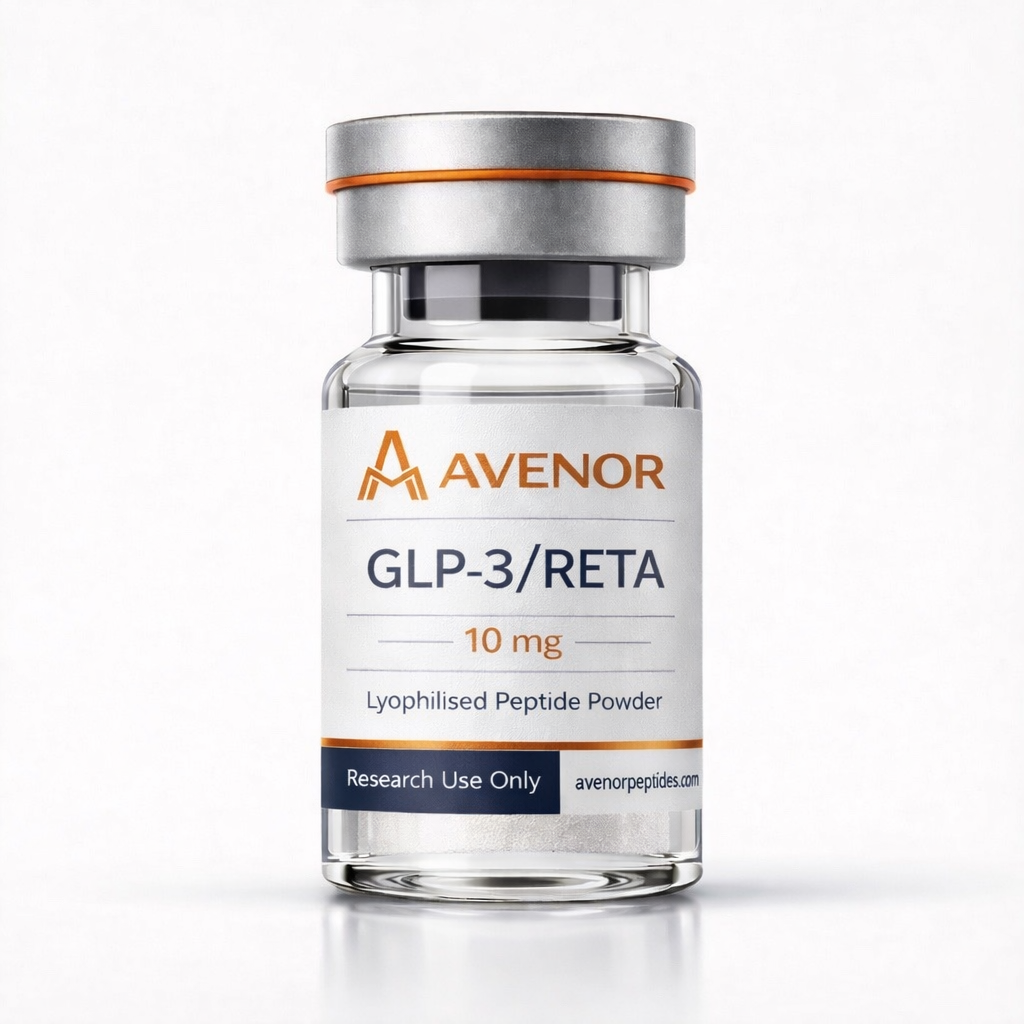
    GLP-3/Reta 10 mg - Avenor Peptides

    Weight & Metabolism

    GLP-3/Reta

    Strength: 10 mg

    GLP-3/Reta is a research-use catalogue item organized around product identity, SKU traceability and available documentation.

    €105,00
    In stock
    Published independent analysis for this batch
    1

    The more products, the bigger the discount

    2 → −5%
    3 → −8%
    4 → −11%
    5+ → −15%
    across your whole basket, automatically
    Batch documentationShips from GreeceVerified purity

    Free shipping: Greece from €50, Cyprus and Bulgaria from €100, France, Germany, Italy, Belgium, Netherlands and Spain from €200. Details

    This product is intended exclusively for laboratory research use. It is not intended for human consumption, diagnosis, treatment, or prevention of disease.

    Product information

    FormResearch product
    Strength10 mg
    SKUAV-RETA-10MG
    Stock statusIn stock
    COA / BatchSee the documentation state below
    StorageIn powder form: freezer (−20°C).
    Packaging / shippingCareful shipping with clear labelling.

    Independent Avenor testing

    Published documentation for this specific SKU variant.

    View document
    Batch
    Not set
    Test date
    22 Jul 2026
    Method
    HPLC

    Research overview

    Documentation & COA

    Batch documentation and COA, where available, are linked to the specific product batch and SKU.

    This product is intended exclusively for laboratory research use. It is not intended for human consumption, diagnosis, treatment, or prevention of disease.

    Latest literature review: cardiovascular biomarkers

    Laboratory analysis: what products contain

    Product profile

    3

    receptors in a single molecule — GIP, GLP-1, glucagon

    -24.2%

    change in body weight at 48 weeks, highest Phase 2 arm (Jastreboff, 2023)

    -81.4%

    change in liver fat at 24 weeks, 8 mg arm (Sanyal, 2024)

    Phase 3

    stage of clinical development — programme running since 2023

    Research context

    What it is

    Retatrutide is a synthetic peptide. It mimics three hormones at once — not one, not two.

    Every earlier generation in this family targeted fewer receptors. This is the first to press all three together.

    That is where its whole difference lies.

    The technical detail

    Development code LY3437943, Eli Lilly. A triple agonist of the GIP, GLP-1, and glucagon receptors.

    How it works

    Picture three levers in metabolism.

    The first regulates insulin and talks to the brain about appetite. The second acts on fat tissue and the pancreas.

    The third is the new part. Rather than only cutting intake, it raises energy expenditure and mobilises fat stored inside the liver.

    Older molecules pulled one or two levers. This one works all three.

    The technical detail

    Glucagon receptor agonism increases energy expenditure and hepatic fat oxidation (Neff et al., Diabetes Obes Metab review, 2025).

    What the studies showed

    Two waves of data. A phase 2 trial in 2023 and a phase 3 trial in 2026.

    Both placed the molecule against placebo.

    338

    participants, NEJM 2023

    −24.2%

    weight at 48 weeks

    537

    participants, Lancet 2026

    −15.3%

    weight, type 2 diabetes

    In the 2023 trial, on the highest arm 83% of participants lost more than 15% of body weight by 48 weeks, against 2% on placebo.

    The reduction was dose-dependent and was still climbing at the end of the study.

    How it compares

    The −24.2% figure at 48 weeks is among the largest recorded for any injectable in this class.

    Single- and dual-receptor molecules usually stop lower. The third lever appears to count.

    In type 2 diabetes, the 2026 phase 3 trial (TRANSCEND-T2D-1) showed a fall in glycated haemoglobin of up to −1.94% as monotherapy, alongside weight loss.

    The technical detail

    No published head-to-head randomised comparison of retatrutide against tirzepatide or semaglutide exists yet.

    Laboratory use

    Used in a controlled laboratory setting for identity and purity confirmation by HPLC and mass spectrometry, for stability and reconstitution studies, and for in vitro research in cell lines expressing the GIPR, GLP-1R and GCGR receptors — typically cAMP signaling assays and comparative receptor-by-receptor binding affinity determination.

    Research Use Only. A preclinical/research compound with no regulatory approval in any jurisdiction. Not intended for human or veterinary use, diagnosis, treatment, or disease prevention.

    Structural data

    Code name
    LY3437943
    Class
    Synthetic peptide analog — triple receptor agonist
    Target receptors
    GIPR (glucose-dependent insulinotropic polypeptide), GLP-1R (glucagon-like peptide 1), GCGR (glucagon)
    Structure
    A single peptide chain — one molecular entity, not a mixture of three substances
    Pharmacokinetic profile
    Half-life consistent with once-weekly dosing in the published trials
    Original developer
    Eli Lilly and Company
    Product form
    Lyophilized powder in a vial
    Purity
    ≥98% (HPLC) — supplied with CoA

    Comparison

    Feature comparison

    FeatureRetatrutideTirzepatideSemaglutide
    Receptors activatedThree — GIP, GLP-1, glucagonTwo — GIP, GLP-1One — GLP-1
    GenerationThird (triple agonist)Second (dual agonist)First (single agonist)
    Glucagon armYes — the defining differenceNoNo
    Largest weight reduction in published trials-24.2% at 48 wks (Phase 2)up to -22.5% (Phase 3)-15% to -17% (Phase 3)
    Development stageInvestigational — Phase 3Completed Phase 3 programmeCompleted Phase 3 programme
    Liver fat dataYes — dedicated Phase 2a substudyYesYes
    Volume of literatureLimited — newer compoundExtensiveVery extensive

    Storage & handling

    • Store the lyophilized powder frozen and protected from light.
    • Allow the sealed vial to reach room temperature before opening, to avoid moisture condensation.
    • After reconstitution, keep refrigerated and use within the window defined by the laboratory's protocol.
    • Avoid repeated freeze-thaw cycles, which degrade peptide integrity.
    • Keep away from children and out of food preparation areas.

    Documentation

    • Certificate of Analysis (CoA) per batch, with date and lot number.
    • Purity analysis by HPLC — specification ≥98%.
    • Identity confirmation by mass spectrometry.
    • Research Use Only (RUO) declaration on the packaging.
    • Documents available on request for the specific batch you received.

    References

    References & documentation

    1. 1.Jastreboff A.M. et al. (2023). Triple-Hormone-Receptor Agonist Retatrutide for Obesity — A Phase 2 Trial. N Engl J Med, 389(6), 514-526.
    2. 2.Rosenstock J. et al. (2023). Retatrutide, a GIP, GLP-1 and glucagon receptor agonist, for people with type 2 diabetes: a randomised, double-blind, placebo and active-controlled, parallel-group, phase 2 trial conducted in the USA. Lancet, 402(10401), 529-544.
    3. 3.Sanyal A.J. et al. (2024). Triple hormone receptor agonist retatrutide for metabolic dysfunction-associated steatotic liver disease: a randomized phase 2a trial. Nat Med, 30(7), 2037-2048.
    4. 4.Xie Z. et al. (2024). Seven glucagon-like peptide-1 receptor agonists and polyagonists for weight loss in patients with obesity or overweight: an updated systematic review and network meta-analysis of randomized controlled trials. Metabolism, 161, 156038.
    5. 5.Abdrabou Abouelmagd A. et al. (2025). Efficacy and safety of retatrutide, a novel GLP-1, GIP, and glucagon receptor agonist for obesity treatment: a systematic review and meta-analysis of randomized controlled trials. Proc (Bayl Univ Med Cent), 38(3), 291-303.
    6. 6.Kaur M. and Misra S. (2024). A review of an investigational drug retatrutide, a novel triple agonist agent for the treatment of obesity. Eur J Clin Pharmacol, 80(5), 669-676.

    Category comparison

    Not sure which GLP-1 to choose?

    See the comparison

    Product information

    Frequently asked questions

    What does "triple agonist" actually mean?
    It means a single molecule binds and activates three different receptors: GIP, GLP-1 and glucagon. It is not a blend of three substances but one peptide chain engineered to fit all three. The literature calls it a triple hormone receptor agonist.
    Why is adding glucagon considered so significant?
    Because it is the component absent from every earlier compound in the class. Glucagon relates to energy expenditure and hepatic fat metabolism, and investigators connect that mechanism to the liver fat findings in the Nature Medicine study (Sanyal et al., 2024).
    How does it compare with tirzepatide and semaglutide?
    The core difference is numerical: three receptors versus two for tirzepatide and one for semaglutide. In the network meta-analysis by Xie et al. (2024), retatrutide ranked first for both body weight and waist circumference reduction, with tirzepatide second. See the comparison table above.
    Are there head-to-head trials against the other two?
    No. This is a genuine gap in the literature and Doggrell (2023) flags it explicitly, calling it a major omission in the development programme. The existing comparisons are indirect, made through meta-analyses rather than direct head-to-head trials.
    What stage of clinical development is it at?
    Phase 3. The programme started in August 2023 according to the review by Kaur and Misra (2024). All data published to date come from Phase 1 and Phase 2; no Phase 3 results have been released.
    What data exist on liver fat?
    One Phase 2a substudy in 98 participants with metabolic dysfunction-associated steatotic liver disease (Sanyal et al., Nature Medicine, 2024). At 24 weeks the mean relative change in liver fat was -81.4% in the 8 mg arm versus +0.3% on placebo. That is a small sample over a short window.
    What adverse events were recorded in the trials?
    Mainly gastrointestinal — nausea, diarrhea, vomiting — dose-related and mostly mild to moderate. Dose-dependent increases in heart rate peaking at 24 weeks were also recorded. Meta-analyses found no statistically significant difference in overall adverse events versus placebo.
    Can it be used by humans or animals?
    No. Retatrutide is an investigational compound with no marketing authorization anywhere. The product is supplied exclusively for laboratory research and is not intended for human or veterinary use, nor for in vivo application outside a controlled laboratory setting.