Free shipping — the threshold depends on the destination country, confirmed at checkout.

    Research Use Only (RUO). For laboratory research only. Not for human or veterinary use.

    Research Use Only (RUO):Research classification with product and batch documentation where available.
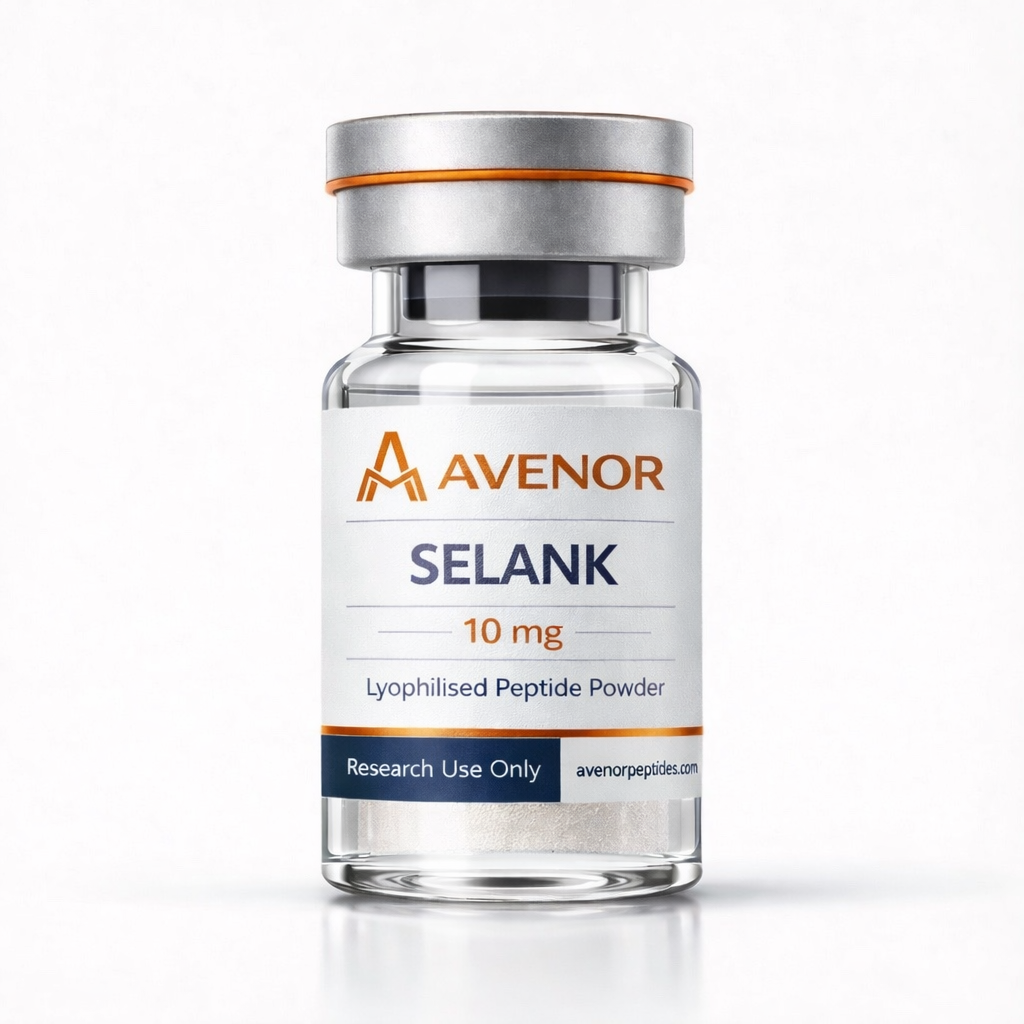
    Selank 10 mg - Avenor Peptides

    Energy & Mind

    Selank

    Strength: 10 mg

    Selank is a research-use catalogue item organized around product identity, SKU traceability and available documentation.

    €44,00
    In stock
    1

    The more products, the bigger the discount

    2 → −5%
    3 → −8%
    4 → −11%
    5+ → −15%
    across your whole basket, automatically
    Batch documentationShips from Greece

    Free shipping: Greece from €50, Cyprus and Bulgaria from €100, France, Germany, Italy, Belgium, Netherlands and Spain from €200. Details

    This product is intended exclusively for laboratory research use. It is not intended for human consumption, diagnosis, treatment, or prevention of disease.

    Product information

    FormResearch product
    Strength10 mg
    SKUAV-SELANK-10MG
    Stock statusIn stock
    COA / BatchSee the documentation state below
    StorageIn powder form: freezer (−20°C).
    Packaging / shippingProtective professional shipping packaging with clear labelling.

    Documentation on request

    There is no published document for this specific SKU variant at the moment.

    Contact us about documentation

    Research overview

    Documentation & COA

    Batch documentation and COA, where available, are linked to the specific product batch and SKU.

    This product is intended exclusively for laboratory research use. It is not intended for human consumption, diagnosis, treatment, or prevention of disease.

    Product profile

    7

    amino acids — Thr-Lys-Pro-Arg-Pro-Gly-Pro

    4

    of them are the natural immunopeptide tuftsin

    ≈751.9

    g/mol molecular weight

    ≥98%

    purity by HPLC

    Research context

    What it is

    Selank is a synthetic peptide, built on a natural piece of the immune system.

    It was designed to keep a calming action, but to stay stable in the body far longer than the natural molecule.

    The technical detail

    An analogue of tuftsin, an immunoglobulin fragment. Amino acids added at its end protect it from rapid breakdown.

    How it works

    It acts like a volume dial, not a brake.

    It touches the system that calms the brain, without the sedation classic tranquillizers bring.

    It also appears to regulate a factor that supports memory.

    The technical detail

    Interaction with the GABAergic system and modulation of BDNF in the hippocampus and prefrontal cortex (Kolik et al.).

    What the research shows

    Most data are in animal models, with one imaging study in healthy humans.

    In a morphine-withdrawal model, the peptide cut the overall syndrome index by about 40%.

    39.6%

    withdrawal index drop

    52

    healthy, fMRI 2020

    tactile sensitivity threshold

    In the human functional-MRI study, it shifted the connectivity between the amygdala and temporal cortex — regions that regulate anxiety.

    How it compares

    In the same withdrawal model, the peptide was placed directly beside a reference benzodiazepine.

    39.6%

    Selank

    vs

    49.3%

    Diazepam

    The finding is that it approached the benzodiazepine's effect, staying slightly below it.

    Where the research stands today

    Selank remains a molecule with a strong preclinical base and a small but interesting human signal.

    The fact that it works on the same system as tranquillizers, without their classic sedation, is exactly what keeps the research open.

    The technical detail

    Konstantinopolsky et al., morphine withdrawal, 2022. Panikratova et al., fMRI, 2020. Kolik et al., ethanol and BDNF, 2019.

    Laboratory use

    Used in a controlled laboratory setting for in vitro studies of allosteric modulation at GABA receptors using radioligand techniques, for analysis of inhibitory activity against plasma enkephalin-degrading enzymes, for gene expression and BDNF level work in cell systems and tissue homogenates, for comparative study against Semax and other glyproline-family peptides, and for identity and purity confirmation by HPLC and mass spectrometry.

    Research Use Only. For laboratory research exclusively. Not intended for human or veterinary use, diagnosis, treatment, or disease prevention. It is not a medicine and carries no therapeutic or psychiatric indication. It is not intended to address anxiety, mood disorders or any other condition, nor as a substitute for approved medical or psychiatric care. The research data referenced come from the published scientific literature, are presented for informational purposes, and do not constitute a claim of efficacy.

    Structural data

    Class
    Synthetic regulatory neuropeptide — an analogue of the immunopeptide tuftsin, from the glyproline family
    Sequence
    Thr-Lys-Pro-Arg-Pro-Gly-Pro (TKPRPGP)
    Chain length
    7 amino acids (a heptapeptide)
    Molecular formula
    C33H57N11O9
    Molecular weight
    ≈751.9 g/mol
    Structural origin
    The natural tetrapeptide tuftsin (Thr-Lys-Pro-Arg) with the tripeptide Pro-Gly-Pro added at the C-terminus
    Role of Pro-Gly-Pro
    A stabilising tail that slows enzymatic breakdown; the same tripeptide appears in Semax
    Degradation products
    Chiefly the peptides TKPRP, TKP, RP and GP (Zolotarev et al., 2006)
    Product form
    Lyophilized powder in a sealed vial
    Purity
    ≥98% (HPLC) — supplied with CoA

    Comparison

    Feature comparison

    FeatureSelank (this product)SemaxDSIP
    Parent moleculeTuftsin — a natural immunopeptide from the immunoglobulin moleculeACTH(4-10) — a fragment of adrenocorticotropic hormoneA peptide isolated from the cerebral blood of rabbits in delta sleep
    Chain length7 amino acids7 amino acids9 amino acids
    Shared structural elementPro-Gly-Pro tail at the C-terminusPro-Gly-Pro tail at the C-terminusNot part of the glyproline family
    Main axis of studyGABAergic system, enkephalinases, BDNFNeurotrophic factors, ischaemia, nootropic activitySleep regulation, stress, neuroprotection
    Research lineageRussian neuropeptide school (Institute of Molecular Genetics, RAS)Same school — the two are often studied side by sideWestern literature, from the 1970s onward
    Volume of international literatureLimited — a few dozen papers, mostly RussianLarger than Selank's, but also predominantly RussianOlder and more international, but with inconsistent findings
    Product formLyophilized powderLyophilized powderLyophilized powder

    Storage & handling

    • The sealed vial of lyophilized powder is stored frozen and protected from light.
    • Before opening, the vial is allowed to reach ambient temperature gradually, so that moisture does not condense onto the powder.
    • Reconstitution is performed with an appropriate sterile diluent, using gentle swirling rather than vigorous agitation — small peptides are sensitive to mechanical stress.
    • Once reconstituted, the solution is kept refrigerated and protected from light.
    • Avoid repeated freeze–thaw cycles, which degrade peptide integrity.
    • Handle using standard laboratory practice and appropriate personal protective equipment.
    • Keep away from children and out of food preparation areas.

    Documentation

    • Certificate of Analysis (CoA) per batch, with date and lot number.
    • Purity analysis by HPLC — specification ≥98%.
    • Identity and molecular weight confirmation by mass spectrometry.
    • Research Use Only (RUO) declaration on the packaging.
    • Documents available on request for the specific batch you received.

    References

    References & documentation

    1. 1.Zozulya A.A. et al. (2001). The inhibitory effect of Selank on enkephalin-degrading enzymes as a possible mechanism of its anxiolytic activity. Bull Exp Biol Med, 131(4), 315-317.
    2. 2.Sokolov O.Yu. et al. (2002). Effects of Selank on behavioral reactions and activities of plasma enkephalin-degrading enzymes in mice with different phenotypes of emotional and stress reactions. Bull Exp Biol Med, 133(2), 133-135.
    3. 3.Zolotarev Yu.A. et al. (2004). [Leu-enkephalin homogeneously labeled with tritium in studying the Selank inhibiting effect on the enkephalin-degrading enzymes of human plasma]. Bioorg Khim, 30(3), 234-240. (in Russian)
    4. 4.Inozemtseva L.S. et al. (2008). Intranasal administration of the peptide Selank regulates BDNF expression in the rat hippocampus in vivo. Dokl Biol Sci, 421, 241-243.
    5. 5.Zozulya A.A. et al. (2008). [Efficacy and possible mechanisms of action of a new peptide anxiolytic selank in the therapy of generalized anxiety disorders and neurasthenia]. Zh Nevrol Psikhiatr Im S S Korsakova, 108(4), 38-48. (in Russian; PMID 18454096)
    6. 6.Medvedev V.E. et al. (2015). [Optimization of the treatment of anxiety disorders with selank]. Zh Nevrol Psikhiatr Im S S Korsakova, 115(6), 33-40. (in Russian)
    7. 7.Volkova A. et al. (2016). Selank Administration Affects the Expression of Some Genes Involved in GABAergic Neurotransmission. Front Pharmacol, 7, 31.
    8. 8.Filatova E. et al. (2017). GABA, Selank, and Olanzapine Affect the Expression of Genes Involved in GABAergic Neurotransmission in IMR-32 Cells. Front Pharmacol, 8, 89.
    9. 9.Kasian A. et al. (2017). Peptide Selank Enhances the Effect of Diazepam in Reducing Anxiety in Unpredictable Chronic Mild Stress Conditions in Rats. Behav Neurol, 2017, 5091027.
    10. 10.Povarov I.S. et al. (2017). Effect of Selank on Spontaneous Synaptic Activity of Rat Hippocampal CA1 Neurons. Bull Exp Biol Med, 162(5), 640-642.
    11. 11.Vyunova T.V. et al. (2018). Peptide-based Anxiolytics: The Molecular Aspects of Heptapeptide Selank Biological Activity. Protein Pept Lett, 25(10), 914-923.
    12. 12.Kolik L.G. et al. (2019). Selank, Peptide Analogue of Tuftsin, Protects Against Ethanol-Induced Memory Impairment by Regulating of BDNF Content in the Hippocampus and Prefrontal Cortex in Rats. Bull Exp Biol Med, 167(5), 641-644.
    13. 13.Vanhee C. et al. (2020). The occurrence of putative cognitive enhancing research peptides in seized pharmaceutical preparations. Drug Test Anal, 12(3), 371-381.
    14. 14.Panikratova Ya.R. et al. (2020). Functional Connectomic Approach to Studying Selank and Semax Effects. Dokl Biol Sci, 490(1), 9-11.
    15. 15.Doyno C.R. & White C.M. (2021). Sedative-Hypnotic Agents That Impact Gamma-Aminobutyric Acid Receptors: Focus on Flunitrazepam, Gamma-Hydroxybutyric Acid, Phenibut, and Selank. J Clin Pharmacol, 61(Suppl 2), S114-S128.
    16. 16.Konstantinopolsky M.A. et al. (2022). Selank, a Peptide Analog of Tuftsin, Attenuates Aversive Signs of Morphine Withdrawal in Rats. Bull Exp Biol Med, 173(6), 730-733.

    Product information

    Frequently asked questions

    What exactly is tuftsin, and why was it used as the starting point?
    Tuftsin is a natural tetrapeptide (Thr-Lys-Pro-Arg) the body produces by cleaving a fragment from the immunoglobulin G molecule, known as an immunostimulant that activates macrophages. Its main drawback as a research tool is how fast it degrades. Adding Pro-Gly-Pro produced a more stable molecule: Selank.
    What is the relationship with Semax?
    Both were developed by the same Russian neuropeptide school and share the same stabilising Pro-Gly-Pro tail at the C-terminus. They differ in their parent molecule: Selank derives from tuftsin, Semax from the ACTH(4-10) fragment of adrenocorticotropic hormone. See the comparison table above.
    Why is the absence of benzodiazepine-type sedation considered interesting?
    Because it engages the same system by a different route. Vyunova and colleagues (2018) recorded positive allosteric modulator activity on GABA binding — the molecule does not occupy GABA's own site but alters the receptor's shape. The same work showed it can block the modulatory activity of diazepam, which implies the binding sites are not the same.
    What do the data show regarding enkephalins?
    Zozulya and colleagues (2001) found Selank inhibits plasma enkephalin hydrolysis with an IC50 of roughly 15 μM, more potently than bacitracin or puromycin. Zolotarev and colleagues (2004) showed the inhibition is more selective for carboxypeptidases than for aminopeptidases. So the molecule does not mimic enkephalins — it slows their breakdown.
    What do the data show regarding BDNF?
    Inozemtseva and colleagues (2008) recorded regulation of BDNF expression in the rat hippocampus after intranasal administration. Kolik and colleagues (2019) found that in rats on chronic ethanol intake, Selank prevented the ethanol-induced rise in BDNF in the hippocampus and frontal cortex — meaning the effect here is regulatory rather than a simple increase.
    Are there negative or contradictory findings?
    Yes, and they matter. Filatova and colleagues (2017) found no change at all in GABAergic gene mRNA levels in IMR-32 cells under Selank alone, contrasting with the findings of Volkova and colleagues (2016) in rat tissue. Povarov and colleagues (2017) also observed no statistically significant dose-dependence across the concentration range they tested.
    How strong is the international evidence base?
    Limited, and this should be stated plainly. Almost the entire literature comes from Russian research centres, much of it published in Russian, and independent replication by laboratories outside that network is essentially absent. Vanhee and colleagues (2020) noted that Selank and Semax have not completed clinical trials by international standards.
    Is there any human imaging data?
    One study. Panikratova and colleagues (2020) examined 52 healthy participants with resting-state functional MRI and recorded changes in functional connectivity between the right amygdala and the right temporal cortex. The authors themselves describe the finding as reported for the first time — meaning no other group has confirmed it.
    Can it be used by humans or animals?
    No. The product is supplied exclusively for laboratory research. It is not intended for human or veterinary use, nor for in vivo application outside a controlled laboratory setting. It is not a medicine, carries no therapeutic or psychiatric indication, and no administration or dosing guidance is provided.