
Free shipping — the threshold depends on the destination country, confirmed at checkout.

    Research Use Only (RUO). For laboratory research only. Not for human or veterinary use.

    Research Use Only (RUO):Research classification with product and batch documentation where available.
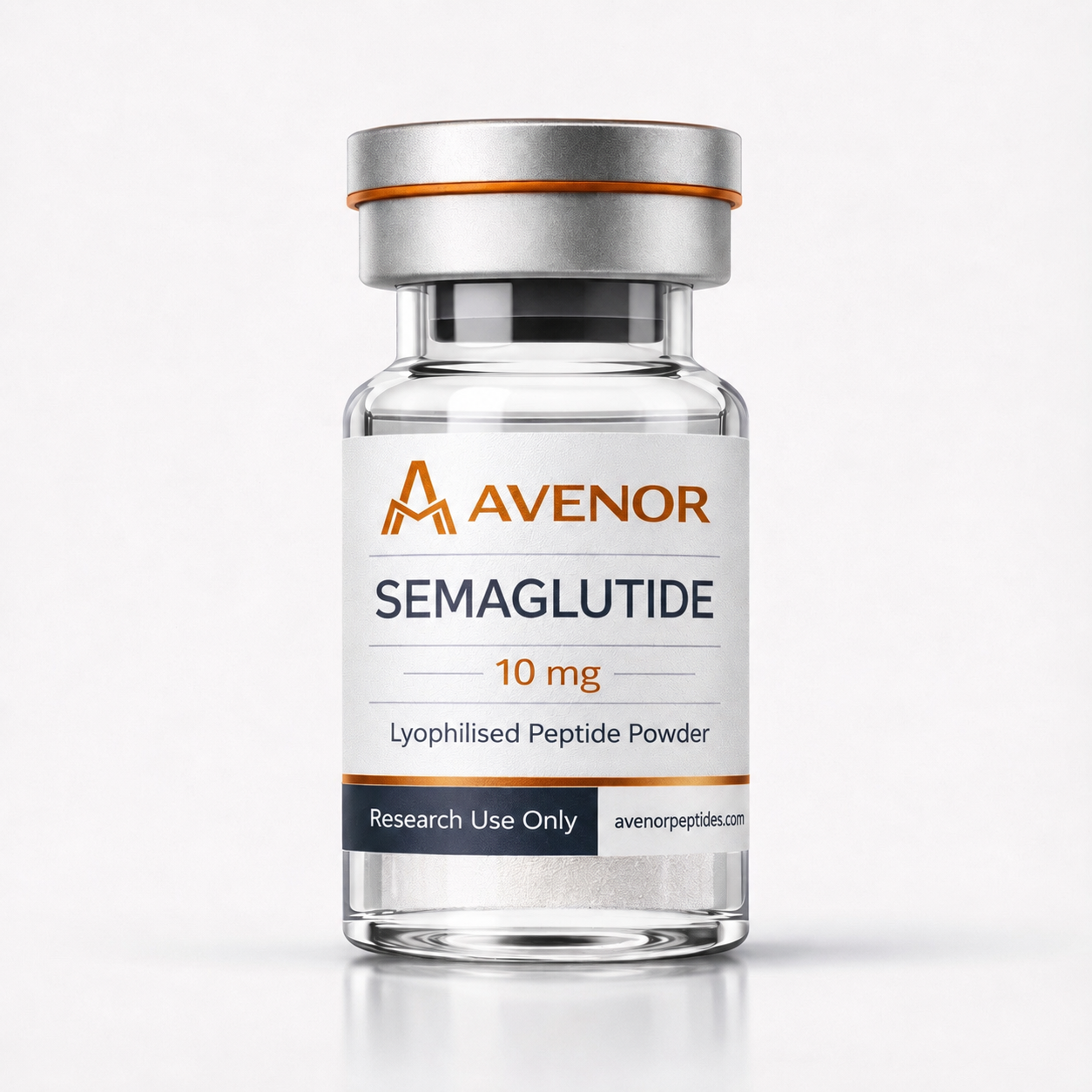
    Semaglutide 10 mg - Avenor Peptides

    Weight & Metabolism

    Semaglutide

    Strength: 10 mg

    Semaglutide is a research-use catalogue item organized around product identity, SKU traceability and available documentation.

    €65,00
    In stock
    1

    The more products, the bigger the discount

    2 → −5%
    3 → −8%
    4 → −11%
    5+ → −15%
    across your whole basket, automatically
    Batch documentationShips from Greece

    Free shipping: Greece from €50, Cyprus and Bulgaria from €100, France, Germany, Italy, Belgium, Netherlands and Spain from €200. Details

    This product is intended exclusively for laboratory research use. It is not intended for human consumption, diagnosis, treatment, or prevention of disease.

    Product information

    FormResearch product
    Strength10 mg
    SKUAV-SEMA-10MG
    Stock statusIn stock
    COA / BatchSee the documentation state below
    StorageIn powder form: freezer (−20°C).
    Packaging / shippingProtective professional shipping packaging with clear labelling.

    Documentation on request

    There is no published document for this specific SKU variant at the moment.

    Contact us about documentation

    Research overview

    Documentation & COA

    Batch documentation and COA, where available, are linked to the specific product batch and SKU.

    This product is intended exclusively for laboratory research use. It is not intended for human consumption, diagnosis, treatment, or prevention of disease.

    Product profile

    31

    amino acids — an analogue of human GLP-1

    0.38 nM

    GLP-1 receptor binding affinity (Lau et al., 2015)

    17,604

    participants in the largest published trial (SELECT, 2023)

    ≥98%

    purity by HPLC — CoA supplied per batch

    Research context

    What it is

    Semaglutide is a synthetic peptide. It mimics a hormone the gut releases after every meal.

    It is one of the most studied molecules in its class worldwide, with data from tens of thousands of participants.

    The technical detail

    A GLP-1 analogue, modified to resist enzymatic breakdown and act for days. Belongs to the GLP-1 receptor agonist class.

    How it works

    Picture a switch the body presses naturally after eating.

    It regulates insulin release, slows how fast the stomach empties, and sends the brain a satiety signal.

    The result is lower food intake and steadier blood sugar.

    The technical detail

    Activation of the GLP-1 receptor in the pancreas, gut and hypothalamus. The effect on appetite is largely central.

    What the studies showed

    The trials are large, multicentre and placebo-controlled.

    One of them followed more than 17,000 people with cardiovascular disease.

    17,604

    SELECT, Lancet 2024

    751

    SURMOUNT-5, NEJM 2025

    −13.7%

    weight, 72 wks

    −13.0 cm

    waist circumference

    In SELECT, among participants with heart failure the risk of major cardiovascular events was lower by about 28%.

    How it compares

    One randomized trial put it directly against tirzepatide, in 751 people without diabetes, over 72 weeks.

    −13.7%

    Semaglutide

    vs

    −20.2%

    Tirzepatide

    This is one of the few times in peptide research where the comparison is a measurement, not an estimate.

    Where the research stands today

    Today semaglutide is a benchmark for the whole class.

    The cardiovascular benefit has been documented in a population of tens of thousands.

    Research in 2026 is already moving to the next step — how the effect is maintained and how the same action moves into a pill.

    The technical detail

    Deanfield et al., SELECT analysis, Lancet 2024. Aronne et al., SURMOUNT-5, NEJM 2025. ATTAIN-MAINTAIN (orforglipron), Nature Medicine 2026.

    Laboratory use

    Used in a controlled laboratory setting for identity and purity confirmation by HPLC and mass spectrometry, for stability studies of both the lyophilized material and the reconstituted solution, for in vitro GLP-1 receptor binding work in cell lines, and as a reference compound in comparative analyses against other incretin receptor agonists.

    Research Use Only. For laboratory research exclusively. Not intended for human or veterinary use, diagnosis, treatment, or disease prevention. The clinical data referenced concern approved pharmaceutical products and do not transfer to research-grade material.

    Structural data

    Sequence
    His-Aib-Glu-Gly-Thr-Phe-Thr-Ser-Asp-Val-Ser-Ser-Tyr-Leu-Glu-Gly-Gln-Ala-Ala-Lys-Glu-Phe-Ile-Ala-Trp-Leu-Val-Arg-Gly-Arg-Gly (Lys26 carries a C18 fatty diacid side chain via a γGlu/AEEA linker)
    Modifications vs native GLP-1
    Aib at position 8, Arg at position 34, acylation at Lys26 (Lau et al., 2015)
    Molecular formula
    C187H291N45O59
    Molecular weight
    4113.6 g/mol
    CAS number
    910463-68-2
    Class
    GLP-1 receptor agonist
    GLP-1 receptor affinity
    0.38 ± 0.06 nM (Lau et al., 2015)
    Product form
    Lyophilized powder in vial, 10 mg
    Purity
    ≥98% (HPLC) — supplied with CoA

    Comparison

    Feature comparison

    FeatureSemaglutide (this product)TirzepatideRetatrutide
    Receptors engagedGLP-1 (one)GIP + GLP-1 (two)GIP + GLP-1 + glucagon (three)
    Molecule generationSingle agonistDual agonistTriple agonist
    Volume of published dataLargest of the three — thousands of publicationsSubstantial, more recentSmallest — newest molecule
    Cardiovascular outcome dataPublished (SUSTAIN-6, SELECT)Ongoing at time of writingNot published
    Oral form studiedYes — gastric absorption with SNAC documentedNot in the literature reviewedNo
    Research contextGlucose metabolism, body weight, cardiovascular endpointsGlucose metabolism and body weightMulti-receptor metabolic research, early stage
    Catalog formLyophilized vialLyophilized vialLyophilized vial

    Storage & handling

    • Store the lyophilized vial refrigerated and protected from light.
    • For extended storage, keeping the sealed vial frozen is preferred.
    • After reconstitution, keep the solution refrigerated and shielded from light.
    • Avoid repeated freeze–thaw cycles, which degrade peptide integrity.
    • Do not shake the vial vigorously during reconstitution — peptides are sensitive to mechanical stress.
    • Keep away from children and out of food preparation areas.

    Documentation

    • Certificate of Analysis (CoA) per batch, with date and lot number.
    • Purity analysis by HPLC — specification ≥98%.
    • Identity and molecular weight confirmation by mass spectrometry.
    • Research Use Only (RUO) declaration on the packaging.
    • Documents available on request for the specific batch you received.

    References

    References & documentation

    1. 1.Lau J. et al. (2015). Discovery of the Once-Weekly Glucagon-Like Peptide-1 (GLP-1) Analogue Semaglutide. J Med Chem, 58(18), 7370-7380.
    2. 2.Marso S.P. et al. (2016). Semaglutide and Cardiovascular Outcomes in Patients with Type 2 Diabetes (SUSTAIN-6). N Engl J Med, 375(19), 1834-1844.
    3. 3.Buckley S.T. et al. (2018). Transcellular stomach absorption of a derivatized glucagon-like peptide-1 receptor agonist. Sci Transl Med, 10(467).
    4. 4.Nauck M.A. et al. (2021). GLP-1 receptor agonists in the treatment of type 2 diabetes - state-of-the-art. Mol Metab, 46, 101102.
    5. 5.Wilding J.P.H. et al. (2021). Once-Weekly Semaglutide in Adults with Overweight or Obesity (STEP 1). N Engl J Med, 384(11), 989-1002.
    6. 6.Lincoff A.M. et al. (2023). Semaglutide and Cardiovascular Outcomes in Obesity without Diabetes (SELECT). N Engl J Med, 389(24), 2221-2232.

    Category comparison

    Not sure which GLP-1 to choose?

    See the comparison

    Product information

    Frequently asked questions

    What exactly is the GLP-1 receptor, and why does it matter?
    It is a protein on the cell surface that works like a lock: when the GLP-1 hormone binds to it, a cascade of intracellular signals fires. Semaglutide was engineered to fit that lock with an affinity of 0.38 nM — very tightly — while surviving in the bloodstream far longer than the natural hormone.
    Why isn't native GLP-1 studied directly?
    Because the enzyme DPP-4 cleaves it within minutes. Lau and colleagues (2015) substituted position 8 with Aib, a synthetic amino acid the enzyme does not recognize, and the molecule became stable.
    What does the fatty chain attached to the molecule actually do?
    It acts as an anchor. It binds the peptide to albumin, the most abundant plasma protein, so the kidneys cannot clear it quickly. The measured result was a 46.1-hour half-life in mini-pigs after intravenous administration.
    What is the real difference from tirzepatide and retatrutide?
    The number of receptors. Semaglutide engages the GLP-1 receptor only; tirzepatide engages two (GIP and GLP-1); retatrutide engages three (GIP, GLP-1 and glucagon). Semaglutide is the oldest of the three and carries the largest published evidence base. See the comparison table above.
    How large are the published trials?
    Very large for a molecule in this class. SUSTAIN-6 (Marso et al., 2016) enrolled 3,297 participants, STEP 1 (Wilding et al., 2021) enrolled 1,961, and SELECT (Lincoff et al., 2023) enrolled 17,604 with a mean follow-up approaching 40 months.
    Why is there research into an oral form if peptides are destroyed in the stomach?
    Because Buckley and colleagues (2018) showed that with the absorption enhancer SNAC, uptake happens in the stomach itself, in a narrow zone at the tablet surface where SNAC creates a locally protective pH environment. That is a different formulation from this product.
    Does the literature report negative findings too?
    Yes, and they are worth stating. SUSTAIN-6 recorded a significantly higher rate of retinopathy complications in the semaglutide arm, and in SELECT 16.6% of that group discontinued permanently due to adverse events versus 8.2% on placebo. The Nauck et al. (2021) review also notes that the effect on gastric emptying fades under chronic exposure.
    Can it be used by humans or animals?
    No. The product is supplied exclusively for laboratory research. It is not intended for human or veterinary use, nor for in vivo application outside a controlled laboratory setting. The clinical trial findings cited above concern approved pharmaceutical formulations under medical supervision and do not transfer to research-grade material.