Free shipping: Greece from €50, Cyprus and Bulgaria from €100, France, Germany, Italy, Belgium, Netherlands and Spain from €200. Details
This product is intended exclusively for laboratory research use. It is not intended for human consumption, diagnosis, treatment, or prevention of disease.
Product information
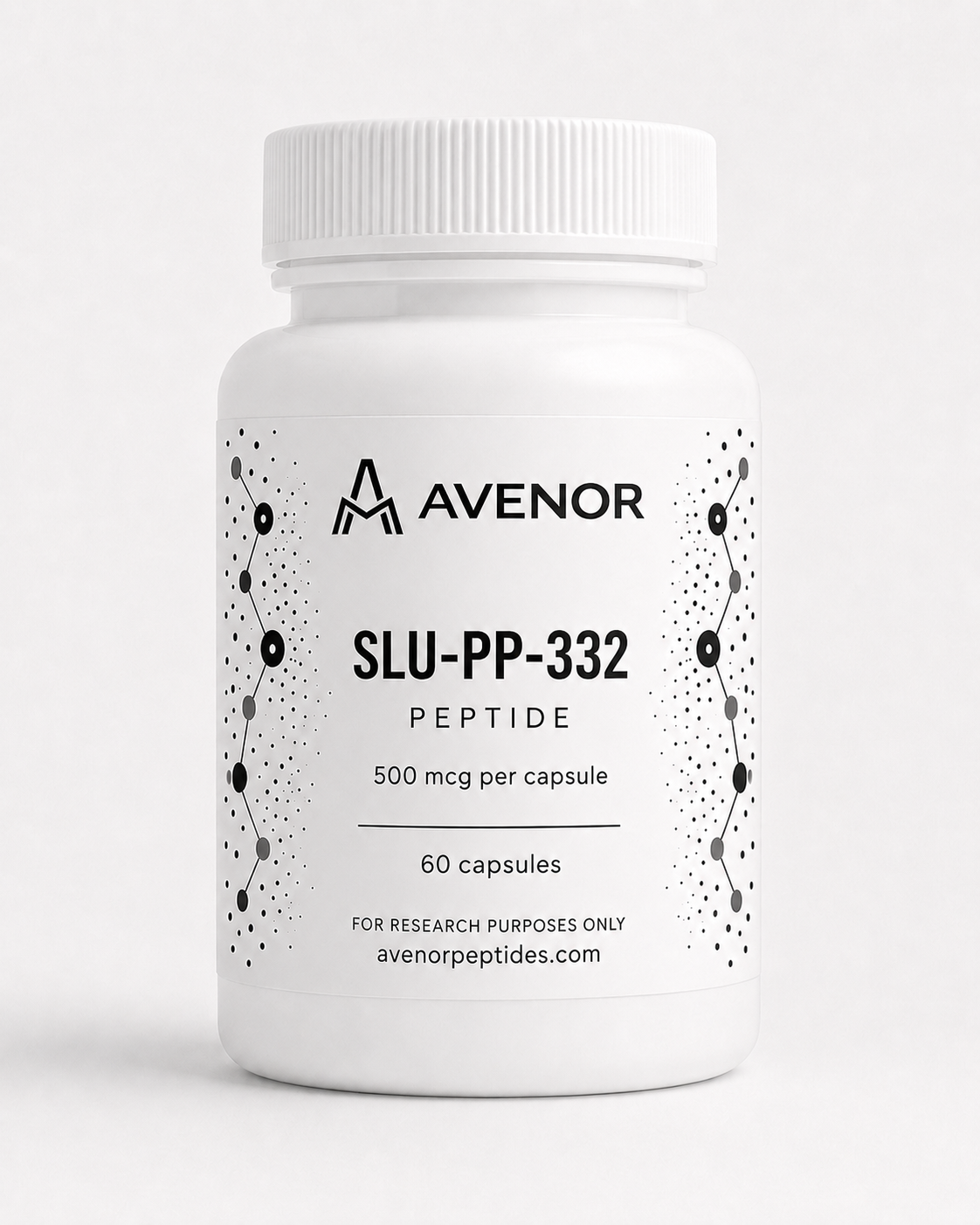
FormOral form
Strength500mcg X 60 capsules
SKUAVR-SLUPP332-500MCGX60CAPSULES
Stock statusIn stock
COA / BatchSee the documentation state below
StorageRefer to the label and available documentation details.
Packaging / shippingControlled shipping preparation according to the available SKU variant.
Documentation on request
There is no published document for this specific SKU variant at the moment.
Batch documentation and COA, where available, are linked to the specific product batch and SKU.
This product is intended exclusively for laboratory research use. It is not intended for human consumption, diagnosis, treatment, or prevention of disease.
Product profile
3
target receptors — ERRα, ERRβ and ERRγ (pan-agonist)
0
clinical trials in humans — none, anywhere
2023
year of the first full characterization paper
≥98%
purity by HPLC
Research context
01
What it is
SLU-PP-332 is not a peptide. It is a small synthetic molecule.
It belongs to a new idea: a molecule that tries to copy what exercise does to muscle, without the exercise itself.
The technical detail
A pan-agonist of the ERR receptors (ERRα/β/γ), with strongest activity at ERRα. Described as an exercise mimetic.
02
How it works
It targets a switch inside the muscle cell that aerobic effort normally flips on.
Once flipped, cells build more mitochondria and burn more fat for energy.
The gene program it turns on resembles that of an acute aerobic workout.
The technical detail
Activation of an ERRα-dependent transcriptional program, inducing genes such as Ddit4. It raises fatty-acid oxidation and oxidative type IIa muscle fibers.
03
What the research shows
All the data are in cells and mice. There are no human clinical studies yet.
In mice, the molecule increased endurance and reduced fat in obesity models.
3
ERR subtypes targeted
IIa
oxidative muscle fibers
2023
first described
In metabolic-syndrome models it improved insulin sensitivity and raised energy expenditure, without evident toxicity in the animals.
04
How it compares
The original molecule had a problem: it is poorly absorbed by mouth. So a successor was designed, SLU-PP-915.
injectable
SLU-PP-332
vs
oral
SLU-PP-915
The 915 reached a similar endurance gain to 332, but with oral bioavailability.
05
Where the research stands today
Work in 2025 and 2026 maps the molecule's chemistry and builds better versions.
It shows enough promise that anti-doping authorities have already developed detection methods for it — a sign the molecule is considered genuinely active.
The technical detail
Billon et al., original description, ACS Chem Biol 2023 and metabolic syndrome, JPET 2024. Okda et al., SAR, Int J Biol Macromol 2026. Möller et al., in vitro metabolism and doping, RCM 2026.
Laboratory use
Used in a controlled laboratory setting as a chemical probe for in vitro studies of ERRα, ERRβ and ERRγ activation, for analysis of transcriptional programmes and gene expression (RNA sequencing, qPCR on marker genes such as Ddit4), for studies of mitochondrial function and cellular respiration in cell lines, for genetic dependency work distinguishing the contribution of each ERR subtype, and as a reference standard in analytical chemistry and metabolite identification method development.
Research Use Only. For laboratory research exclusively. SLU-PP-332 is an early preclinical research compound. It holds NO approval from any regulatory authority, in any country, for any indication. There is NO clinical trial in humans and ZERO human safety data. It is not intended for human or veterinary use, diagnosis, treatment or disease prevention, nor for consumption in any form. All findings referenced derive from cell culture and laboratory animals and do not transfer to humans. No dosing or administration protocols are provided.
Structural data
Molecule class
Synthetic small molecule — NOT a peptide, and it has no peptide chain whatsoever
Molecular target
The orphan nuclear receptors ERRα, ERRβ, ERRγ (estrogen-related receptors) — a pan-agonist
Selectivity
Activates all three subtypes, with greatest potency at ERRα (Billon et al., 2023)
Origin
Produced by structure-based design; the principal group is that of Thomas Burris (Saint Louis University / Washington University / University of Florida)
Related molecule
SLU-PP-915 — a chemically distinct pan-ERR agonist from the same group, with oral bioavailability
Oral bioavailability
None; explicitly reported as lacking oral bioavailability (Billon et al., 2025)
Development stage
Early preclinical. Used in the literature as a chemical probe, not as a drug candidate in trials
Regulatory status
No approval from FDA, EMA, the Greek NOM or any other authority, in any indication
Anti-doping status
The exercise mimetic and metabolic modulator class is prohibited by WADA; detection methods for its metabolites have already been published (Avliyakulov et al., 2026)
Product form
Dry powder in a sealed vial
Purity
≥98% (HPLC) — supplied with CoA
Comparison
Feature comparison
Feature
SLU-PP-332 (this product)
MOTS-c
SS-31
Molecule type
Synthetic small molecule — not a peptide
A 16-amino-acid peptide encoded by mitochondrial DNA
A synthetic tetrapeptide
Molecular target
The ERRα/β/γ nuclear receptors
No single defined receptor target; acts on metabolic pathways
Cardiolipin in the inner mitochondrial membrane
Level of action
Transcriptional — it regulates which genes are expressed
Metabolic signalling
Structural/biophysical — membrane stabilization, no transcriptional action
Where the research stands
Early preclinical — zero human data
Preclinical, with limited human investigation
The most advanced of the three — studied in clinical trials
Maturity of the literature
A few dozen publications, all from 2023 onward
A larger body of literature
The most fully documented dataset
Product form
Dry powder
Lyophilized powder
Lyophilized powder
Storage & handling
The dry powder is stored at room temperature in a sealed container, away from light and moisture.
Keep in the original packaging until the point of laboratory use.
Avoid exposure to elevated temperature and to direct sunlight.
Avoid repeated exposure of the powder to ambient air — reseal the container immediately after use.
Handle using standard laboratory practice and appropriate personal protective equipment; this is a compound with no human toxicology data whatsoever and should be treated accordingly.
Keep away from children and out of food preparation areas.
Documentation
Certificate of Analysis (CoA) per batch, with date and lot number.
Purity analysis by HPLC — specification ≥98%.
Identity and molecular weight confirmation by mass spectrometry.
Research Use Only (RUO) declaration on the packaging.
Documents available on request for the specific batch you received.
It is a scientific term with a narrow meaning, and it is frequently misread. It means the molecule switches on a transcriptional programme — a set of genes — resembling the one activated after an aerobic exercise session in laboratory animals. The resemblance applies strictly at the level of gene expression. It does not mean the molecule substitutes for exercise, nor that it reproduces exercise's cardiovascular, skeletal, neural or psychological effects. Any broader reading of the term is not supported by the data.
Is there any human data?
No. No clinical trial, at any stage, anywhere. There is no Phase I study, no tolerability study, no pharmacokinetics in a human body and no human safety data at all. Every published finding comes from cell culture and from mice. The single paper using human material (Bonanni et al., 2025) concerns myoblasts in a dish, not administration to human beings.
Is it a peptide?
No. It is a synthetic small molecule, an organic compound with no amino acid chain of any kind. That separates it from most materials in this catalogue category and affects everything — from how it acts to how it is stored and handled in the laboratory.
What are the ERRs, and why are they called "orphan"?
The ERRs (estrogen-related receptors) are three nuclear receptors — ERRα, ERRβ, ERRγ — that regulate genes for mitochondrial biogenesis, oxidative phosphorylation and fatty acid oxidation. They are called "orphan" because no natural hormone activating them has been identified. Despite the name they do not bind estrogen; the resemblance to the estrogen receptor is structural, not functional.
Who discovered the molecule, and when?
It was produced by structure-based design in the group of Thomas Burris. The first full characterization paper is Billon and colleagues in ACS Chemical Biology, 2023. Essentially the entire primary literature dates from 2023 onward — this is a very young field.
What exactly did the animal studies show?
In mice, Billon and colleagues (2023) recorded an increase in type IIa oxidative muscle fibres and activation of a gene programme that depended on ERRα. Billon and colleagues (2024) in obesity models recorded increased energy expenditure and improved insulin sensitivity. Xu and colleagues (2024, Circulation) in a heart failure model recorded improved ejection fraction and reduced fibrosis, with ERRγ as the principal mediator. These are all animal findings and do not transfer to humans.
What is the difference from SLU-PP-915?
SLU-PP-915 is a chemically distinct pan-ERR agonist from the same research group. The main practical difference is bioavailability: Billon and colleagues (2025) state explicitly that SLU-PP-332 is not orally bioavailable, and SLU-PP-915 was designed precisely to close that gap.
How does it compare with MOTS-c and SS-31?
All three relate to mitochondrial metabolism, but they operate at entirely different levels. SS-31 is a tetrapeptide that binds cardiolipin and acts structurally on the mitochondrial membrane. MOTS-c is a peptide encoded by mitochondrial DNA. SLU-PP-332 is not a peptide and acts transcriptionally, inside the nucleus. They also differ dramatically in the maturity of their data — see the comparison table above.
Has it been approved anywhere?
No, nowhere. There is no approval from the FDA, EMA, the Greek NOM or any other regulatory authority, for any indication in any country. It is not a medicine, not a supplement, and not a drug candidate in clinical trials. It is a research chemical tool.
Can it be used by humans or animals?
No. The product is supplied exclusively for laboratory research. It is not intended for human or veterinary use, nor for in vivo application outside a controlled laboratory setting. No administration or dosing guidance is provided. Note also that WADA prohibits the exercise mimetic and metabolic modulator class, and detection methods for this molecule's metabolites have already been published.
Do I receive a certificate of analysis?
Yes. Every batch is accompanied by a CoA with HPLC analysis and mass spectrometry identity confirmation. It is available on request for the specific batch you received.