Free shipping — the threshold depends on the destination country, confirmed at checkout.
Research Use Only (RUO). For laboratory research only. Not for human or veterinary use.
Research Use Only (RUO):Research classification with product and batch documentation where available.
Muscle & Performance
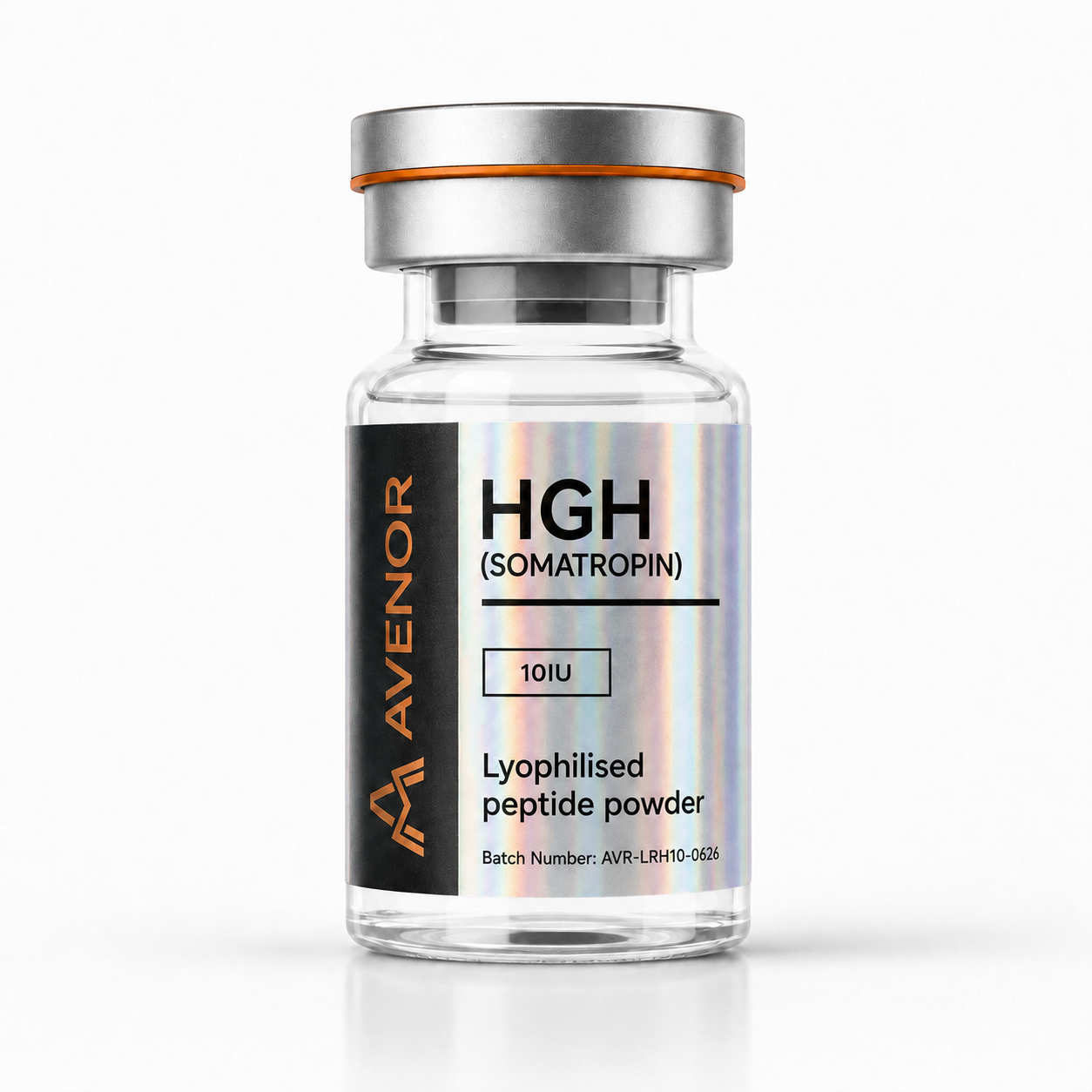
Somatropin (HGH)
Strength: 10 IU
Somatropin (HGH) is a research-use catalogue item organized around product identity, SKU traceability and available documentation.
€23,80€28,00
-15% off
Available to order
Estimated arrival: 01/10/2026 – 10/10/2026
Εκτιμώμενη Αποστολή 30-35 ημέρες
1
Batch documentationShips from Greece
Free shipping: Greece from €50, Cyprus and Bulgaria from €100, France, Germany, Italy, Belgium, Netherlands and Spain from €200. Details
This product is intended exclusively for laboratory research use. It is not intended for human consumption, diagnosis, treatment, or prevention of disease.
Product information
FormResearch product
Strength10 IU
SKUAV-HGH-10IU
Stock statusAvailable to order
COA / BatchSee the documentation state below
StorageIn powder form: freezer (−20°C).
Packaging / shippingProtective professional shipping packaging with clear IU labelling.
Documentation on request
There is no published document for this specific SKU variant at the moment.
Batch documentation and COA, where available, are linked to the specific product batch and SKU.
This product is intended exclusively for laboratory research use. It is not intended for human consumption, diagnosis, treatment, or prevention of disease.
Product profile
191
amino acids — single-chain protein, the 22 kDa form
1:2
stoichiometry — one hormone molecule, two receptor molecules
1985
the year cadaveric sourcing was withdrawn and recombinant material took over
≥98%
purity by HPLC
Research context
01
What it is
Somatropin is the recombinant form of human growth hormone.
It is identical to the hormone the pituitary produces, but it is made in a lab instead of being isolated from tissue.
The technical detail
A 191-amino-acid peptide, identical to endogenous GH. Produced with recombinant DNA technology (rhGH).
02
How it works
It works on two levels.
Directly, it speaks to cells about growth and metabolism.
Indirectly, it tells the liver to make a second messenger, which carries much of the growth message.
The technical detail
It activates the GH receptor. Much of its anabolic action is mediated by liver-produced IGF-1.
03
What the research shows
The established use is in documented growth hormone deficiency.
One striking finding: when children diagnosed with deficiency are retested later, many no longer meet the criteria.
191
amino acids
2,057
patients, 2026 review
46–70%
diagnosis reversed on retesting
This shows how hard the diagnosis itself is — and why the hormone only makes sense when the deficiency is real.
04
Status and safety
Somatropin is a prescription medicine, with approved indications and medical supervision.
It is also a prohibited doping substance, on the WADA list, banned at all times.
Unapproved uses — for anti-aging or athletic performance — are off-label and can cause serious adverse effects, as the 2026 review stresses.
The technical detail
Historically GH was isolated from cadaver pituitaries, carrying a risk of Creutzfeldt-Jakob disease; since the mid-1980s all clinical GH is recombinant. Lisbona-Buzali et al., Arch Med Res 2026; Vliegenthart et al., J Endocr Soc 2026.
Laboratory use
Used in a controlled laboratory setting for in vitro binding and activation studies at the GHR receptor, for analysis of JAK2-STAT5B signalling and the parallel Src/ERK route, for studies of IGF-1 expression induction in hepatocyte lines, for comparative work against molecules acting on the pituitary rather than the peripheral receptor, and for identity, integrity and purity confirmation by HPLC, SDS-PAGE and mass spectrometry.
Research Use Only. For laboratory research exclusively. Not intended for human or veterinary use, diagnosis, treatment, or disease prevention. Recombinant human growth hormone is a prescription medicine, approved only for specific medical indications and only under medical supervision, and appears on the World Anti-Doping Agency (WADA) prohibited list. The clinical data referenced concern approved pharmaceutical products and do not transfer to research-grade material. No dosing, protocols or administration guidance is provided, and nothing here constitutes medical advice or encouragement of use.
Structural data
Class
Recombinant human growth hormone (somatropin) — a protein, not a short synthetic peptide
Chain length
191 amino acids, single polypeptide chain
Molecular weight
≈22 kDa (the principal form; described in the literature as the "22K" form)
Secondary structure
A four-helix bundle with an unusual topology (de Vos et al., 1992)
Disulfide bonds
Two intramolecular disulfide bridges
Gene
GH1, chromosome 17
Receptor
GHR — a class I cytokine receptor that exists as a constitutive dimer in the membrane
Binding stoichiometry
One hormone molecule to two receptor molecules, via two dissimilar binding sites on the same hormone
Signalling pathway
JAK2 → STAT5B (principal), with Src/ERK activated in parallel
Natural variant
A 20 kDa form arising from deletion of residues 32-46 (Adelman et al., 1983)
Vial content
24 IU of lyophilized powder in a sealed vial
Purity
≥98% (HPLC) — supplied with CoA
Comparison
Feature comparison
Feature
HGH / Somatropin (this product)
CJC-1295 + Ipamorelin
Tesamorelin
What the molecule is
The hormone itself — a 191-amino-acid protein
Two short synthetic peptides used in combination
A synthetic analogue of growth hormone-releasing hormone (GHRH)
Fundamental difference in approach
The hormone is supplied — the pituitary is bypassed
The pituitary is prompted to release its own hormone
The pituitary is prompted via the GHRH receptor
Site of action
The GHR receptor on peripheral tissues
The GHRH receptor and the secretagogue receptor (GHSR) in the pituitary
The GHRH receptor in the pituitary
Pulsatile secretion pattern preserved
No — the profile is set by the exogenous molecule
Yes, on the working hypothesis — release stays under pituitary control
Yes, on the working hypothesis
Physiological negative feedback
Bypassed
Retained
Retained
Regulatory status
Prescription medicine; prohibited substance under WADA
No medicine approval; prohibited class under WADA
Approved medicine for a specific indication (FDA, 2010); prohibited substance under WADA
Maturity of the evidence
Decades of clinical and basic research; crystal structure solved in 1992
Limited published human data
Completed clinical trial programme for the approved indication
Product form
Lyophilized powder, injectable vial
Lyophilized powder
Lyophilized powder
Storage & handling
The sealed vial of lyophilized powder is stored refrigerated and protected from light.
This is a sensitive four-helix protein, not a small robust peptide — the structure denatures more readily.
Once reconstituted, the solution is kept refrigerated and not frozen; freezing can cause aggregation.
Avoid vigorous agitation or vortexing of the solution — mechanical stress and foaming denature the protein.
Mix reconstituted solution by gently swirling the vial, never by shaking.
Avoid repeated freeze–thaw cycles of the powder, which degrade the integrity of the molecule.
Avoid prolonged exposure to room temperature and to direct sunlight.
Handle using standard laboratory practice and appropriate personal protective equipment.
Keep away from children and out of food preparation areas.
Documentation
Certificate of Analysis (CoA) per batch, with date and lot number.
Purity analysis by HPLC — specification ≥98%.
Identity and molecular weight confirmation by mass spectrometry.
Research Use Only (RUO) declaration on the packaging.
Documents available on request for the specific batch you received.
What exactly is somatropin at the molecular level?
It is recombinant human growth hormone: a single-chain protein of 191 amino acids, roughly 22 kDa, folded into a four-helix bundle and stabilised by two disulfide bridges. It differs categorically from the synthetic 10-40 amino acid peptides that dominate this catalogue — it is a whole protein, not a peptide analogue.
How is the receptor activated?
de Vos, Ultsch and Kossiakoff (Science, 1992) showed crystallographically at 2.8 ångström that one hormone molecule binds two receptor molecules, through two sites that share no structural similarity with each other. Brooks and Waters (2010) subsequently established that the receptor already exists as a constitutive dimer; the hormone does not form it, it rearranges it.
What does JAK2 do after binding?
Brooks and colleagues (Science, 2014) described the mechanism in detail: the transmembrane helices shift from a parallel arrangement to a left-handed crossover, the JAK2 binding motifs separate, the inhibitory pseudokinase domain is withdrawn from the catalytic domain of the opposing JAK2, and the two kinases trans-activate. Phosphorylation of STAT5B and its translocation to the nucleus follow.
What is the relationship with IGF-1?
Part of the hormone's action is direct, at target tissues. The other part is indirect: STAT5B signalling in the liver induces transcription of IGF-1, which carries the signal to the periphery. That these really are two distinct arms is visible in Laron syndrome, where administering IGF-1 does not fully restore the picture because the direct actions are missing (Brooks & Waters, 2010).
Why does the 1985 history matter?
Until then the only source was the pituitary glands of the dead. In 1985 the first cases of Creutzfeldt-Jakob disease were diagnosed in recipients of cadaveric hormone. In the cohort of 5,570 US recipients, Abrams and colleagues (2011) recorded 22 cases — all in people who had begun before 1977. Later, Banerjee and colleagues (Nature Medicine, 2024) described cases of iatrogenic Alzheimer's disease attributed to parallel contamination with amyloid-beta.
How was the sourcing problem solved?
By recombinant production. In 1979 Goeddel and colleagues published in Nature the direct expression in Escherichia coli of a hybrid gene coding for human growth hormone, under control of the lac promoter. Recombinant hormone reached the market in 1985 — the year cadaveric sourcing was withdrawn. It is one of the few cases where biotechnology terminated a route of disease transmission.
What did studies in healthy populations show?
Less than the molecule's reputation suggests. The systematic review by Liu and colleagues (Annals of Internal Medicine, 2007) pooled 31 articles, 18 populations and 220 participants with a mean age of 69 and mean duration of 27 weeks. Changes were small, weight did not change significantly, bone density did not change, and the authors concluded that the hormone cannot be recommended as an antiaging therapy.
What adverse effects have been recorded?
In that same review: significantly more soft tissue edema, arthralgias, carpal tunnel syndrome and gynecomastia, with an increased tendency toward diabetes mellitus and impaired fasting glucose. La Gerche and Brosnan (Circulation, 2017) note potential cardiovascular consequences. Erfanifar and colleagues (2022) published a fatal case of acute overdose with rhabdomyolysis and hyperthermia. Chronic excess activity along this axis corresponds pathophysiologically to acromegaly.
What is the regulatory status?
Recombinant human growth hormone is a prescription medicine, approved only for specific medical indications and only under medical supervision. In addition, both it and IGF-1 appear on the WADA prohibited list (Guha et al., 2009). These are restrictions, not features of the material.
How does it differ from CJC-1295 with Ipamorelin, or from Tesamorelin?
In the fundamental approach. Here the hormone itself is supplied and the peripheral receptor is engaged directly — the pituitary is bypassed and physiological negative feedback does not operate. The other molecules act one step upstream, at the pituitary, prompting release of endogenous hormone. See the comparison table above.
Can it be used by humans or animals?
No. The product is supplied exclusively for laboratory research. It is not intended for human or veterinary use, nor for in vivo application outside a controlled laboratory setting. No administration guidance, dosing or protocols are provided.
Do I receive a certificate of analysis?
Yes. Every batch is accompanied by a CoA with HPLC analysis and mass spectrometry identity confirmation. It is available on request for the specific batch you received.