Free shipping — the threshold depends on the destination country, confirmed at checkout.

    Research Use Only (RUO). For laboratory research only. Not for human or veterinary use.

    Research Use Only (RUO):Research classification with product and batch documentation where available.
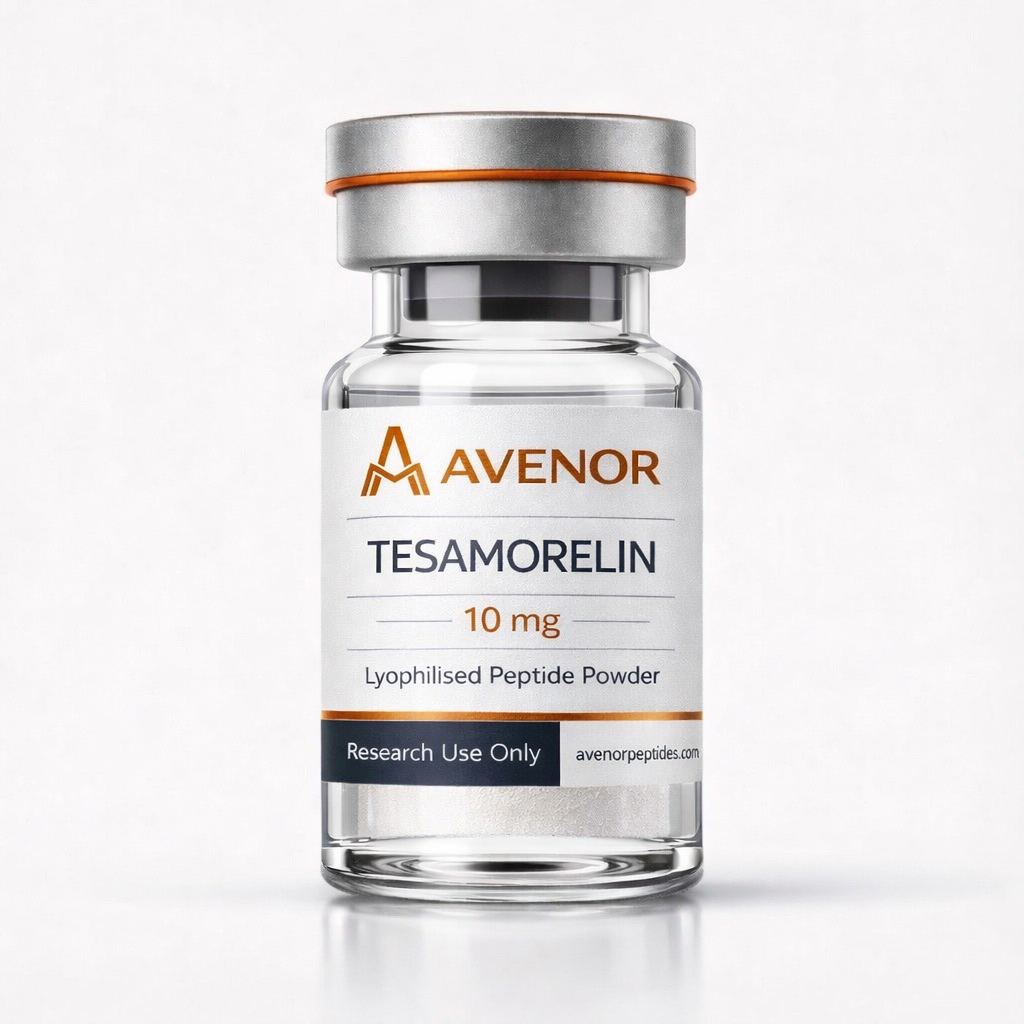
    Tesamorelin 10 mg - Avenor Peptides

    Muscle & Performance

    Tesamorelin

    Strength: 10 mg

    Tesamorelin is a research-use catalogue item organized around product identity, SKU traceability and available documentation.

    €64,80
    In stock
    Published independent analysis for this batch
    1

    The more products, the bigger the discount

    2 → −5%
    3 → −8%
    4 → −11%
    5+ → −15%
    across your whole basket, automatically
    Batch documentationShips from GreeceVerified purity

    Free shipping: Greece from €50, Cyprus and Bulgaria from €100, France, Germany, Italy, Belgium, Netherlands and Spain from €200. Details

    This product is intended exclusively for laboratory research use. It is not intended for human consumption, diagnosis, treatment, or prevention of disease.

    Product information

    FormResearch product
    Strength10 mg
    SKUAV-TESA-10MG
    Stock statusIn stock
    COA / BatchSee the documentation state below
    StorageIn powder form: freezer (−20°C).
    Packaging / shippingProtective professional shipping packaging with clear labelling.

    Independent Avenor testing

    Published documentation for this specific SKU variant.

    View document
    Batch
    AVR-TSM10-280326
    Test date
    13 May 2026
    Method
    HPLC

    Research overview

    Documentation & COA

    Batch documentation and COA, where available, are linked to the specific product batch and SKU.

    This product is intended exclusively for laboratory research use. It is not intended for human consumption, diagnosis, treatment, or prevention of disease.

    Product profile

    44

    amino acids — the full human GHRH sequence with a stabilizing modification

    2010

    year of FDA approval for one specific indication in patients with HIV

    412

    participants in the pivotal Phase III trial (Falutz et al., NEJM 2007)

    ≥98%

    purity by HPLC

    Research context

    What it is

    Tesamorelin is a synthetic peptide, a variant of a hormone the brain produces.

    It is not growth hormone. It is the 'signal' that tells the body to make its own.

    The technical detail

    An analogue of growth-hormone-releasing hormone (GHRH). It acts on the pituitary and raises the IGF-1 factor.

    How it works

    Rather than adding growth hormone from outside, it instructs the pituitary to secrete more.

    The effect shows up mainly in one type of fat: visceral fat, the kind that wraps around the organs deep in the abdomen.

    The technical detail

    Secretion stays pulsatile, like the natural rhythm; that is what sets it apart from giving growth hormone directly.

    What the research shows today

    It is the only approved molecule for abdominal-fat accumulation in people with HIV. The most recent studies look beyond fat.

    In 2024 it was confirmed to reduce visceral and liver fat even on newer antiretroviral regimens. In 2025 it was also tested for cognition.

    −25 cm²

    visceral fat, 2024

    −4.2%

    liver fat, 2024

    −2.7 cm

    waist circumference, 2025

    73

    participants, cognition 2025

    In the 2025 cognition study waist circumference dropped, but the cognitive benefit did not differ statistically from the control.

    Where it stands

    The big question today is fatty liver in people with HIV, where the molecule shows promise in dedicated studies.

    Alongside that, a small 2026 pilot examined a low dose of the GHRH 'signal' in adults with mild cognitive impairment.

    The technical detail

    Its effect in MASLD-HIV remains under investigation (Gattu & Fourman, 2025); the cognition pilot used advanced machine learning (Stewart et al., 2026).

    Laboratory use

    Used in a controlled laboratory setting for in vitro binding and activation studies at the GHRH receptor, for analysis of cAMP signalling in somatotroph cells, for comparative stability work against native GHRH in the presence of DPP-4, for study of pulsatile secretion and negative feedback in the somatotropic axis, and for identity and purity confirmation by HPLC and mass spectrometry.

    Research Use Only. For laboratory research exclusively. Not intended for human or veterinary use, diagnosis, treatment, or disease prevention. The FDA approval referenced in this text concerns a different, approved pharmaceutical-grade product and a single indication in a defined patient population under medical supervision. It does not constitute an indication, a recommendation, or a justification for use of this research material, and the clinical data cited do not transfer to it. Tesamorelin appears on the WADA Prohibited List (class S2), in and out of competition.

    Structural data

    Class
    Stabilized synthetic analogue of growth hormone-releasing hormone (GHRH) — a growth hormone secretagogue
    Chain length
    44 amino acids — corresponding to the full GRF(1-44) sequence of human GHRH
    Structural modification
    A trans-3-hexenoyl group attached at the N-terminus — this is the modification that makes the molecule resistant to enzymatic degradation
    CAS number
    218949-48-5
    Development code
    TH9507
    Target
    The GHRH receptor (GHRHR) on somatotroph cells of the anterior pituitary
    Regulatory status
    Approved by the FDA in 2010 as a pharmaceutical product for one specific indication; listed on the WADA Prohibited List (class S2)
    Product form
    Lyophilized powder in a sealed vial, for reconstitution in a laboratory setting
    Purity
    ≥98% (HPLC) — supplied with CoA

    Comparison

    Feature comparison

    FeatureTesamorelin (this product)HGH / SomatropinCJC-1295 + Ipamorelin
    What is actually introducedAn analogue of the releasing hormone — not growth hormone itselfRecombinant human growth hormone itselfTwo molecules: a GHRH analogue plus a ghrelin receptor agonist
    Site of actionThe GHRH receptor in the anterior pituitaryDirectly at peripheral GH receptors — the pituitary is bypassedTwo different pituitary receptors at once
    Pulsatile releasePreserved — the pituitary secretes its own hormone in pulsesAbolished — steady levels rather than physiological pulsesPreserved, with amplified pulse amplitude
    Negative feedback controlRemains intact — somatostatin and IGF-I still regulate outputBypassedRemains intact
    Regulatory statusFDA approval (2010) for one specific indication in patients with HIVApproved medicine for growth hormone deficiency and other indicationsNo approval — research molecules
    Maturity of the evidenceCompleted Phase III trials, 806 participants in the pooled analysisDecades of clinical use and dataLimited published human data
    WADA statusProhibited substance (S2)Prohibited substance (S2)Prohibited substances (S2)

    Storage & handling

    • The sealed vial of lyophilized powder is stored refrigerated and protected from light.
    • Keep in the original packaging until the point of laboratory use.
    • Once reconstituted with an appropriate sterile diluent, the solution is kept refrigerated and used within a short window — reconstituted peptides are markedly less stable than the lyophilized form.
    • Reconstitute by adding the diluent gently down the wall of the vial, avoiding vigorous agitation, which foams and degrades the peptide.
    • Avoid repeated freeze–thaw cycles.
    • Avoid prolonged exposure to room temperature and to direct sunlight.
    • Handle using standard laboratory practice and appropriate personal protective equipment.
    • Keep away from children and out of food preparation areas.

    Documentation

    • Certificate of Analysis (CoA) per batch, with date and lot number.
    • Purity analysis by HPLC — specification ≥98%.
    • Identity and molecular weight confirmation by mass spectrometry.
    • Research Use Only (RUO) declaration on the packaging.
    • Documents available on request for the specific batch you received.

    References

    References & documentation

    1. 1.Falutz J. et al. (2007). Metabolic effects of a growth hormone-releasing factor in patients with HIV. N Engl J Med, 357(23), 2359-2370.
    2. 2.Falutz J. et al. (2008). Long-term safety and effects of tesamorelin, a growth hormone-releasing factor analogue, in HIV patients with abdominal fat accumulation. AIDS, 22(14), 1719-1728.
    3. 3.Falutz J. et al. (2010). Effects of tesamorelin (TH9507), a growth hormone-releasing factor analog, in HIV-infected patients with excess abdominal fat: a pooled analysis of two multicenter, double-blind placebo-controlled phase 3 trials with safety extension data. J Clin Endocrinol Metab, 95(9), 4291-4304.
    4. 4.Grunfeld C., Dritselis A. & Kirkpatrick P. (2011). Tesamorelin. Nat Rev Drug Discov, 10(2), 95-96.
    5. 5.Baker L.D. et al. (2012). Effects of growth hormone-releasing hormone on cognitive function in adults with mild cognitive impairment and healthy older adults: results of a controlled trial. Arch Neurol, 69(11), 1420-1429.
    6. 6.Friedman S.D. et al. (2013). Growth hormone-releasing hormone effects on brain γ-aminobutyric acid levels in mild cognitive impairment and healthy aging. JAMA Neurol, 70(7), 883-890.
    7. 7.Stanley T.L. et al. (2014). Effect of tesamorelin on visceral fat and liver fat in HIV-infected patients with abdominal fat accumulation: a randomized clinical trial. JAMA, 312(4), 380-389.
    8. 8.Stanley T.L. et al. (2019). Effects of tesamorelin on non-alcoholic fatty liver disease in HIV: a randomised, double-blind, multicentre trial. Lancet HIV, 6(12), e821-e830.
    9. 9.Fourman L.T. et al. (2020). Effects of tesamorelin on hepatic transcriptomic signatures in HIV-associated NAFLD. JCI Insight, 5(16), e140134.
    10. 10.Spooner L.M. & Olin J.L. (2012). Tesamorelin: a growth hormone-releasing factor analogue for HIV-associated lipodystrophy. Ann Pharmacother, 46(2), 240-247.

    Product information

    Frequently asked questions

    How does it differ from HGH?
    In where it acts. Exogenous growth hormone goes straight to peripheral receptors, bypassing the pituitary — physiological pulsatile release is abolished and the negative feedback machinery has nothing left to act on. Tesamorelin adds no hormone; it stimulates the pituitary to secrete its own, in pulses, with somatostatin and IGF-I feedback still imposing a ceiling. It is a structurally different approach to the same axis, not a different dose of the same thing.
    What does "stabilized GHRH analogue" mean?
    Native GHRH is broken down within minutes by the enzyme DPP-4, which makes it practically unusable as a research tool. In tesamorelin a trans-3-hexenoyl group has been attached at the N-terminus of the 44-amino-acid chain. The sequence remains that of the human hormone; only its resistance to degradation changes.
    Is it true that it has FDA approval?
    Yes, and it matters that this is stated precisely. In November 2010 the FDA approved a pharmaceutical-grade tesamorelin product for a single indication: reduction of excess abdominal fat in patients with HIV-associated lipodystrophy (Grunfeld et al., 2011). That is a regulatory event concerning a different, controlled preparation and a defined patient population under medical supervision. It is not an indication or a recommendation for use of this research material for any purpose.
    What exactly did the clinical trials show?
    In the trial by Falutz and colleagues (NEJM, 2007) in 412 patients with HIV and lipodystrophy, visceral adipose tissue fell by 15.2% at 26 weeks against a 5.0% rise on placebo, alongside reduced triglycerides and an 81% rise in IGF-I. This is a finding in a specific patient population with a medically recognised complication of antiretroviral therapy — not a generalisable conclusion.
    What does the liver fat data show?
    In the randomised multicentre trial by Stanley and colleagues (Lancet HIV, 2019) in 61 patients with HIV and non-alcoholic fatty liver disease, hepatic fat fraction fell by 37% in relative terms at twelve months against placebo. The mechanistic biopsy analysis by Fourman and colleagues (2020) found increased expression of oxidative phosphorylation gene sets and decreased expression of inflammation and fibrosis gene sets.
    Is there data on cognitive function?
    Yes, and it comes from an entirely separate research field. Baker and colleagues (Archives of Neurology, 2012) studied 152 adults aged 55 to 87, 66 of them with mild cognitive impairment, over twenty weeks. A favourable effect on overall cognitive performance was recorded (p=0.03), with the strongest signal in executive function (p=0.005). The substudy by Friedman and colleagues (2013) found increased brain GABA levels by magnetic resonance spectroscopy.
    What adverse events have been recorded?
    Across the clinical programmes the main reports were injection site reactions, arthralgia, myalgia, peripheral oedema and paraesthesia. In the Baker study (2012) adverse events were reported by 68% of participants in the active arm against 36% on placebo, and fasting insulin rose by 35% in the mild-cognitive-impairment subgroup. In the Stanley trial (JAMA, 2014) a transient rise in fasting glucose was recorded at two weeks, which was no longer significant at six months.
    Do the findings persist after discontinuation?
    No. This is one of the clearest points in the literature. Falutz and colleagues (AIDS, 2008) followed participants switched to placebo in the second six months and observed reaccumulation of visceral adipose tissue. The effect lasts as long as the stimulation of the axis does.
    What is the WADA status?
    Tesamorelin appears on the WADA Prohibited List under class S2 (peptide hormones, growth factors and related substances), prohibited both in and out of competition. This is a real restriction that applies regardless of the form or origin of the material, and supplying it for research does not alter it.
    Can it be used by humans or animals?
    No. The product is supplied exclusively for laboratory research. It is not intended for human or veterinary use, nor for in vivo application outside a controlled laboratory setting. No administration or dosing guidance is provided.
    Do I receive a certificate of analysis?
    Yes. Every batch is accompanied by a CoA with HPLC analysis and mass spectrometry identity confirmation. It is available on request for the specific batch you received.