Free shipping — the threshold depends on the destination country, confirmed at checkout.
Research Use Only (RUO). For laboratory research only. Not for human or veterinary use.
Research Use Only (RUO):Research classification with product and batch documentation where available.
Weight & Metabolism
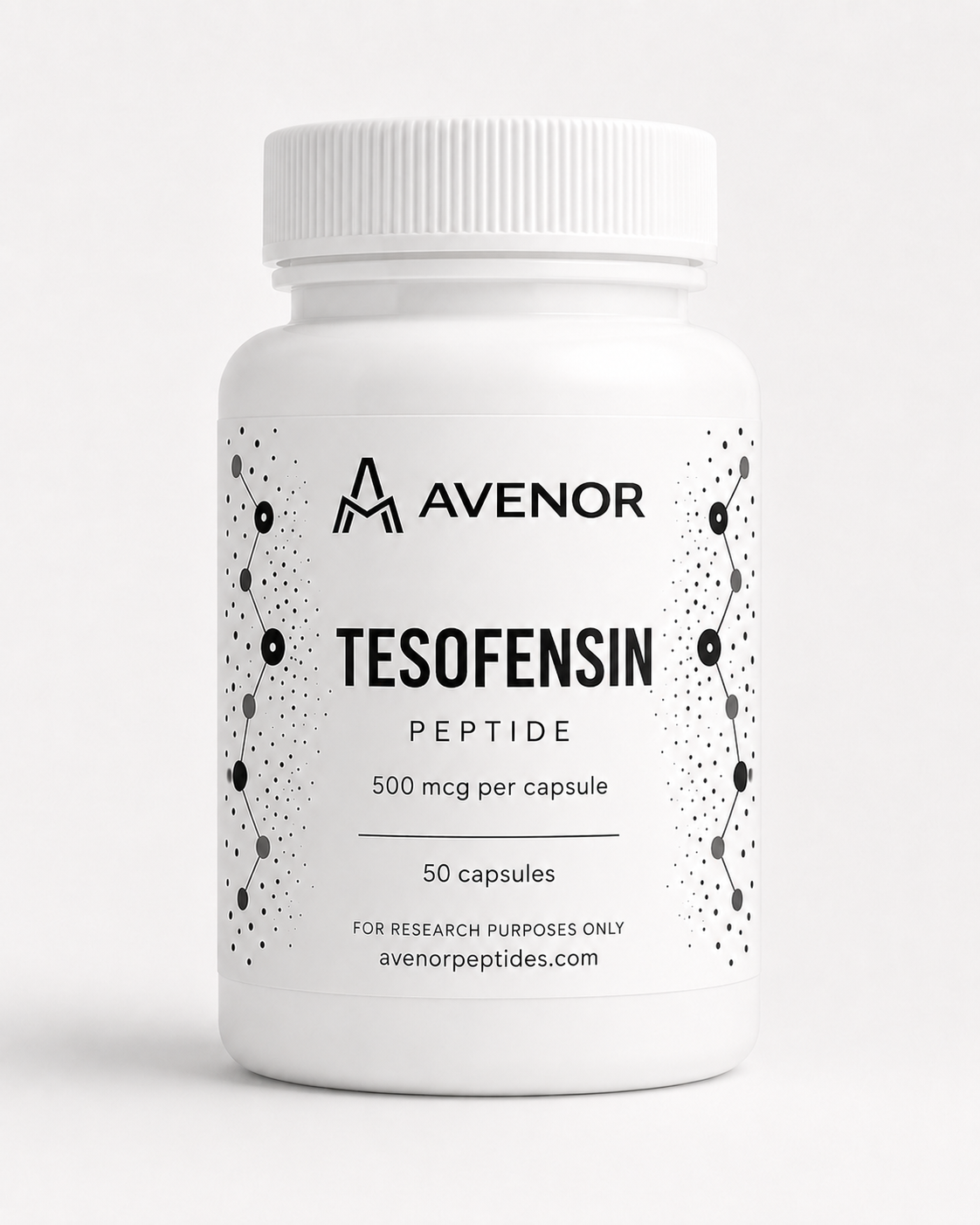
TESOFENSIN
Strength: 500 mcg
Tesofensin is studied around appetite and body weight, but it works differently from the GLP-1 compounds: it acts in the brain, on the signals that regulate hunger. It is a pill, not a peptide.
Free shipping: Greece from €50, Cyprus and Bulgaria from €100, France, Germany, Italy, Belgium, Netherlands and Spain from €200. Details
This product is intended exclusively for laboratory research use. It is not intended for human consumption, diagnosis, treatment, or prevention of disease.
Product information
FormOral form
Strength500 mcg
SKUAVR-TESO-500MCG
Stock statusIn stock
COA / BatchSee the documentation state below
StorageRefer to the label and available documentation details.
Packaging / shippingControlled shipping preparation according to the available SKU variant.
Documentation on request
There is no published document for this specific SKU variant at the moment.
The GLP-1 compounds press a "switch" in the gut. Tesofensin works higher up, in the brain. Same research topic, an entirely different route.
Documentation & COA
Batch documentation and COA, where available, are linked to the specific product batch and SKU.
This product is intended exclusively for laboratory research use. It is not intended for human consumption, diagnosis, treatment, or prevention of disease.
Product profile
3
monoamine transporters at once — norepinephrine, dopamine, serotonin
~234 hours
half-life estimated in a population model (Lehr et al., 2007)
18–77%
dopamine transporter occupancy measured by PET (Appel et al., 2013)
≥98%
active substance purity by HPLC
Research context
01
What it is
Tesofensine is not a peptide. It is a small molecule that acts on the brain.
It began as an experimental drug for neurological conditions. It failed there — but volunteers were losing weight. So it changed course.
The technical detail
Development code NS-2330. A reuptake inhibitor of three neurotransmitters: noradrenaline, dopamine and serotonin.
02
How it works
In the brain, three chemical messengers help set how hungry we feel.
Tesofensine blocks their 'recycling', so they stay active longer. The satiety signal strengthens and appetite drops.
The technical detail
In 2024 it was shown to silence specific GABAergic neurons of the lateral hypothalamus, reducing the drive to eat (Perez et al., PLoS One).
03
What the research shows today
The pivotal study remains the 2008 phase II trial in the Lancet, with 203 participants.
In 2022 a combination with a heart-rate agent was tested in a rare obesity caused by hypothalamic injury, adding further weight loss.
−9.2%
weight, wk 24, Lancet 2008
+7.4
beats/min (mid dose)
203
participants, phase II
2008
last large trial
The loss was nearly double that of the drugs approved at the time — but the phase III for general obesity was never completed.
04
What you should know
The Lancet authors themselves kept a reservation: the findings need confirmation in phase III. That was never done for general obesity.
There is a cardiovascular signal: at the mid dose heart rate rose by 7.4 beats per minute.
It is sold online as a 'supplement', but it is a prohibited substance in sport (WADA, class S6).
The technical detail
Astrup et al., Lancet, 2008 (TIPO-1 trial); Tesomet combination, Huynh et al., 2022; urinary detection, Krug et al., 2026.
Laboratory use
Used in a controlled laboratory setting for in vitro inhibition studies at the dopamine (DAT), norepinephrine (NET) and serotonin (SERT) transporters, for comparative work against selective reuptake inhibitors, for structural and computational binding studies at the dopamine transporter, for LC-MS analytical method development and metabolite identification work, and for identity and purity confirmation by HPLC and mass spectrometry.
Research Use Only — For laboratory research exclusively. Tesofensin is NOT approved as a medicine by the European Medicines Agency (EMA), the FDA, or the Greek National Organisation for Medicines (EOF). It is not a medicinal product, a dietary supplement, or a food. It is not intended for human or veterinary use, nor for the diagnosis, treatment, prevention or mitigation of any disease or condition. No dosing, protocols or administration guidance are provided. This is a psychoactive molecule with documented dose-dependent effects on heart rate and blood pressure; its development has not progressed beyond Phase II. It is listed under class S6 (stimulants) on the World Anti-Doping Agency's Prohibited List. The study data referenced here are presented for scientific information only and do not transfer to any non-research use. Sale is intended for research institutions and laboratories only.
What does "triple monoamine reuptake inhibitor" mean?
It means the molecule simultaneously blocks three transporter proteins at the synapse: the norepinephrine, dopamine and serotonin transporters. These transporters normally clear neurotransmitters back into the neuron. When they are blocked, all three neurotransmitters linger longer in the synapse. This is a mechanism that acts in the brain, not in the gut or the pancreas.
How does it differ from GLP-1 molecules such as semaglutide?
Fundamentally, on three levels. First, chemically: tesofensin is a small tropane molecule of ~328 g/mol, whereas semaglutide is a 31-amino-acid peptide. Second, mechanistically: GLP-1 molecules activate a hormone receptor in the incretin system; tesofensin blocks neurotransmitter transporters in the brain. Third, in terms of evidence: semaglutide has a completed Phase III programme and regulatory approvals, while tesofensin reached Phase II and holds no approval anywhere. These are not two versions of the same thing.
What safety concerns are recorded in the literature?
The principal concern is cardiovascular. The meta-analysis by Astrup and colleagues (Obesity, 2008), covering 740 participants, recorded a dose-dependent heart rate increase of up to 6.8 beats per minute relative to placebo. Subsequent reports also recorded significant blood pressure increases at the higher arms. Doggrell's evaluation (2009) additionally listed nausea, dry mouth, flatulence, insomnia and depressed mood, and called for further tolerability assessment. Beyond that, The Lancet published an expression of concern in 2013 regarding the 2008 Phase II trial, along with a letter titled "Under-reporting of adverse effects of tesofensine". These form part of the molecule's published record.
Why was it originally developed for Alzheimer's and Parkinson's disease?
Because both conditions involve loss of monoaminergic signalling, dopaminergic in particular. The hypothesis was that a molecule boosting all three monoamines might offset part of that loss. The programme advanced to Phase II trials — ADVANS by Rascol and colleagues (Arch Neurol, 2008) in advanced Parkinson's disease, and a 14-week study in 320 patients with Alzheimer's disease. Ultimately, as Bello and Zahner summarise (2009), the compound did not prove effective in those indications.
How did it end up being studied in the body-weight field?
As a side effect. Participants in the neurological trials showed unintended weight loss. Astrup and colleagues (Obesity, 2008) pooled four of those trials — 740 people on the compound, 228 on placebo — and demonstrated a statistically significant dose-dependent change in body weight over 14 weeks, with no dietary programme attached. That finding is what redirected the research.
What did the imaging studies show?
The PET study by Appel and colleagues (Eur Neuropsychopharmacol, 2013), using the [11C]βCIT-FE tracer, measured striatal dopamine transporter occupancy and found it varied dose-dependently between 18% and 77%. It is one of the few cases where the mechanism was confirmed directly in humans rather than inferred.
Why is the half-life so long?
The population pharmacokinetic model of Lehr and colleagues (Br J Clin Pharmacol, 2007) estimated a half-life of approximately 234 hours for the parent compound and 374 hours for the principal metabolite M1, arising from low apparent clearance combined with a large apparent volume of distribution. That is days rather than hours — which bears directly on how any laboratory study is designed.
Is there recent mechanistic work?
Yes. Perez and colleagues (PLoS One, 2024) showed the compound silences a subset of GABAergic neurons in the lateral hypothalamus, with a greater effect in obese than in lean rats. Li and colleagues (Nat Commun, 2025) resolved by cryo-electron microscopy the structure of the dopamine transporter bound to the molecule, showing it stabilises the transporter in an outward-facing conformation.
What is the regulatory status of the molecule?
It has not been approved by the EMA, the FDA or the Greek EOF, and it is not a medicinal product. ChEMBL records it at a maximum development phase of 2. It is additionally classified under class S6 (stimulants) on the World Anti-Doping Agency's Prohibited List and is banned in-competition (Krug et al., Drug Test Anal). That same paper notes it has been marketed online as a "dietary supplement" — a practice with no regulatory basis at all.
Can it be used by humans or animals?
No. The product is supplied exclusively for laboratory research. It is not intended for human or veterinary use, nor for in vivo application outside a controlled laboratory setting. No administration guidance, dosing or protocols are provided. Given the psychoactive nature of the molecule and its documented cardiovascular profile, this restriction is absolute.
Do I receive a certificate of analysis?
Yes. Every batch is accompanied by a CoA with HPLC purity analysis and mass spectrometry identity confirmation. It is available on request for the specific batch you received.