
Free shipping — the threshold depends on the destination country, confirmed at checkout.

    Research Use Only (RUO). For laboratory research only. Not for human or veterinary use.

    Research Use Only (RUO):Research classification with product and batch documentation where available.
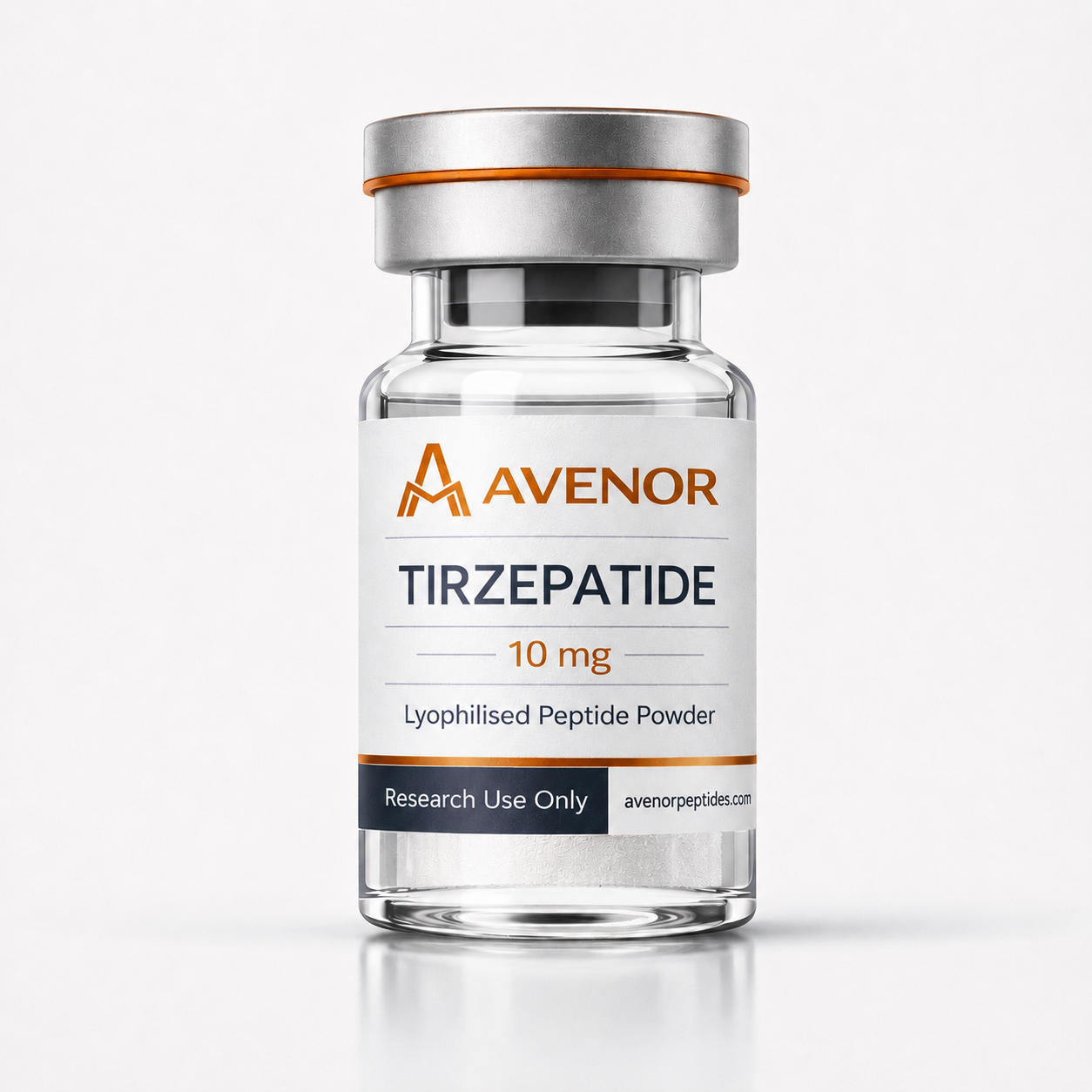
    Tirzepatide 10 mg - Avenor Peptides

    Weight & Metabolism

    Tirzepatide

    Strength: 10 mg

    Tirzepatide is a research-use catalogue item organized around product identity, SKU traceability and available documentation.

    €75,00
    In stock
    1

    The more products, the bigger the discount

    2 → −5%
    3 → −8%
    4 → −11%
    5+ → −15%
    across your whole basket, automatically
    Batch documentationShips from Greece

    Free shipping: Greece from €50, Cyprus and Bulgaria from €100, France, Germany, Italy, Belgium, Netherlands and Spain from €200. Details

    This product is intended exclusively for laboratory research use. It is not intended for human consumption, diagnosis, treatment, or prevention of disease.

    Product information

    FormResearch product
    Strength10 mg
    SKUAV-TIRZ-10MG
    Stock statusIn stock
    COA / BatchSee the documentation state below
    StorageIn powder form: freezer (−20°C).
    Packaging / shippingProtective professional shipping packaging with clear labelling.

    Documentation on request

    There is no published document for this specific SKU variant at the moment.

    Contact us about documentation

    Research overview

    Documentation & COA

    Batch documentation and COA, where available, are linked to the specific product batch and SKU.

    This product is intended exclusively for laboratory research use. It is not intended for human consumption, diagnosis, treatment, or prevention of disease.

    Product profile

    2

    receptors at once — GIP and GLP-1

    39

    amino acids — a synthetic single-chain peptide

    ~5 days

    half-life reported in the literature

    ≥98%

    purity by HPLC

    Research context

    What it is

    Tirzepatide is a synthetic peptide — a chain of 39 amino acids. It mimics two hormones the gut releases after every meal.

    Every earlier molecule in this class mimicked one hormone. This one mimics two. That is the whole difference.

    The technical detail

    Development code LY3298176. A dual agonist of the GIP and GLP-1 receptors, from the incretin agonist class.

    How it works

    Picture two switches in the body.

    The first regulates insulin, slows how fast the stomach empties, and talks to the brain about appetite.

    The second acts on both the pancreas and fat tissue — which the first one does not. Older molecules pressed only the first; this one presses both.

    The technical detail

    GLP-1 = glucagon-like peptide-1. GIP = gastric inhibitory polypeptide.

    What the research shows today

    In 2025 the largest outcome trial of the molecule was published, in people with diabetes and established cardiovascular disease.

    In a population without diabetes, weight reduction at 72 weeks reached the highest figures recorded for any molecule in this class.

    13,165

    SURPASS-CVOT, NEJM 2025

    −21.1%

    weight, wk 72, SURMOUNT-J 2025

    0.92

    HR for cardiovascular events

    46.9

    months of follow-up

    The cardiovascular outcome was non-inferior to an active comparator — something few molecules in this class have shown.

    How it compares

    SURPASS-CVOT compared tirzepatide directly against an established GLP-1 molecule, dulaglutide, in over 13,000 participants.

    A second 2025 study, SURMOUNT-5, compared it directly against semaglutide in people without diabetes, favouring tirzepatide.

    23.7%

    Tirzepatide

    vs

    27.4%

    Dulaglutide

    This is a composite of cardiovascular and kidney events; fewer events means a better outcome.

    The technical detail

    6-component composite endpoint, post hoc analysis of SURPASS-CVOT, HR 0.84 (Nissen et al., JAMA Cardiology, 2026).

    Laboratory use

    Used in a controlled laboratory setting for in vitro binding and activation studies at the GIP and GLP-1 receptors, for signalling pathway analysis (cAMP generation, beta-arrestin recruitment, receptor internalization), for comparative work against selective GLP-1 agonists, and for identity and purity confirmation by HPLC and mass spectrometry.

    Research Use Only. For laboratory research exclusively. Not intended for human or veterinary use, diagnosis, treatment, or disease prevention. The clinical data referenced concern approved pharmaceutical products and do not transfer to research-grade material.

    Structural data

    Class
    Dual GIP and GLP-1 receptor agonist (dual incretin co-agonist)
    Chain length
    39 amino acids, synthetic peptide
    Molecular formula
    C225H348N48O68
    Molecular weight
    ≈4813.5 g/mol
    CAS number
    2023788-19-2
    Development code
    LY3298176
    Structural modification
    A C20 fatty diacid attached via a linker — this is what gives the molecule its extended half-life
    Backbone
    Based on the human GIP sequence, with non-natural Aib residues conferring resistance to DPP-4 degradation
    Product form
    Lyophilized powder in a sealed vial
    Purity
    ≥98% (HPLC) — supplied with CoA

    Comparison

    Feature comparison

    FeatureTirzepatide (this product)SemaglutideRetatrutide
    Receptors activatedTWO: GIP + GLP-1ONE: GLP-1THREE: GIP + GLP-1 + glucagon
    Molecule classDual incretin agonistSelective GLP-1 agonistTriple agonist
    Chain length39 amino acids31 amino acids39 amino acids
    Sequence backboneBased on human GIPBased on human GLP-1Based on GIP
    Maturity of the evidenceCompleted Phase III programme (SURPASS, SURMOUNT)Completed Phase III programmePhase II data — still under active study
    Direct comparison in trialsOutperformed semaglutide in a meta-analysis of direct comparative studies (Wen et al., 2025)The reference molecule in these comparisonsNo large Phase III head-to-head yet
    Product formLyophilized powderLyophilized powderLyophilized powder

    Storage & handling

    • The sealed vial of lyophilized powder is stored refrigerated and protected from light.
    • Keep in the original packaging until the point of laboratory use.
    • Avoid repeated freeze–thaw cycles, which degrade peptide integrity.
    • Avoid prolonged exposure to room temperature and to direct sunlight.
    • Handle using standard laboratory practice and appropriate personal protective equipment.
    • Keep away from children and out of food preparation areas.

    Documentation

    • Certificate of Analysis (CoA) per batch, with date and lot number.
    • Purity analysis by HPLC — specification ≥98%.
    • Identity and molecular weight confirmation by mass spectrometry.
    • Research Use Only (RUO) declaration on the packaging.
    • Documents available on request for the specific batch you received.

    References

    References & documentation

    1. 1.Coskun T. et al. (2018). LY3298176, a novel dual GIP and GLP-1 receptor agonist for the treatment of type 2 diabetes mellitus: From discovery to clinical proof of concept. Mol Metab, 18, 3-14.
    2. 2.Frías J.P. et al. (2018). Efficacy and safety of LY3298176, a novel dual GIP and GLP-1 receptor agonist, in patients with type 2 diabetes: a randomised, placebo-controlled and active comparator-controlled phase 2 trial. Lancet, 392(10160), 2180-2193.
    3. 3.Willard F.S. et al. (2020). Tirzepatide is an imbalanced and biased dual GIP and GLP-1 receptor agonist. JCI Insight, 5(17), e140532.
    4. 4.Rosenstock J. et al. (2021). Efficacy and safety of a novel dual GIP and GLP-1 receptor agonist tirzepatide in patients with type 2 diabetes (SURPASS-1): a double-blind, randomised, phase 3 trial. Lancet, 398(10295), 143-155.
    5. 5.Jastreboff A.M. et al. (2022). Tirzepatide Once Weekly for the Treatment of Obesity (SURMOUNT-1). N Engl J Med, 387(3), 205-216.
    6. 6.Karagiannis T. et al. (2022). Management of type 2 diabetes with the dual GIP/GLP-1 receptor agonist tirzepatide: a systematic review and meta-analysis. Diabetologia, 65(8), 1251-1261.
    7. 7.Nauck M.A. & D'Alessio D.A. (2022). Tirzepatide, a dual GIP/GLP-1 receptor co-agonist for the treatment of type 2 diabetes with unmatched effectiveness regarding glycaemic control and body weight reduction. Cardiovasc Diabetol, 21(1), 169.
    8. 8.Wen J. et al. (2025). Tirzepatide Versus Semaglutide on Weight Loss in Type 2 Diabetes Patients: A Systematic Review and Meta-Analysis of Direct Comparative Studies. Endocrinol Diabetes Metab, 8(3), e70045.

    Category comparison

    Not sure which GLP-1 to choose?

    See the comparison

    Product information

    Frequently asked questions

    What does "dual agonist" mean and why does it matter?
    It means a single molecule activates two different receptors, GIP and GLP-1. Earlier molecules in this class, semaglutide among them, activate the GLP-1 receptor only. Adding the GIP arm widens the set of metabolic pathways involved, which in the trials registered as a larger effect than the selective comparator agonist.
    What is the real difference from semaglutide?
    Two receptors instead of one, and a different sequence backbone — tirzepatide was built on human GIP, semaglutide on human GLP-1. In the meta-analysis by Wen and colleagues (2025), pooling four direct comparative studies with 28,827 participants, mean weight change was -11.4% versus -7.3%.
    How does it compare with retatrutide?
    Retatrutide goes a step further, activating three receptors — GIP, GLP-1 and glucagon. The difference lies in the maturity of the evidence: tirzepatide has a completed Phase III programme, while retatrutide sits at an earlier stage of study. See the comparison table above.
    What does it mean that the molecule is a "biased" agonist?
    Willard and colleagues (2020) showed that at the GLP-1 receptor tirzepatide favours cAMP generation over beta-arrestin recruitment, so the receptor internalizes less than it does with native GLP-1. Its engagement of the GIP receptor is also the stronger of the two — meaning the dual action is not symmetric.
    How extensive is the published data?
    Unusually extensive for a molecule in this category. The systematic review by Karagiannis and colleagues (Diabetologia, 2022) pooled seven randomised trials with 6,609 participants, while SURMOUNT-1 (Jastreboff et al., 2022) alone enrolled 2,539 participants over a 72-week horizon.
    Why is the half-life so long?
    Because of a C20 fatty diacid attached to the peptide chain through a linker. This allows reversible binding to plasma albumin, so the molecule circulates for days rather than minutes. The literature reports a half-life of roughly five days.
    Are there open questions in the literature?
    Yes, and they concern the mechanism. Nauck and D'Alessio (2022) note that the precise contribution of the GIP arm in humans remains unresolved, while the analysis by Thomas and colleagues (2021) found that weight loss explained only 13-21% of the improvement in insulin resistance.
    Can it be used by humans or animals?
    No. The product is supplied exclusively for laboratory research. It is not intended for human or veterinary use, nor for in vivo application outside a controlled laboratory setting. No administration or dosing guidance is provided.
    Do I receive a certificate of analysis?
    Yes. Every batch is accompanied by a CoA with HPLC analysis and mass spectrometry identity confirmation. It is available on request for the specific batch you received.