Free shipping — the threshold depends on the destination country, confirmed at checkout.

    Research Use Only (RUO). For laboratory research only. Not for human or veterinary use.

    Research Use Only (RUO):Research classification with product and batch documentation where available.
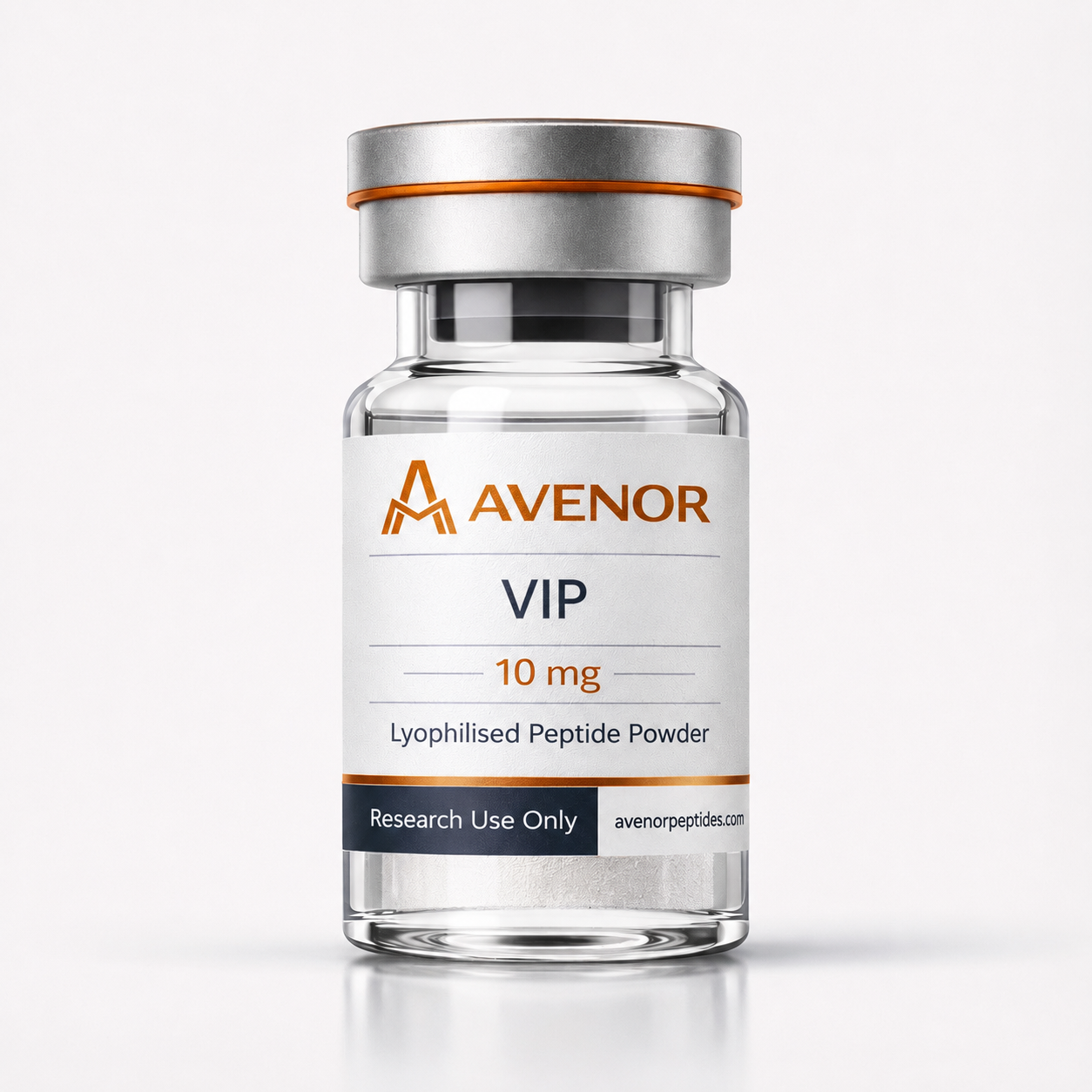
    VIP 10 mg - Avenor Peptides

    Recovery & Repair

    VIP

    Strength: 10 mg

    VIP is a research-use catalogue item organized around product identity, SKU traceability and available documentation.

    €75,00
    In stock
    1

    The more products, the bigger the discount

    2 → −5%
    3 → −8%
    4 → −11%
    5+ → −15%
    across your whole basket, automatically
    Batch documentationShips from Greece

    Free shipping: Greece from €50, Cyprus and Bulgaria from €100, France, Germany, Italy, Belgium, Netherlands and Spain from €200. Details

    This product is intended exclusively for laboratory research use. It is not intended for human consumption, diagnosis, treatment, or prevention of disease.

    Product information

    FormResearch product
    Strength10 mg
    SKUAV-VIP-10MG
    Stock statusIn stock
    COA / BatchSee the documentation state below
    StorageRefer to the label and available documentation details.
    Packaging / shippingControlled shipping preparation according to the available SKU variant.

    Documentation on request

    There is no published document for this specific SKU variant at the moment.

    Contact us about documentation

    Research overview

    Documentation & COA

    Batch documentation and COA, where available, are linked to the specific product batch and SKU.

    This product is intended exclusively for laboratory research use. It is not intended for human consumption, diagnosis, treatment, or prevention of disease.

    Product profile

    28

    amino acids — as determined in the original 1970 isolation

    2

    high-affinity receptors — VPAC1 and VPAC2

    ~70%

    sequence identity with the related peptide PACAP

    ≥98%

    purity by HPLC

    Research context

    What it is

    VIP is a peptide the body makes naturally — 28 amino acids. The gut and the nerves release it constantly.

    Its name tells half the story: 'vasoactive intestinal peptide'. It relaxes blood vessels and opens the airways.

    The technical detail

    Vasoactive intestinal peptide. It belongs to the same family as secretin and glucagon; the synthetic form is called aviptadil.

    How it works

    It does not do one thing. It does many at once.

    It widens blood vessels, relaxes the airways, regulates fluid secretion in the gut and dampens inflammation.

    In the lungs it also supports the fluid that keeps the air sacs open.

    The technical detail

    It acts through the VPAC1 and VPAC2 receptors, raising intracellular cAMP. In 2026 a role in the scleral Wnt/β-catenin pathway was also shown (You et al.).

    What the research shows today

    During the pandemic, the synthetic form was tested for severe respiratory failure. The results were mixed.

    The large 2023 TESICO trial, with 471 participants, showed no benefit. A smaller 2022 study had shown a signal of better survival.

    28

    amino acids in the molecule

    471

    participants, TESICO 2023

    OR 2.0

    survival at 60 days, 2022

    196

    participants, 2022

    The primary endpoint was not met in the large trial — which is why the picture remains open.

    Where it stands

    VIP's physiology is clearest in the opposite case: tumours that overproduce VIP cause intense diarrhoea and potassium loss.

    In 2026 research opened new directions — from gut motility to the progression of myopia in experimental models.

    The technical detail

    The VIPoma syndrome shows its action at full scale (Stafl et al., 2026); a role at the gut VIPR1 receptor was also reported (Li et al., 2026).

    Laboratory use

    Used in a controlled laboratory setting for in vitro binding and activation studies at the VPAC1 and VPAC2 receptors, for signalling pathway analysis via cAMP accumulation assays, for comparative selectivity work against PACAP and the PAC1 receptor, for studies in immune cell lines and suprachiasmatic nucleus tissue preparations, and for identity and purity confirmation by HPLC and mass spectrometry.

    Research Use Only. For laboratory research exclusively. Not intended for human or veterinary use, diagnosis, treatment, or disease prevention. The data referenced come from preclinical models, genetically modified laboratory animals and cell systems, and do not transfer to humans. No dosing, protocols, or administration guidance is provided.

    Structural data

    Class
    Neuropeptide of the secretin/glucagon superfamily — the same family as PACAP, secretin, GIP and GHRH
    Chain length
    28 amino acids, linear peptide
    Molecular weight
    ≈3326 Da
    Receptors
    VPAC1 and VPAC2 — class B (secretin-like) G protein-coupled receptors. It also binds PAC1, but with far lower affinity than PACAP does
    Principal signalling pathway
    Adenylate cyclase activation and a rise in intracellular cAMP
    First isolation
    1970, from porcine small intestine (Said & Mutt, Science)
    Stability in circulation
    Very low — the native peptide is degraded rapidly, which is the central obstacle to any attempt at pharmaceutical development
    Product form
    Lyophilized powder in a sealed vial
    Purity
    ≥98% (HPLC) — supplied with CoA

    Comparison

    Feature comparison

    FeatureVIP (this product)DSIPSelank
    Chain length28 amino acids9 amino acids7 amino acids
    Target receptorVPAC1 and VPAC2 — cloned, characterised class B receptorsNo specific receptor identifiedNo specific receptor identified
    OriginEndogenous mammalian peptide — isolated from intestine in 1970Endogenous peptide, isolated from rabbit cerebral bloodSynthetic analogue of the endogenous tetrapeptide tuftsin
    Principal field of studyCircadian rhythms, immunoregulation, pulmonary vascular biologySleep regulation — findings inconsistentNeuromodulatory and immunomodulatory studies, largely Russian literature
    Maturity of mechanistic dataHigh — genetic knockout models, an IUPHAR review, mapped signallingLow — the mechanism remains unresolvedLow — limited internationally reproduced documentation
    Human dataLimited and inconclusive — largely correlational findingsVery limitedVery limited outside the Russian-language literature
    Product formLyophilized powderLyophilized powderLyophilized powder

    Storage & handling

    • VIP is an unstable peptide — it requires stricter storage than most research peptides.
    • The sealed vial of lyophilized powder is stored frozen, protected from light and moisture.
    • Keep in the original packaging until the point of laboratory use.
    • Strictly avoid repeated freeze–thaw cycles, which degrade peptide integrity rapidly.
    • Avoid any prolonged exposure to room temperature and to direct sunlight.
    • Handle using standard laboratory practice and appropriate personal protective equipment.
    • Keep away from children and out of food preparation areas.

    Documentation

    • Certificate of Analysis (CoA) per batch, with date and lot number.
    • Purity analysis by HPLC — specification ≥98%.
    • Identity and molecular weight confirmation by mass spectrometry.
    • Research Use Only (RUO) declaration on the packaging.
    • Documents available on request for the specific batch received.

    References

    References & documentation

    1. 1.Said S.I. & Mutt V. (1970). Polypeptide with broad biological activity: isolation from small intestine. Science, 169(3951), 1217-1218.
    2. 2.Harmar A.J. et al. (2002). The VPAC(2) receptor is essential for circadian function in the mouse suprachiasmatic nuclei. Cell, 109(4), 497-508.
    3. 3.Aton S.J., Colwell C.S., Harmar A.J., Waschek J. & Herzog E.D. (2005). Vasoactive intestinal polypeptide mediates circadian rhythmicity and synchrony in mammalian clock neurons. Nat Neurosci, 8(4), 476-483.
    4. 4.Ganea D., Gonzalez-Rey E. & Delgado M. (2006). A novel mechanism for immunosuppression: from neuropeptides to regulatory T cells. J Neuroimmune Pharmacol, 1(4), 400-409.
    5. 5.Haberl I., Petkov V. et al. (2006). Vasoactive intestinal peptide gene alterations in patients with idiopathic pulmonary arterial hypertension. Eur J Hum Genet, 15(1), 18-22.
    6. 6.Said S.I. et al. (2007). Moderate pulmonary arterial hypertension in male mice lacking the vasoactive intestinal peptide gene. Circulation, 115(10), 1260-1268.
    7. 7.Gonzalez-Rey E., Delgado-Maroto V., Souza Moreira L. & Delgado M. (2010). Neuropeptides as therapeutic approach to autoimmune diseases. Curr Pharm Des, 16(28), 3158-3172.
    8. 8.Harmar A.J. et al. (2012). Pharmacology and functions of receptors for vasoactive intestinal peptide and pituitary adenylate cyclase-activating polypeptide: IUPHAR review 1. Br J Pharmacol, 166(1), 4-17.
    9. 9.Szema A.M., Hamidi S.A., Smith S.D. & Benveniste H. (2013). VIP gene deletion in mice causes cardiomyopathy associated with upregulation of heart failure genes. PLoS One, 8(5), e61449.
    10. 10.Benitez R. et al. (2018). Vasoactive Intestinal Peptide Ameliorates Acute Myocarditis and Atherosclerosis by Regulating Inflammatory and Autoimmune Responses. J Immunol, 200(11), 3697-3710.
    11. 11.Lu J., Piper S.J., Zhao P., Miller L.J., Wootten D. & Sexton P.M. (2022). Targeting VIP and PACAP Receptor Signaling: New Insights into Designing Drugs for the PACAP Subfamily of Receptors. Int J Mol Sci, 23(15), 8069.

    Product information

    Frequently asked questions

    Why is it called an "intestinal" peptide when it acts in the brain?
    Because the name records where it was first found, not where it works. In 1970 Said and Mutt isolated it from porcine small intestine while searching for vasodilator substances, and named it accordingly. It later emerged that the same molecule is produced by neurons throughout the body — in the hypothalamus, the lungs, the vasculature, and immune cells. The name simply stuck from day one and was never revised.
    What are the VPAC1 and VPAC2 receptors?
    Two class B (secretin-like) G protein-coupled receptors that bind VIP with high affinity. Activating them raises intracellular cAMP. Because they are distributed differently across tissues, the same molecule produces very different effects depending on where it acts. The IUPHAR review (Harmar et al., 2012) is the official reference point.
    What is its relationship to circadian rhythms?
    This is the best-documented part of its literature. In the suprachiasmatic nucleus, VIP keeps the neurons of the master biological clock synchronised. Aton and colleagues (2005) showed that in mice lacking VIP, roughly half the neurons of the nucleus lose their rhythm outright, while the remainder fall out of synchrony with each other.
    What did the rescue experiment by Aton and colleagues establish?
    That the causal chain runs specifically through the VPAC2 receptor. Daily application of a VPAC2 agonist restored both rhythmicity and synchrony in tissue from VIP-null mice — but had no effect at all in tissue from mice lacking the receptor. It is among the cleanest causal experiments in circadian neuroscience.
    What did the knockout models show about clock genes?
    Harmar and colleagues (Cell, 2002) found that mice lacking the VPAC2 receptor show no circadian expression at all of the core clock genes mPer1, mPer2 and mCry1 in the suprachiasmatic nucleus, nor the acute induction of mPer1 and mPer2 by nocturnal light. Both the clock and the mechanism that sets it by light are disrupted.
    What is known about its immunoregulatory action?
    In animals and cell systems, VIP is described as inhibiting pro-inflammatory cytokine release from activated macrophages and dendritic cells, and as inducing tolerogenic dendritic cells that generate regulatory T cells (Ganea et al., 2006). These findings are confined to preclinical models and have not been translated to humans.
    What is the connection to pulmonary arterial hypertension?
    Said and colleagues (Circulation, 2007) showed that mice with the VIP gene deleted spontaneously develop moderate pulmonary hypertension with pulmonary vascular remodelling. In humans the picture is not clean: the study by Haberl, Petkov and colleagues (2006) could not correlate the single coding-region alteration with the disease, since it also appeared in 46% of controls.
    How does it differ from DSIP and Selank?
    In size, and above all in the maturity of the evidence. VIP has 28 amino acids and two cloned, fully characterised receptors, whereas DSIP (9 amino acids) and Selank (7 amino acids) have no specific identified receptor. See the comparison table above.
    Why do claims circulate that the literature does not support?
    VIP is widely promoted online for indications and via routes of administration that published data do not support. The literature cited here concerns mechanisms, genetic models and laboratory animals. There is no documentation justifying claims of therapeutic benefit in humans, and the product is not supplied for such use.
    Can it be used by humans or animals?
    No. The product is supplied exclusively for laboratory research. It is not intended for human or veterinary use, nor for in vivo application outside a controlled laboratory setting. No administration or dosing guidance is provided in any form.
    Is a certificate of analysis provided?
    Yes. Every batch is accompanied by a CoA with HPLC analysis and mass spectrometry identity confirmation. It is available on request for the specific batch received.