Free shipping — the threshold depends on the destination country, confirmed at checkout.

    Research Use Only (RUO). For laboratory research only. Not for human or veterinary use.

    Research Use Only (RUO):Research classification with product and batch documentation where available.
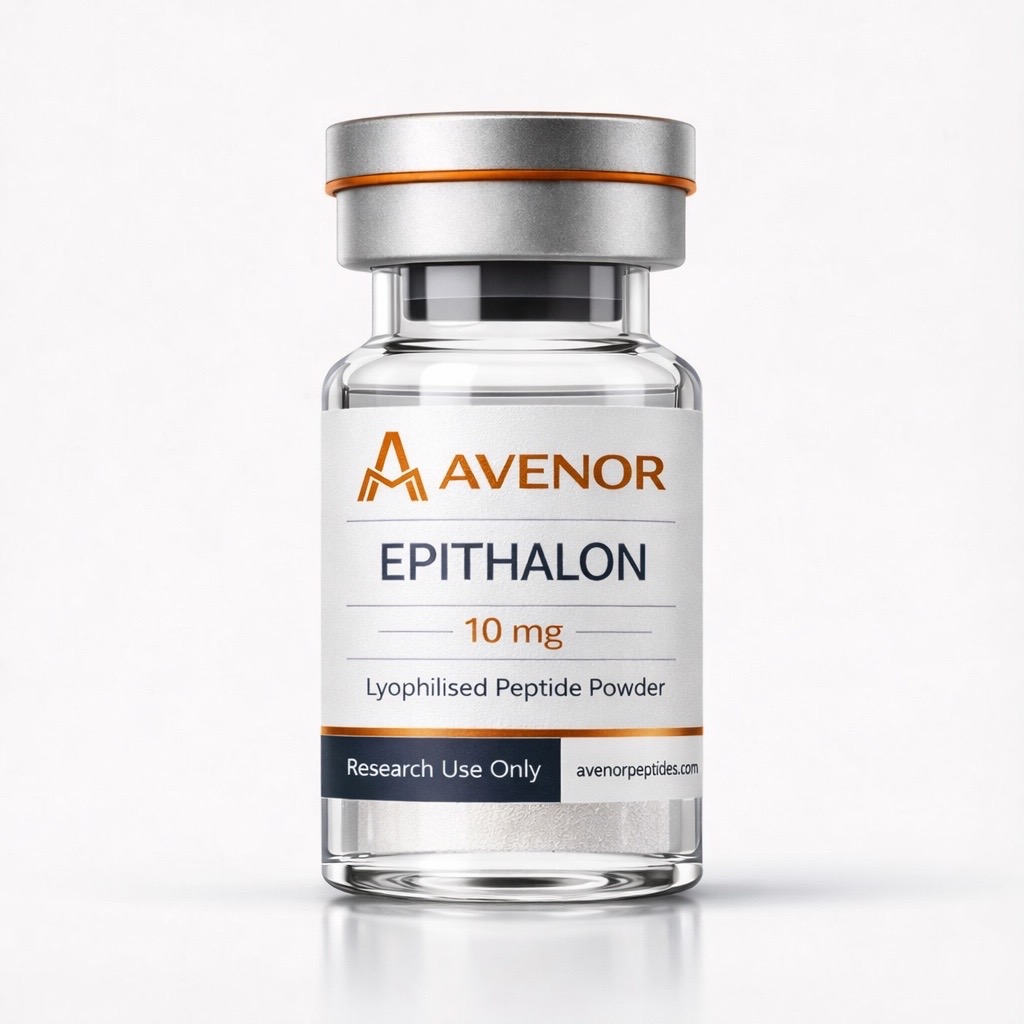
    Epithalon 10 mg - Avenor Peptides

    Skin & Hair

    Epithalon

    Strength: 10 mg

    Epithalon is a research-use catalogue item organized around product identity, SKU traceability and available documentation.

    €31,00€34,44
    -10% off
    In stock
    Published independent analysis for this batch
    1

    The more products, the bigger the discount

    2 → −5%
    3 → −8%
    4 → −11%
    5+ → −15%
    across your whole basket, automatically
    Batch documentationShips from GreeceVerified purity

    Free shipping: Greece from €50, Cyprus and Bulgaria from €100, France, Germany, Italy, Belgium, Netherlands and Spain from €200. Details

    This product is intended exclusively for laboratory research use. It is not intended for human consumption, diagnosis, treatment, or prevention of disease.

    Product information

    FormResearch product
    Strength10 mg
    SKUAV-ET-10MG
    Stock statusIn stock
    COA / BatchSee the documentation state below
    StorageIn powder form: freezer (−20°C).
    Packaging / shippingProtective professional shipping packaging with clear labelling.

    Independent Avenor testing

    Published documentation for this specific SKU variant.

    View document
    Batch
    Not set
    Test date
    22 Jul 2026
    Method
    HPLC

    Research overview

    Documentation & COA

    Batch documentation and COA, where available, are linked to the specific product batch and SKU.

    This product is intended exclusively for laboratory research use. It is not intended for human consumption, diagnosis, treatment, or prevention of disease.

    Product profile

    4

    amino acids — Ala-Glu-Asp-Gly, one of the smallest research peptides

    ≈390 g/mol

    molecular weight — under a tenth of a typical GLP-1 peptide

    10

    extra cell divisions in human fibroblasts (Khavinson et al., 2004)

    ≥98%

    purity by HPLC

    Research context

    What it is

    Epithalon is a very small peptide — just four amino acids.

    It was not invented.

    It copies the composition of a natural extract from the pineal gland, the gland that governs biological rhythms.

    The technical detail

    Ala-Glu-Asp-Gly (AEDG). It was synthesized based on epithalamin, a bovine pineal extract (Araj et al., Int J Mol Sci, 2025).

    How it works

    Its best-known finding concerns the ends of chromosomes — the telomeres.

    Every time a cell divides, these shorten. When they run out, the cell stops.

    They act like the fuse of a clock counting down.

    The peptide was seen to activate the enzyme that rebuilds them.

    The technical detail

    It activates telomerase. It also affects melatonin synthesis and interleukin-2 mRNA (Araj et al., 2025).

    Where it stands today

    Twenty-five years of research have mapped geroprotective and neuroendocrine effects.

    Along the way, antioxidant and neuroprotective properties emerged.

    It remains one of the few molecules shown, in human cells, to extend their lifespan.

    The technical detail

    Most in vivo data come from animal models; the foundational work in human cells is from Khavinson et al. (Bull Exp Biol Med, 2004).

    What the studies showed

    In human fetal fibroblasts that had stopped dividing, the peptide lengthened the telomeres.

    +10

    extra cell divisions

    4

    amino acids (tetrapeptide)

    25

    years of study

    Cells that normally stopped at the 34th generation continued to the 44th — overcoming the Hayflick limit, the natural ceiling on how often a cell divides.

    Laboratory use

    Used in a controlled laboratory setting for in vitro cellular senescence work in fibroblast and stem cell cultures, for telomerase activity and telomere length measurement, for analysis of circadian gene and senescence marker expression, for peptide-histone interaction studies using molecular modelling approaches, and for identity and purity confirmation by HPLC and mass spectrometry.

    Research Use Only. For laboratory research exclusively. Not intended for human or veterinary use, nor for the diagnosis, treatment, prevention or mitigation of any disease or condition. No therapeutic, geroprotective or anti-aging indication is claimed. The findings referenced come from published experimental studies in cell culture, animals or third-party research protocols; they do not transfer to research-grade material and do not constitute an indication for use. Supplied to adult professionals in a controlled laboratory setting.

    Structural data

    Class
    Synthetic tetrapeptide; described in the literature as a geroprotective / epigenetic regulator
    Sequence
    Ala-Glu-Asp-Gly (AEDG) — alanine, glutamic acid, aspartic acid, glycine
    Chain length
    4 amino acids
    Molecular formula
    C14H22N4O9
    Molecular weight
    ≈390.35 g/mol
    Synonyms in the literature
    Epithalon, Epitalon, Epithalone, AEDG peptide
    Design origin
    Synthesized from the amino acid composition of epithalamin, a bovine pineal gland polypeptide extract (Araj et al., 2025)
    Product form
    Lyophilized powder in a sealed vial
    Purity
    ≥98% (HPLC) — supplied with CoA

    Comparison

    Feature comparison

    FeatureEpithalon (this product)GHK-CuMOTS-cSS-31
    Chain length4 amino acids3 amino acids plus a copper ion16 amino acids4 amino acids (synthetic, non-natural residues)
    OriginSynthetic, modelled on pineal epithalaminA natural tripeptide found in human plasmaA peptide encoded by mitochondrial DNAFully synthetic, designed in the laboratory
    Main pathway in the literatureTelomerase, epigenetic regulation, circadian rhythmCollagen synthesis, wound repair, matrix metalloproteinasesAMPK metabolic signalling, mitochondrial homeostasisCardiolipin of the inner mitochondrial membrane
    Where the action sitsThe nucleus — interaction with histones and DNAExtracellular matrix and skinCytoplasm and nucleus, metabolic controlMitochondria exclusively
    Maturity and provenance of the evidenceLargely one Russian research group over 25 years; limited independent replicationBroad international literature, mostly dermatologicalInternational literature, mostly preclinicalHas reached clinical trials internationally
    Product formLyophilized powderLyophilized powderLyophilized powderLyophilized powder

    Storage & handling

    • The sealed vial of lyophilized powder is stored frozen, protected from light and moisture.
    • In its lyophilized form the peptide is stable; moisture is the main route to degradation, so the vial is allowed to reach room temperature before it is opened.
    • Once reconstituted, the solution is kept refrigerated and treated as short-lived — it is not intended for extended storage.
    • Avoid repeated freeze–thaw cycles, which degrade peptide integrity.
    • Avoid vigorous agitation of the reconstituted solution and prolonged exposure to room temperature or direct sunlight.
    • Handle using standard laboratory practice, aseptic technique and appropriate personal protective equipment.
    • Keep away from children and out of food preparation areas.

    Documentation

    • Certificate of Analysis (CoA) per batch, with date and lot number.
    • Purity analysis by HPLC — specification ≥98%.
    • Identity and molecular weight confirmation by mass spectrometry.
    • Research Use Only (RUO) declaration on the packaging.
    • Documents available on request for the specific batch you received.

    References

    References & documentation

    1. 1.Khavinson V.Kh., Bondarev I.E., Butyugov A.A. (2003). Epithalon peptide induces telomerase activity and telomere elongation in human somatic cells. Bull Exp Biol Med, 135(6), 590-592.
    2. 2.Khavinson V.Kh. et al. (2004). Peptide promotes overcoming of the division limit in human somatic cell. Bull Exp Biol Med, 137(5), 503-506.
    3. 3.Anisimov V.N. et al. (2001). Effect of pineal peptide on parameters of the biological age and life span in mice. Ross Fiziol Zh Im I M Sechenova, 87(1), 125-136. (in Russian)
    4. 4.Korkushko O.V., Khavinson V.Kh., Shatilo V.B., Magdich L.V. (2004). Effect of peptide preparation epithalamin on circadian rhythm of epiphyseal melatonin-producing function in elderly people. Bull Exp Biol Med, 137(4), 389-391.
    5. 5.Korkushko O.V. et al. (2007). Normalizing effect of the pineal gland peptides on the daily melatonin rhythm in old monkeys and elderly people. Adv Gerontol, 20(1), 74-85. (in Russian)
    6. 6.Korkushko O.V. et al. (2011). Peptide geroprotector inhibits rapid aging of elderly people: results of 15-year follow-up. Bull Exp Biol Med, 151(3), 366-369.
    7. 7.Vanhee C. et al. (2014). Identification of the small research tetra peptide Epitalon in two illegal pharmaceutical preparations. Drug Test Anal, 7(3), 259-264.
    8. 8.Lin'kova N.S. et al. (2016). Peptide Regulation of Skin Fibroblast Functions during Their Aging In Vitro. Bull Exp Biol Med, 161(1), 175-178.
    9. 9.Fedoreyeva L.I. et al. (2017). Short Exogenous Peptides Regulate Expression of CLE, KNOX1, and GRF Family Genes in Nicotiana tabacum. Biochemistry (Mosc), 82(4), 521-528.
    10. 10.Khavinson V. et al. (2020). AEDG Peptide (Epitalon) Stimulates Gene Expression and Protein Synthesis during Neurogenesis: Possible Epigenetic Mechanism. Molecules, 25(3), 609.
    11. 11.Ivko O.M. et al. (2020). The influence of AEDG and KE peptides on mitochondria staining and L7A ribosomal protein expression during human pineal gland and thymus cell senescence in vitro. Adv Gerontol, 33(4), 741-747. (in Russian)
    12. 12.Yue X. et al. (2022). Epitalon protects against post-ovulatory aging-related damage of mouse oocytes. Aging (Albany NY), 14(7), 3191-3202.
    13. 13.Kraskovskaya N. et al. (2024). Short Peptides Protect Fibroblast-Derived Induced Neurons from Age-Related Changes. Int J Mol Sci, 25(21), 11363.
    14. 14.Ivko O.M. et al. (2024). Peptidergic regulation of expression of cellular aging marker proteins in buccal epithelium. Adv Gerontol, 37(5), 516-524. (in Russian)
    15. 15.Araj S.K., Brzezik J., Mądra-Gackowska K., Szeleszczuk Ł. (2025). Overview of Epitalon — Highly Bioactive Pineal Tetrapeptide with Promising Properties. Int J Mol Sci, 26(6), 2691.

    Product information

    Frequently asked questions

    What exactly is epithalon?
    A synthetic four-amino-acid tetrapeptide with the sequence Ala-Glu-Asp-Gly. It was synthesized from the amino acid composition of epithalamin, a polypeptide extract of the bovine pineal gland. It is not a natural molecule that was isolated — it is a laboratory synthesis modelled on a natural extract.
    What is the connection to telomerase and telomeres?
    Telomeres are the protective caps on chromosome ends that shorten with every cell division; telomerase is the enzyme that can rebuild them, but in most somatic cells it sits switched off. Khavinson and colleagues (2003) reported that in human fetal fibroblast cultures epithalon induced expression of the telomerase catalytic subunit and telomere elongation. The finding is from cell culture, not from a whole organism.
    What is the Hayflick limit, and what did the 2004 study show?
    It is the finite number of divisions a normal human cell can complete before it stops. In Khavinson and colleagues (2004), fetal lung fibroblasts stalled at passage 34; with epithalon they completed ten further divisions, reaching passage 44. It is a striking result, but it comes from one group and has not been widely replicated.
    What is the link to melatonin and circadian rhythm?
    Korkushko and colleagues (2004, 2007) studied pineal function in older adults and in aged monkeys. What is interesting is that the effect is described as bidirectional: nocturnal melatonin rose in subjects with low pineal function, while in those with normal function it tended to fall. At the gene level, effects have been reported on Cry2, AANAT, ASMT and CLOCK.
    How does such a small molecule do anything?
    The leading hypothesis is not a classical receptor but an epigenetic one: being very small, the peptide reaches the nucleus and influences how tightly DNA is packaged. Molecular modelling by Khavinson and colleagues (2020) indicated binding to histones H1/3 and H1/6. Supporting this, Fedoreyeva and colleagues (2017) found effects on gene expression in tobacco plant tissue — where no animal receptors exist.
    Is there research from groups outside Russia?
    There is, but it is limited. The most notable is Yue and colleagues in Aging (2022), from Chinese and US institutions, in post-ovulatory aging mouse oocytes: reduced reactive oxygen species, fewer spindle defects, higher mitochondrial membrane potential. There is also the 2025 review by Araj and colleagues at a Polish university.
    How strong is the evidence base overall?
    Narrow in provenance. Most of the research originates from one Russian group, the St Petersburg Institute of Bioregulation and Gerontology, and is published largely in Russian journals. There are no large multicentre randomised trials of synthetic epithalon. The Araj review (2025) concludes that it remains uncertain whether the known mechanisms are the only ones.
    Are there findings that point the other way?
    Yes. In Kraskovskaya and colleagues (2024), studying induced neurons from elderly donors' fibroblasts, short peptides increased dendritic branching but left mitochondrial and lysosomal activity and p16 levels unchanged — and the reduction in oxidative DNA damage came from EDR, not AEDG. Separately, Vanhee and colleagues (2014) identified epitalon in two illegal pharmaceutical preparations, showing the molecule circulates outside controlled settings.
    How does it differ from other molecules in this space, like GHK-Cu or SS-31?
    They differ in where they act. GHK-Cu is studied mainly in the extracellular matrix and skin, SS-31 targets cardiolipin in the inner mitochondrial membrane, MOTS-c acts on AMPK metabolic signalling. Epithalon is studied largely at the nuclear level — telomerase, histones, gene expression. See the comparison table above.
    Can it be used by humans or animals?
    No. The product is supplied exclusively for laboratory research. It is not intended for human or veterinary use, nor for in vivo application outside a controlled laboratory setting. No administration or dosing guidance is provided, and no anti-aging or therapeutic indication is claimed.