
Free shipping — the threshold depends on the destination country, confirmed at checkout.

    Research Use Only (RUO). For laboratory research only. Not for human or veterinary use.

    Research Use Only (RUO):Research classification with product and batch documentation where available.
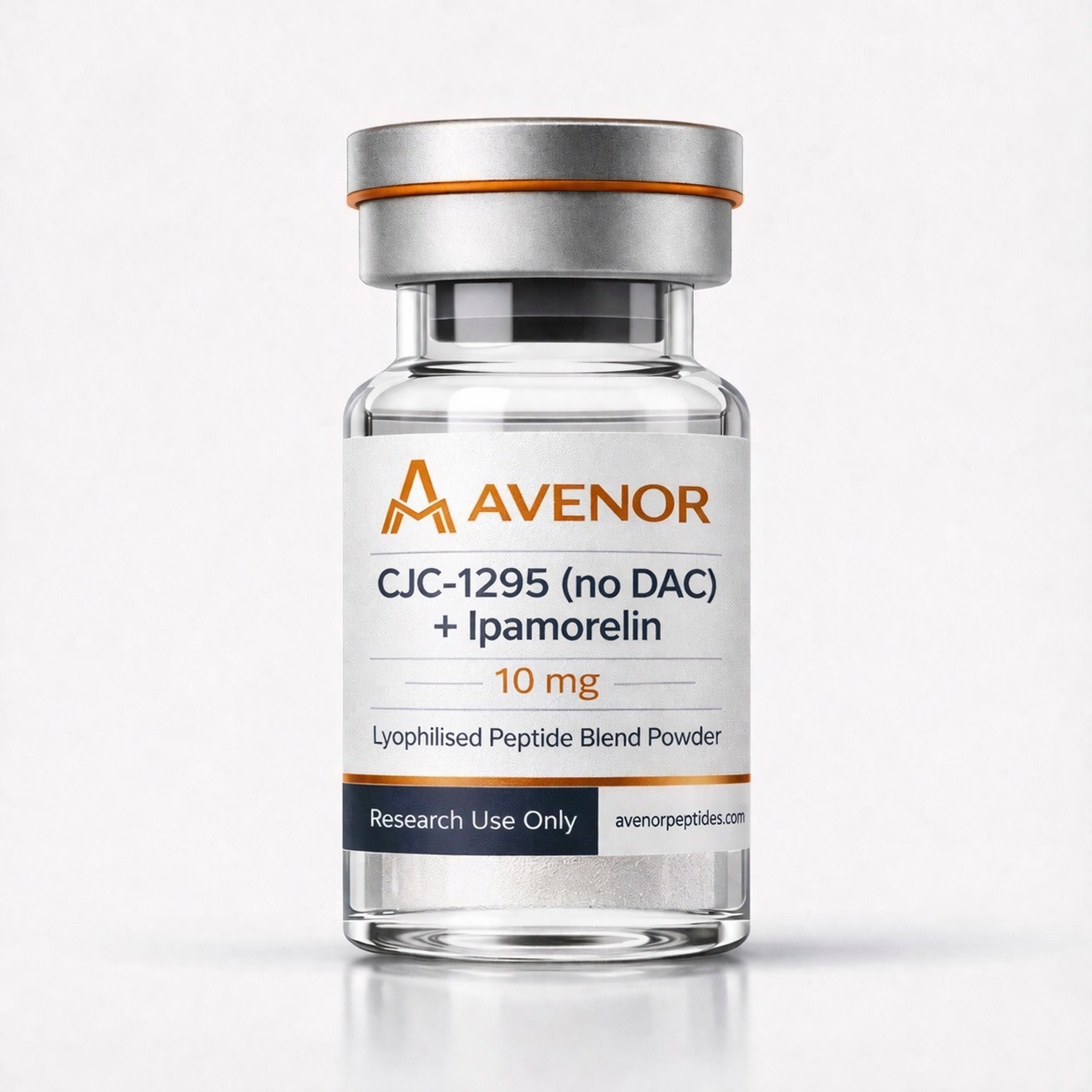
    CJC1295 (no DAC) + Ipamorelin 5 mg + 5 mg - Avenor Peptides

    Muscle & Performance

    CJC1295 (no DAC) + Ipamorelin

    Strength: 5 mg + 5 mg

    CJC1295 (no DAC) + Ipamorelin is a research-use catalogue item organized around product identity, SKU traceability and available documentation.

    €65,00
    In stock
    Published independent analysis for this batch
    1

    The more products, the bigger the discount

    2 → −5%
    3 → −8%
    4 → −11%
    5+ → −15%
    across your whole basket, automatically
    Batch documentationShips from GreeceVerified purity

    Free shipping: Greece from €50, Cyprus and Bulgaria from €100, France, Germany, Italy, Belgium, Netherlands and Spain from €200. Details

    This product is intended exclusively for laboratory research use. It is not intended for human consumption, diagnosis, treatment, or prevention of disease.

    Product information

    FormResearch product
    Strength5 mg + 5 mg
    SKUAV-CJCIPA-10MG
    Stock statusIn stock
    COA / BatchSee the documentation state below
    StorageIn powder form: freezer (−20°C).
    Packaging / shippingProtective professional shipping packaging with clear labelling.

    Independent Avenor testing

    Published documentation for this specific SKU variant.

    View document
    Batch
    AVR-CJCIPA-10MG
    Test date
    13 May 2026
    Method
    HPLC

    Research overview

    Documentation & COA

    Batch documentation and COA, where available, are linked to the specific product batch and SKU.

    This product is intended exclusively for laboratory research use. It is not intended for human consumption, diagnosis, treatment, or prevention of disease.

    Product profile

    29 + 5

    amino acids — two peptides in one vial

    2

    distinct receptors within the same system

    1998

    year ipamorelin was first described in the literature

    ≥98%

    purity by HPLC

    Research context

    What it is

    It is a pairing of two molecules that make the body release its own growth hormone.

    It is not growth hormone.

    It is two different buttons pressing the same gland.

    The technical detail

    CJC-1295 is a long-acting analog of GHRH (growth hormone-releasing hormone). Ipamorelin is a selective agonist of the ghrelin receptor (GHS-R1a).

    How it works

    The gland that makes growth hormone has two separate switches.

    The first molecule presses one — the natural 'releasing' switch — but for many days.

    The second presses the other, without meaningfully raising cortisol or prolactin.

    The technical detail

    Ipamorelin belongs to the growth hormone secretagogues (GHS). Its selectivity for GHS-R1a sets it apart from older GHRPs (Ferro et al., Drug Test Anal, 2016).

    Why combine them

    One molecule holds the switch down for days.

    The other delivers a sharp, strong pulse.

    Together they join duration with intensity — something neither does alone.

    The technical detail

    The two mechanisms — a GHRH analog and a ghrelin agonist — act on different receptors of the GH–IGF-1 axis (Dominikowski et al., Front Endocrinol, 2026).

    What the human data show

    CJC-1295 is one of the few in this class with published data in healthy humans, in a randomized controlled trial.

    2–10×

    GH rise after a single injection

    1.5–3×

    IGF-1 rise

    28

    days with IGF-1 above baseline

    A single injection raised growth hormone for 6 days or more. With repeated doses, IGF-1 stayed above baseline for up to 28 days.

    Laboratory use

    Used in a controlled laboratory setting for identity and purity confirmation of both components by HPLC and mass spectrometry, for stability studies of the lyophilized powder and the reconstituted solution, and for in vitro research on binding and activation of the GHRH-R and GHS-R1a receptors in cell lines.

    Research Use Only. Lyophilized material for laboratory use exclusively. Not intended for human or veterinary use, nor for in vivo application outside a controlled laboratory setting. No therapeutic or hormonal claim is made.

    Structural data

    Component 1
    CJC-1295 without DAC — also known as Modified GRF (1-29)
    CJC-1295 (no DAC) sequence
    Tyr-D-Ala-Asp-Ala-Ile-Phe-Thr-Gln-Ser-Tyr-Arg-Lys-Val-Leu-Ala-Gln-Leu-Ser-Ala-Arg-Lys-Leu-Leu-Gln-Asp-Ile-Leu-Ser-Arg-NH2
    CJC-1295 chain length
    29 amino acids — an analog of the natural GRF (1-29) fragment
    CJC-1295 target
    Growth hormone-releasing hormone receptor (GHRH-R)
    Component 2
    Ipamorelin
    Ipamorelin sequence
    Aib-His-D-2-Nal-D-Phe-Lys-NH2
    Ipamorelin chain length
    5 amino acids — a pentapeptide
    Ipamorelin molecular formula
    C38H49N9O5
    Ipamorelin molecular weight
    711.9 g/mol
    Ipamorelin CAS number
    170851-70-4
    Ipamorelin target
    Ghrelin receptor (GHS-R1a)
    Product form
    Lyophilized powder in a vial — requires reconstitution
    Purity
    ≥98% (HPLC) — supplied with CoA

    Comparison

    Feature comparison

    FeatureCJC-1295 + Ipamorelin (this product)TesamorelinHGH / Somatropin
    ClassBlend: GHRH analog + ghrelin receptor agonistGHRH analogGrowth hormone itself
    Target receptorTwo: GHRH-R and GHS-R1aOne: GHRH-RNeither — acts on the peripheral GH receptor
    Site of actionPituitary — drives endogenous secretionPituitary — drives endogenous secretionBypasses the pituitary entirely
    Molecule length29 amino acids + 5 amino acids44 amino acids191 amino acids — a protein
    Preserves pulsatile secretion patternYes, in the models studiedYes, in the models studiedNo — administration is exogenous
    Regulatory statusResearch compound (RUO)Approved medicine in some jurisdictionsApproved medicine
    FormLyophilized powderLyophilized powderPowder or ready solution

    Storage & handling

    • Before reconstitution: store the lyophilized powder refrigerated and protected from light. Freezing is preferable for long-term storage.
    • The vial ships and arrives sealed; check the integrity of the rubber stopper before any handling.
    • Reconstitute with bacteriostatic water under aseptic conditions. Add the diluent slowly down the vial wall, never directly onto the powder.
    • Do not shake. Swirl the vial gently until the powder fully dissolves — vigorous agitation destroys peptides.
    • After reconstitution: refrigeration at 2-8 °C is required, with protection from light.
    • Avoid repeated freeze-thaw cycles, which degrade both peptides.
    • Keep away from children and out of food preparation areas.

    Documentation

    • Certificate of Analysis (CoA) per batch, with date and lot number.
    • Purity analysis by HPLC for each component separately — specification ≥98%.
    • Identity confirmation of both peptides by mass spectrometry.
    • Declaration of the ratio of the two components in the vial.
    • Research Use Only (RUO) declaration on the packaging.
    • Documents available on request for the specific batch you received.

    References

    References & documentation

    1. 1.Teichman S.L. et al. (2005). Prolonged stimulation of growth hormone (GH) and insulin-like growth factor I secretion by CJC-1295, a long-acting analog of GH-releasing hormone, in healthy adults. J Clin Endocrinol Metab, 91(3), 799-805.
    2. 2.Raun K. et al. (1998). Ipamorelin, the first selective growth hormone secretagogue. Eur J Endocrinol, 139(5), 552-561.
    3. 3.Massoud A.F. et al. (1997). Interaction of the growth hormone releasing peptide hexarelin with somatostatin. Clin Endocrinol (Oxf), 47(5), 537-547.
    4. 4.Ahnfelt-Rønne I. et al. (2001). Do growth hormone-releasing peptides act as ghrelin secretagogues? Endocrine, 14(1), 133-135.
    5. 5.Andersen N.B. et al. (2001). The growth hormone secretagogue ipamorelin counteracts glucocorticoid-induced decrease in bone formation of adult rats. Growth Horm IGF Res, 11(5), 266-272.
    6. 6.Venkova K. et al. (2009). Efficacy of ipamorelin, a novel ghrelin mimetic, in a rodent model of postoperative ileus. J Pharmacol Exp Ther, 329(3), 1110-1116.
    7. 7.Damjanović S. et al. (1996). Pituitary enlargement due to primary hypothyroidism: growth hormone response to GHRH, GHRP-6 and GHRH plus GHRP-6. J Pediatr Endocrinol Metab, 9(5), 549-553.
    8. 8.Thomas A. et al. (2022). Probing for peptidic drugs (2-10 kDa) in doping control blood samples. Anal Sci Adv, 3(7-8), 235-243.

    Product information

    Frequently asked questions

    What does "no DAC" mean?
    DAC stands for Drug Affinity Complex — a chemical addition that binds the peptide to blood albumin and keeps it in circulation for days. In Teichman et al. (2005) the DAC version had an estimated half-life of 5.8 to 8.1 days. The version without DAC lacks that addition and has a distinctly shorter presence in circulation.
    Why are the two peptides studied together rather than separately?
    Because they act on two different receptors within the same system — CJC-1295 on the GHRH receptor and ipamorelin on the ghrelin receptor. They do not compete for the same binding site. In the literature, combining a GHRH analog with a peptide from the GHRP family produced a synergistic growth hormone response, greater than the sum of the two individually (Massoud et al., 1997).
    How do they differ from growth hormone itself (HGH)?
    HGH is the hormone itself, a 191-amino-acid protein administered exogenously that bypasses the pituitary. These two peptides act one step upstream, at the pituitary, prompting it to secrete. See the comparison table above.
    How does this differ from tesamorelin?
    Tesamorelin is also a GHRH analog and acts on the same receptor as CJC-1295, but it is a larger 44-amino-acid molecule and has been approved as a medicine in some jurisdictions. This product is a blend of two peptides covering two receptors, and is supplied exclusively as a research compound.
    What does it mean that ipamorelin is "selective"?
    Earlier peptides in the same family, such as GHRP-6 and GHRP-2, also raised other hormones — specifically ACTH and cortisol. In the original work by Raun et al. (1998), ipamorelin produced no such rise even at levels more than 200-fold above those required for its effect on growth hormone.
    Does it need reconstitution? How is that done?
    Yes. The product is a lyophilized powder and is reconstituted with bacteriostatic water under aseptic conditions in the laboratory. The diluent is added slowly down the vial wall and the powder dissolved by gentle swirling, never by shaking. Refrigeration is required after reconstitution.
    Is there human data?
    Limited and uneven. For CJC-1295 there is a randomized, double-blind trial in healthy adults with pharmacokinetic data (Teichman et al., 2005). For ipamorelin the overwhelming majority of findings come from rodents, swine and cell lines. This specific combination has not been evaluated in controlled clinical trials.
    Do I receive a certificate of analysis?
    Yes. Every batch is accompanied by a CoA with HPLC analysis for each component separately, identity confirmation by mass spectrometry, and a declaration of the ratio of the two peptides in the vial.
    Can it be used by humans or animals?
    No. The product is supplied exclusively for laboratory research. It is not intended for human or veterinary use, nor for in vivo application outside a controlled laboratory setting. Neither compound has been approved as a medicine, and both are among the substances screened in anti-doping control.