Free shipping: Greece from €50, Cyprus and Bulgaria from €100, France, Germany, Italy, Belgium, Netherlands and Spain from €200. Details
This product is intended exclusively for laboratory research use. It is not intended for human consumption, diagnosis, treatment, or prevention of disease.
Product information
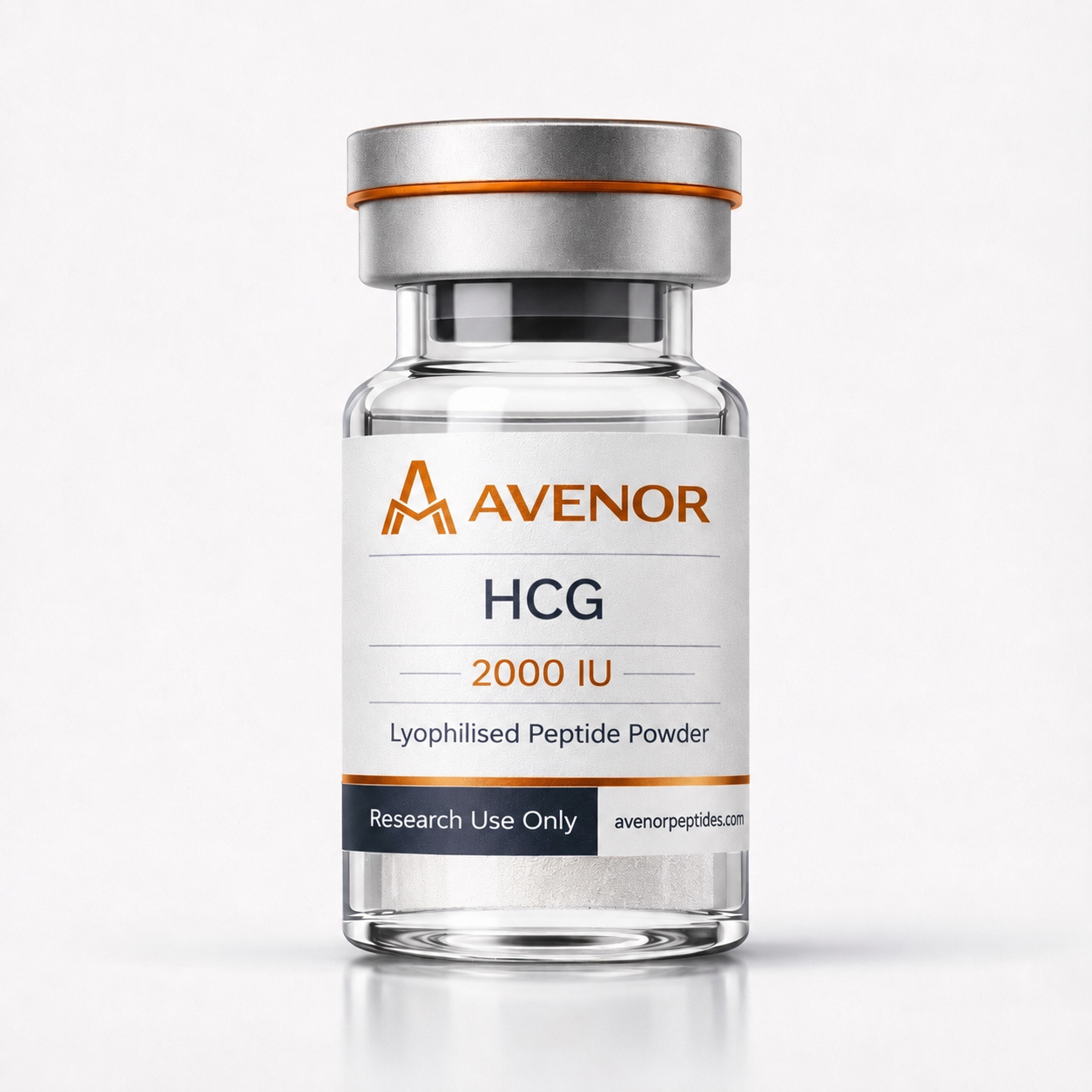
FormResearch product
Strength2000 IU
SKUAV-HCG-2000IU
Stock statusIn stock
COA / BatchSee the documentation state below
StorageRefer to the label and available documentation details.
Packaging / shippingControlled shipping preparation according to the available SKU variant.
Documentation on request
There is no published document for this specific SKU variant at the moment.
Batch documentation and COA, where available, are linked to the specific product batch and SKU.
This product is intended exclusively for laboratory research use. It is not intended for human consumption, diagnosis, treatment, or prevention of disease.
Product profile
92
amino acids in the alpha subunit — shared with LH, FSH and TSH
145
amino acids in the beta subunit — where the specificity sits
≈36 kDa
molecular weight of the heterodimer — roughly a third of it is carbohydrate
≥98%
purity by HPLC
Research context
01
What it is
hCG is a hormone the placenta naturally produces in pregnancy.
In pharmacology it is used because it mimics, almost perfectly, another of the body's hormones — the one that gives the testes their orders.
The technical detail
A glycoprotein hormone. It acts as a functional mimic of luteinizing hormone (LH) at its receptor.
02
How it works
It sends the same signal as the hormone LH, but it lasts longer.
The signal reaches specific cells in the testes and tells them to produce testosterone.
It is this local testosterone that triggers the process of sperm production.
The technical detail
It activates the LH/hCG receptor on Leydig cells, driving steroidogenesis and, indirectly, spermatogenesis.
03
What the research shows
The strongest evidence is in male infertility where the problem starts in the brain, not the testes.
In a contemporary case series, gonadotropin therapy achieved spermatogenesis in about three out of four men.
74%
spermatogenesis induction
68%
pregnancy achieved
35
men in the series
hCG stimulation studies confirm that, even under stress, the cells of the testes keep their capacity to respond.
04
How it compares
In the same series, monotherapy was compared with hCG combined with FSH.
33%
hCG alone
vs
78%
hCG + FSH
The combination was clearly more effective at inducing spermatogenesis than hCG alone.
05
Status and safety
hCG is a prescription medicine. Its use is under medical supervision and after assessment of the hormonal profile.
It is also a prohibited doping substance: it is on the WADA list and is banned specifically in men.
Who may benefit depends on the underlying cause — which is why the literature stresses the importance of stratification before anything else.
The technical detail
Huijben et al., gonadotropins in hypogonadotropic hypogonadism, Reprod Fertil 2026. Esteves et al., hCG in non-obstructive azoospermia, Andrology 2025.
Laboratory use
Used in a controlled laboratory setting as a reference standard in hCG immunoassays and antibody-specificity work, for in vitro binding and activation studies at the LHCGR, for signalling pathway analysis (cAMP generation, beta-arrestin recruitment) in cell lines, for comparative work against recombinant LH, for glycosylation-pattern characterization, and for identity and purity confirmation by HPLC and mass spectrometry.
Research Use Only. For laboratory research exclusively. Not intended for human or veterinary use, diagnosis, treatment, or disease prevention. Chorionic gonadotropin is a prescription medicine and appears on the World Anti-Doping Agency (WADA) Prohibited List; its use in a sporting context constitutes an anti-doping rule violation. No dosages, protocols or administration guidance are provided, and nothing on this page constitutes medical advice. The literature cited concerns basic research and approved pharmaceutical products and does not transfer to research-grade material.
Structural data
Class
Two-subunit glycoprotein hormone; agonist at the LH/choriogonadotropin receptor (LHCGR)
Structure
Heterodimer — one alpha subunit and one beta subunit, non-covalently associated
Alpha subunit
92 amino acids; identical to that of LH, FSH and TSH (CGA gene)
Cystine knot — three disulphide bonds per subunit, a motif shared with growth factors such as NGF, PDGF-B and TGF-beta (Lapthorn et al., 1994)
The "seat belt" feature
A segment of the beta subunit wraps around the alpha subunit and is locked in place by the Cys26–Cys110 disulphide (Lapthorn et al., 1994)
Glycosylation
N-glycosylation on the beta subunit at Asn13 and Asn30; incomplete glycosylation at Asn13 reduces biological activity (Deng et al., 2023)
Receptor
LHCGR — a rhodopsin-family G protein-coupled receptor with a large leucine-rich-repeat extracellular domain
Unit of quantification
International Units (IU) of biological activity against an International Standard — not by mass, unlike synthetic peptides
Product form
Lyophilized powder in a sealed vial
Purity
≥98% (HPLC) — supplied with CoA
Comparison
Feature comparison
Feature
HCG (this product)
Kisspeptin-10
Position on the axis
Downstream — acts directly on the gonads
Upstream — acts on the hypothalamus
Receptor
LHCGR (LH/choriogonadotropin receptor)
KISS1R / GPR54
Molecule type
Two-subunit glycoprotein hormone
Linear single-chain peptide
Size
92 + 145 amino acids, ≈36 kDa
10 amino acids, the C-terminal fragment of kisspeptin-54
Glycosylation
Extensive — roughly a third of the mass
None
Origin
Human placental hormone (or recombinant)
Synthetic fragment of a native peptide
Regulatory status
Prescription medicine; WADA-prohibited substance
Research molecule with no medicinal approval
Product form
Lyophilized powder
Lyophilized powder
Storage & handling
The sealed vial of lyophilized powder is stored refrigerated and protected from light.
As a two-subunit glycoprotein, the molecule is more fragile than a simple synthetic peptide: heat and extremes of pH can dissociate the subunits and destroy biological activity.
Stability drops considerably after reconstitution; the reconstituted solution is kept refrigerated and used within a short window.
Reconstitute gently, letting the liquid run down the vial wall — avoid vigorous shaking, which foams and denatures the protein.
Avoid repeated freeze–thaw cycles.
Avoid prolonged exposure to room temperature and to direct sunlight.
Handle using standard laboratory practice and appropriate personal protective equipment.
Keep away from children and out of food preparation areas.
Documentation
Certificate of Analysis (CoA) per batch, with date and lot number.
Purity analysis by HPLC — specification ≥98%.
Identity and molecular weight confirmation by mass spectrometry.
Statement of content in International Units (IU) of biological activity.
Research Use Only (RUO) declaration on the packaging.
Documents available on request for the specific batch you received.
Why does hCG have two subunits and what does that mean?
The alpha subunit (92 amino acids) is identical across hCG, LH, FSH and TSH — a shared chassis. The beta subunit (145 amino acids) determines which receptor the molecule acts on and what its biological action is. This is why diagnostic tests target the beta subunit specifically: it is the only way to distinguish hCG from the related hormones.
What is the "cystine knot" and why does the literature mention it?
It is the fold motif discovered by Lapthorn and colleagues in 1994: three disulphide bonds per subunit forming a knot that stabilizes the structure. The same motif is found in growth factors such as NGF and TGF-beta, placing hCG structurally in the same superfamily.
What is the molecule's "seat belt"?
A segment of the beta subunit wraps around the alpha subunit and is locked by the Cys26–Cys110 disulphide bond. The 1994 paper itself used this analogy. Without that arrangement the heterodimer does not hold together and receptor binding does not work.
How is the LHCGR receptor activated?
By a "push-and-pull" mechanism, as described by Duan and colleagues in Nature in 2021 on the basis of four cryo-electron microscopy structures. The hormone pushes the extracellular domain upward while a loop pulls it from the other side. A conserved ten-residue fragment (P10) acts as a tethered agonist and relays the signal into the membrane.
Why is it considered a historically important molecule?
Because it was the basis of the first pregnancy test and one of the first biomarkers able to answer a biological question with a simple laboratory test. Every pregnancy strip detects exactly this molecule. Developing ultrasensitive immunoassays for hCG shaped much of modern laboratory biochemistry.
Is it also used as an oncological biomarker?
Yes. As Sisinni and Landriscina describe (2015), hCG is expressed by both trophoblastic and non-trophoblastic malignancies, and its measurement is established in monitoring trophoblastic neoplasms and germ cell tumours. Cole (2009, 2010) also described the free beta subunit as a marker in various non-trophoblastic cancers.
Why is it said that "hCG" is not one molecule?
Because, according to Cole's reviews (2009, 2010), the term covers at least four forms produced by different cell types: regular hCG, hyperglycosylated hCG, the free beta subunit, and a pituitary form. They differ in glycosylation, not in amino acid sequence.
Does glycosylation matter for activity?
Yes, and it has been shown experimentally. Deng and colleagues (2023) analysed recombinant hCG, identified two beta-subunit variants, and demonstrated that absence of glycosylation at residue Asn13 reduces biological activity. Same protein backbone, different sugars, different outcome.
Is it the same as LH, given they act on the same receptor?
No. Riccetti and colleagues (Scientific Reports, 2017) used BRET and FRET technologies in HEK293 cells and a mouse Leydig tumour cell line and found recombinant hCG to be more potent, while LH showed only partial effects on beta-arrestin recruitment. The two hormones act as natural biased agonists at the same receptor.
Is there anything to the claims about the "HCG diet"?
No, and this is documented. The criteria-based meta-analysis by Lijesen and colleagues (British Journal of Clinical Pharmacology, 1995), assessing eight controlled and sixteen uncontrolled trials, concluded there is no scientific evidence of efficacy and that most positive studies were of poor methodological quality. Earlier, the double-blind study by Stein and colleagues (1976) in 51 participants found no statistically significant difference against placebo.
What is the regulatory status of this molecule?
Among the most restrictive in this catalogue. hCG is a prescription medicine and is simultaneously listed on the World Anti-Doping Agency (WADA) Prohibited List, under peptide hormones and growth factors. This product is supplied exclusively as a laboratory reagent and carries no administration guidance whatsoever.
Can it be used by humans or animals?
No. The product is supplied exclusively for laboratory research. It is not intended for human or veterinary use, nor for in vivo application outside a controlled laboratory setting. No dosages, protocols or administration guidance are provided.