Free shipping — the threshold depends on the destination country, confirmed at checkout.

    Research Use Only (RUO). For laboratory research only. Not for human or veterinary use.

    Research Use Only (RUO):Research classification with product and batch documentation where available.
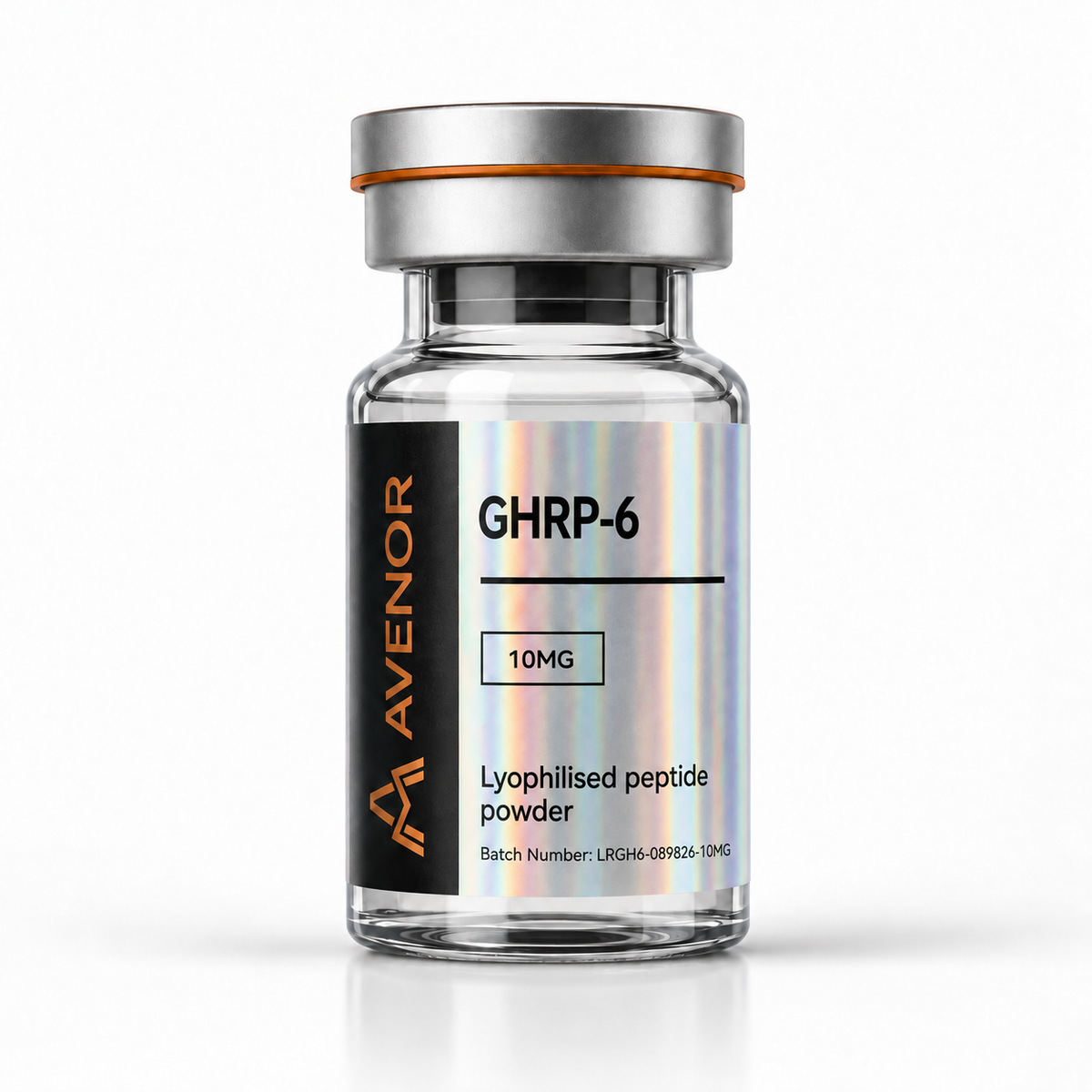
    GHRP-6 10 mg - Avenor Peptides

    Muscle & Performance

    GHRP-6

    Strength: 10 mg

    GHRP-6 (Growth Hormone Releasing Peptide-6) is a synthetic six-amino-acid peptide, one of the first growth hormone secretagogues to be described. It binds the ghrelin receptor (GHS-R1a) and has been in the literature since 1984.

    €45,00€55,00
    -18% off
    In stock
    1

    The more products, the bigger the discount

    2 → −5%
    3 → −8%
    4 → −11%
    5+ → −15%
    across your whole basket, automatically
    Secure payments
    Batch documentationShips from Greece

    Free shipping: Greece from €50, Cyprus and Bulgaria from €100, France, Germany, Italy, Belgium, Netherlands, Spain, Austria, Czechia, Denmark, Estonia, Finland, Hungary, Ireland, Lithuania, Luxembourg, Latvia, Poland, Portugal, Romania, Sweden and Slovakia from €200. Details

    This product is intended exclusively for laboratory research use. It is not intended for human consumption, diagnosis, treatment, or prevention of disease.

    Product information

    FormResearch product
    Strength10 mg
    SKUAVR-GHRP6-10MG
    Stock statusIn stock
    COA / BatchSee the documentation state below
    Packaging / shippingControlled shipping preparation according to the available SKU variant.

    Documentation on request

    There is no published document for this specific SKU variant at the moment.

    Contact us about documentation

    Research overview

    GHRP-6 (Growth Hormone Releasing Peptide-6) is a synthetic six-amino-acid peptide, one of the first growth hormone secretagogues to be described. It binds the ghrelin receptor (GHS-R1a) and has been in the literature since 1984.

    It has been studied because it acts on a different receptor from GHRH. In human studies the two pathways showed a synergistic effect on growth hormone release.

    Documentation & COA

    Batch documentation and COA, where available, are linked to the specific product batch and SKU.

    This product is intended exclusively for laboratory research use. It is not intended for human consumption, diagnosis, treatment, or prevention of disease.

    Product profile

    6

    amino acids — one of the smallest peptides in its class

    1984

    first description of the molecule (Bowers et al., Endocrinology)

    250

    adults in the multicentre Lancet study (Popovic et al., 2000)

    GHS-R1a

    the target receptor, the same one ghrelin uses

    Research context

    What it is

    GHRP-6 is a small synthetic peptide of six amino acids.

    It was designed in the laboratory and described in 1984 as a molecule that makes the pituitary release growth hormone.

    The technical detail

    Hexapeptide His-D-Trp-Ala-Trp-D-Phe-Lys-NH2. A member of the growth hormone secretagogues (GHS). Bowers et al., Endocrinology 1984.
    How it acts

    It binds a receptor in the pituitary and hypothalamus, the same one used by ghrelin, a natural stomach hormone.

    This receptor is different from that of GHRH, the hormone that normally gives the signal for growth hormone.

    That is why, in studies, the two signals together gave a larger response than either one alone.

    The technical detail

    Agonist of GHS-R1a, a G-protein-coupled receptor. Howard et al., Science 1996. Kojima et al., Nature 1999.

    What the research shows

    In 18 healthy men growth hormone release increased, and together with GHRH the effect was synergistic.

    In a multicentre Lancet study of 250 adults, the combination of GHRH and GHRP-6 reliably separated healthy adults from patients with growth hormone deficiency.

    18

    healthy men (Bowers, 1990)

    250

    adults (Popovic, Lancet 2000)

    9

    healthy volunteers, pharmacokinetics (Cabrales, 2013)

    Status

    GHRP-6 has not been approved as a medicine by the EMA or the FDA.

    Research into actions outside the growth hormone axis is at the preclinical stage.

    The technical detail

    Berlanga-Acosta et al., Front Pharmacol 2024 (rat model).

    Laboratory use

    It is intended for use in a controlled laboratory setting as an agonist of the GHS-R1a receptor in binding and signalling studies, in in vitro studies of growth hormone release from pituitary cells, in preclinical cytoprotection studies, and for identity and purity confirmation by HPLC and mass spectrometry.

    Research Use Only. Exclusively for laboratory and research use. Not intended for human or veterinary use, or for the diagnosis, treatment or prevention of disease. The molecule has not been approved as a medicine. The data presented come from published studies and do not constitute instructions for use.

    Structural data

    Class
    Synthetic hexapeptide — growth hormone secretagogue (GHS), agonist of the ghrelin receptor
    Sequence
    His-D-Trp-Ala-Trp-D-Phe-Lys-NH2
    Chain length
    6 amino acids, two of them in D form (D-Trp, D-Phe)
    Molecular weight
    872.44 Da (Cabrales et al., 2013)
    Target
    Growth hormone secretagogue receptor GHS-R1a, in the pituitary and hypothalamus (Howard et al., 1996)
    Natural ligand of the same receptor
    Ghrelin — identified in 1999 (Kojima et al., Nature)
    Product form
    Lyophilised powder in a sealed vial, 10 mg
    Documentation
    Certificate of Analysis (CoA) per batch
    CAS number
    87616-84-0

    Comparison

    Feature comparison

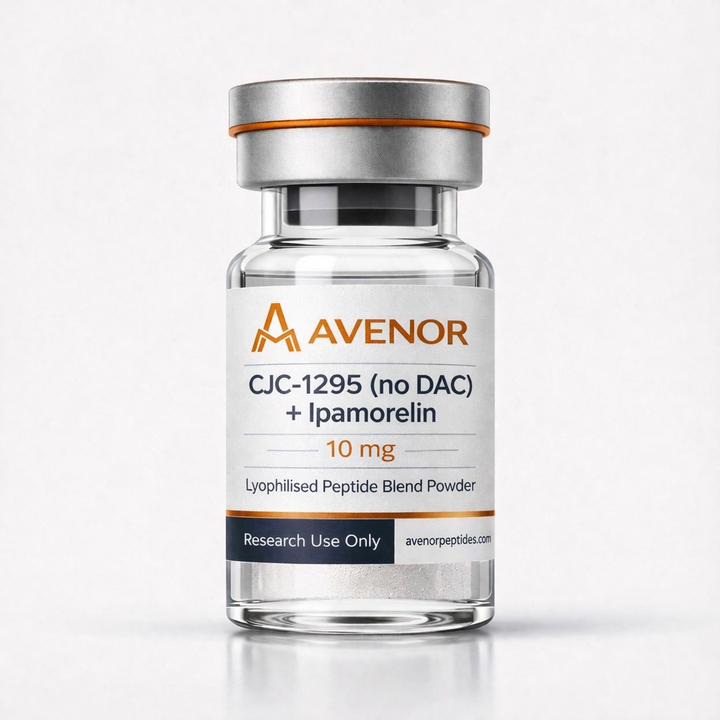
    FeatureGHRP-6 (this product)CJC-1295 + IpamorelinTesamorelin
    Type of moleculeSynthetic hexapeptide, 6 amino acidsGHRH analogue plus a pentapeptideGHRH analogue
    Direct molecular targetGhrelin receptor (GHS-R1a)GHRH receptor (CJC-1295) and ghrelin receptor (ipamorelin)GHRH receptor
    Site of action on the axisPituitary and hypothalamusPituitary, through two different receptorsPituitary

    Documentation

    • Certificate of Analysis (CoA) per batch, where issued, with date and batch number.
    • Purity analysis by HPLC, where a CoA has been issued for the batch.
    • Identity and molecular weight confirmed by mass spectrometry, where a CoA has been issued for the batch.
    • Research Use Only (RUO) statement on the packaging.
    • Documents are available on request for the specific batch you received.

    References

    References & documentation

    1. 1.Bowers C.Y. et al. (1984). On the in vitro and in vivo activity of a new synthetic hexapeptide that acts on the pituitary to specifically release growth hormone. Endocrinology, 114(5), 1537-1545.
    2. 2.Bowers C.Y. et al. (1990). Growth hormone (GH)-releasing peptide stimulates GH release in normal men and acts synergistically with GH-releasing hormone. J Clin Endocrinol Metab, 70(4), 975-982.
    3. 3.Peñalva A. et al. (1993). Influence of sex, age and adrenergic pathways on the growth hormone response to GHRP-6. Clin Endocrinol (Oxf), 38(1), 87-91.
    4. 4.Howard A.D. et al. (1996). A receptor in pituitary and hypothalamus that functions in growth hormone release. Science, 273(5277), 974-977.
    5. 5.Kojima M. et al. (1999). Ghrelin is a growth-hormone-releasing acylated peptide from stomach. Nature, 402(6762), 656-660.
    6. 6.Popovic V. et al. (2000). GH-releasing hormone and GH-releasing peptide-6 for diagnostic testing in GH-deficient adults. Lancet, 356(9236), 1137-1142.
    7. 7.Cabrales A. et al. (2013). Pharmacokinetic study of Growth Hormone-Releasing Peptide 6 (GHRP-6) in nine male healthy volunteers. Eur J Pharm Sci, 48(1-2), 40-46.
    8. 8.Berlanga-Acosta J. et al. (2024). Growth hormone releasing peptide-6 (GHRP-6) prevents doxorubicin-induced myocardial and extra-myocardial damages by activating prosurvival mechanisms. Front Pharmacol, 15, 1402138.

    Product information

    Frequently asked questions

    What does “GHRP-6” mean?
    It stands for Growth Hormone-Releasing Peptide 6. The “6” refers to the six amino acids in its chain: His-D-Trp-Ala-Trp-D-Phe-Lys-NH2.
    Is it a natural hormone of the body?
    No. It is a synthetic molecule designed in the laboratory and described in 1984 by Bowers' group. It was later shown to act on the same receptor as a natural stomach hormone, ghrelin, which was discovered in 1999 (Kojima et al., Nature).
    How does it differ from GHRH and its analogues?
    It acts on a different receptor. GHRH and its analogues (such as CJC-1295 and tesamorelin) bind the GHRH receptor. GHRP-6 binds the GHS-R1a receptor. Bowers and colleagues (1990) showed in healthy men that the two together produced a larger growth hormone release than the sum of each alone, and concluded that these are two independent mechanisms.
    Are there human studies?
    Yes. The first was carried out in 18 healthy men (Bowers et al., 1990). Peñalva and colleagues (1993) studied 25 healthy adults and 12 children. Popovic and colleagues (Lancet, 2000) used it together with GHRH in a multicentre study of 125 adults with pituitary disease and 125 healthy adults. Cabrales and colleagues (2013) measured its pharmacokinetics in nine healthy male volunteers.
    Why is it of interest to researchers as a laboratory tool?
    Because it belongs to the family of molecules that led to the discovery of an entire system. Using peptides of this family, the GHS-R receptor was cloned in 1996 (Howard et al., Science) and three years later its natural ligand, ghrelin, was found.
    Is it studied outside the growth hormone axis?
    Yes, at the preclinical level. A research group in Cuba studies its cytoprotective properties; a 2024 paper (Berlanga-Acosta et al., Frontiers in Pharmacology) examined it in an experimental rat model. These data come from laboratory animals.
    Has it been approved as a medicine?
    No. GHRP-6 has not been approved as a medicine by the EMA or the FDA.
    Can it be used by humans or animals?
    No. The product is supplied exclusively for laboratory research. It is not intended for human or veterinary use. No administration or dosing instructions are provided.
    Do I receive a certificate of analysis?
    For batches that have been tested we publish the CoA in the COA Library, with HPLC purity analysis and mass spectrometry identity confirmation. If no document has been published yet for your batch, ask us and we will tell you where the testing stands.