What it is
A synthetic tripeptide of three amino acids: Glu-Asp-Arg.
Publications refer to it as the EDR peptide.
The technical detail
Tripeptide Glu-Asp-Arg, C15H26N6O8, 418.40 g/mol, CAS 175175-23-2 (PubChem CID 10273502).
Research Use Only (RUO). For laboratory research only. Not for human or veterinary use.

Short peptides
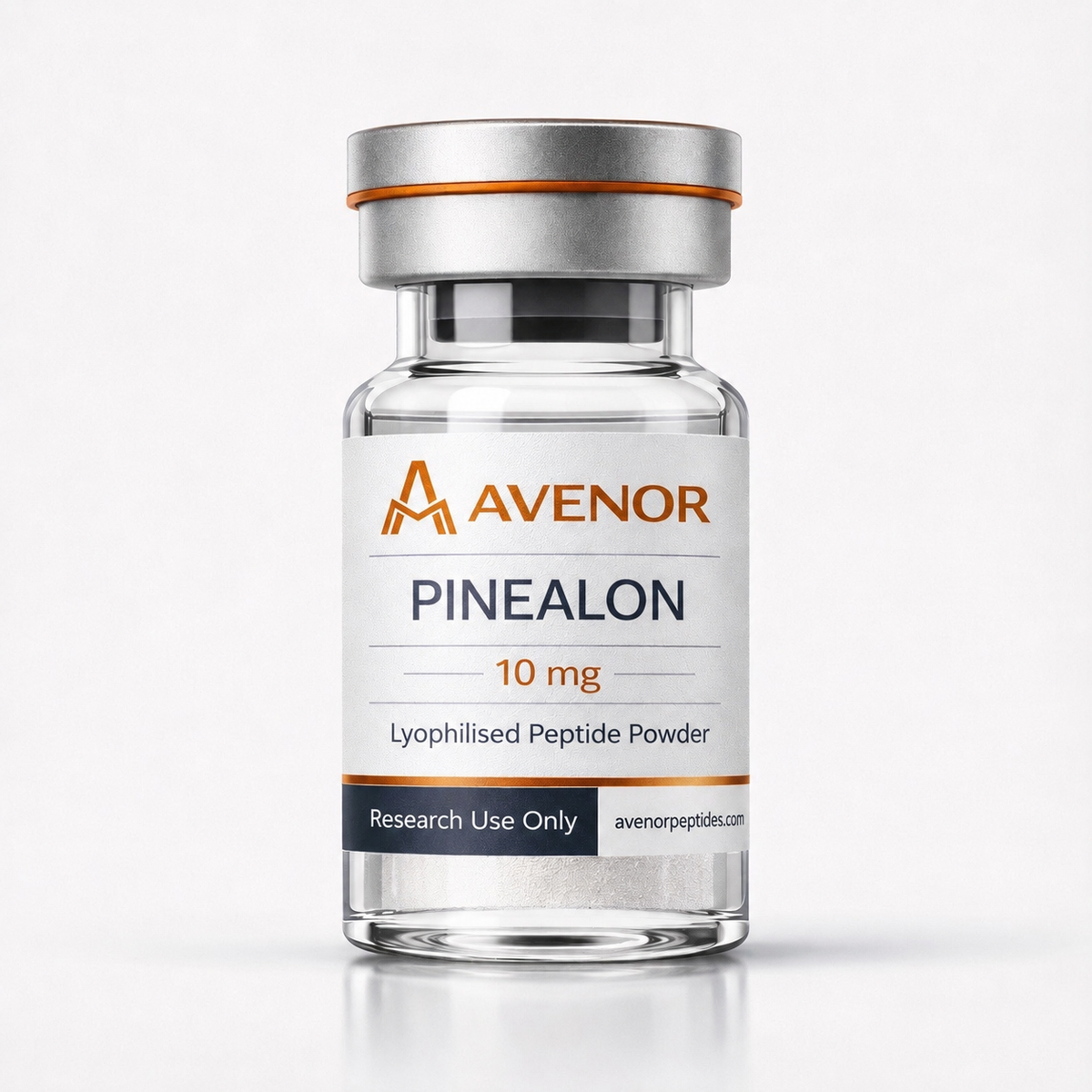
Strength: 10 mg
Pinealon is a synthetic tripeptide with the sequence Glu-Asp-Arg (EDR). In the literature it is called the “EDR peptide” and is studied mainly in cultures of nerve cells.
The more products, the bigger the discount
Free shipping: Greece from €50, Cyprus and Bulgaria from €100, France, Germany, Italy, Belgium, Netherlands, Spain, Austria, Czechia, Denmark, Estonia, Finland, Hungary, Ireland, Lithuania, Luxembourg, Latvia, Poland, Portugal, Romania, Sweden and Slovakia from €200. Details
This product is intended exclusively for laboratory research use. It is not intended for human consumption, diagnosis, treatment, or prevention of disease.
Documentation on request
There is no published document for this specific SKU variant at the moment.
Contact us about documentationResearch overview
Pinealon is a synthetic tripeptide with the sequence Glu-Asp-Arg (EDR). In the literature it is called the “EDR peptide” and is studied mainly in cultures of nerve cells.
It interests researchers as a small molecule for studying oxidative stress and the interaction of short peptides with DNA in nerve cells.
Batch documentation and COA, where available, are linked to the specific product batch and SKU.
This product is intended exclusively for laboratory research use. It is not intended for human consumption, diagnosis, treatment, or prevention of disease.
Product profile
3
amino acids — the tripeptide Glu-Asp-Arg
418.40
molecular weight (g/mol)
EDR
its name in the publications
10 mg
amount per vial
Research context
A synthetic tripeptide of three amino acids: Glu-Asp-Arg.
Publications refer to it as the EDR peptide.
Tripeptide Glu-Asp-Arg, C15H26N6O8, 418.40 g/mol, CAS 175175-23-2 (PubChem CID 10273502).
The mechanism is a working hypothesis.
An interaction of the peptide with DNA has been described.
Partial entry into the major groove of DNA and interaction with N7 and O6 of guanine (Silanteva 2019).
Studies in cultures of nerve cells.
Free radicals and oxidative DNA damage were measured.
Khavinson 2011 (rat cerebellar granule cells, PC12); Kraskovskaya 2024 (induced neurons from elderly donors’ fibroblasts).
The data are mainly preclinical.
Supplied for laboratory research only.
Preclinical data.
It is intended for use in a controlled laboratory setting, in in vitro studies of oxidative stress in nerve-cell cultures and in biophysical studies of peptide–DNA interaction.
Research Use Only. Exclusively for laboratory and research use. Not intended for human or veterinary use, or for the diagnosis, treatment or prevention of any condition. It is not a medicine, a food or a dietary supplement.
References
Product information
Explore more
Products from the same research category for quick comparison of documentation, strength and availability.