Free shipping — the threshold depends on the destination country, confirmed at checkout.

    Research Use Only (RUO). For laboratory research only. Not for human or veterinary use.

    Research Use Only (RUO):Research classification with product and batch documentation where available.
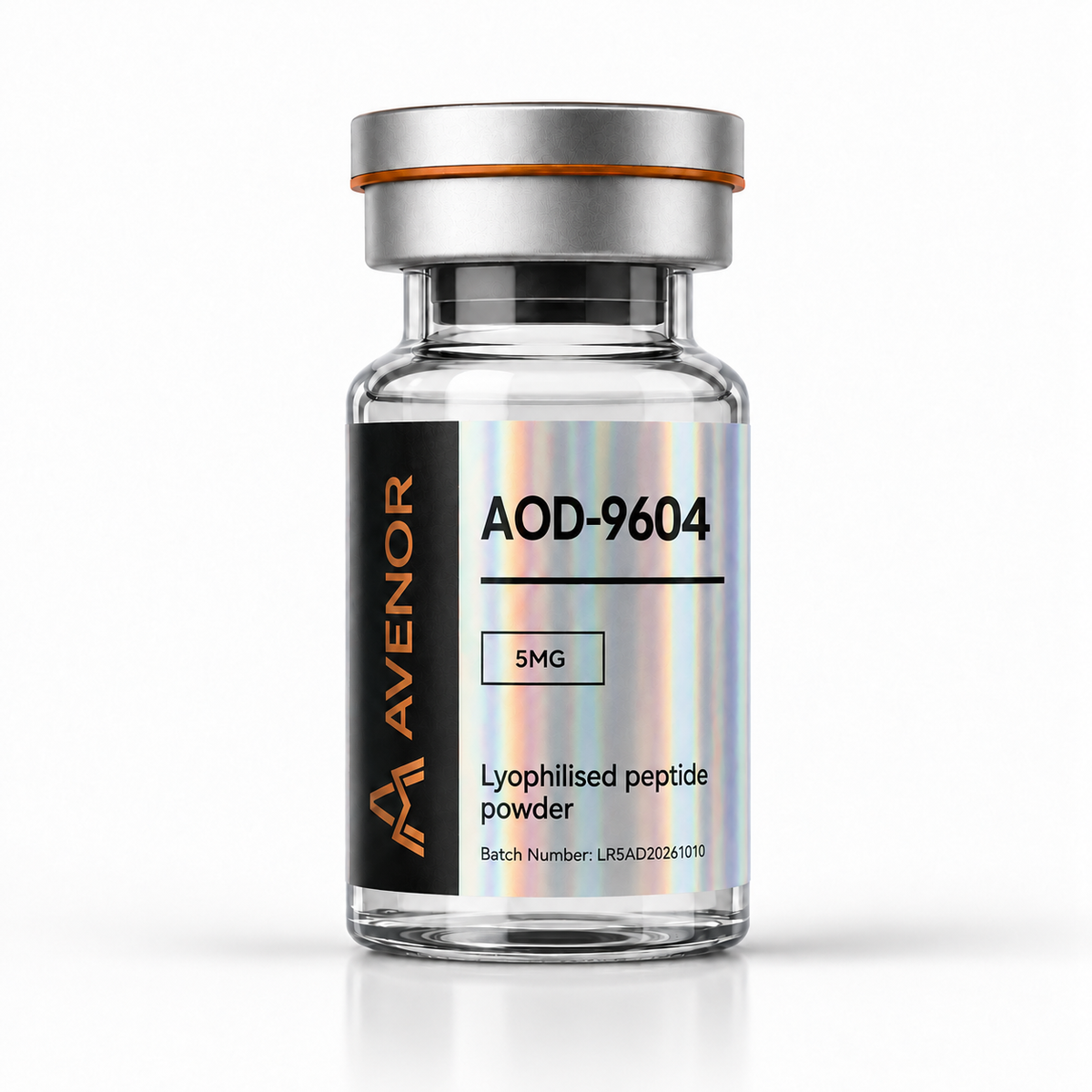
    AOD-9604 5 mg - Avenor Peptides

    Body composition

    AOD-9604

    Strength: 5 mg

    AOD-9604 is a synthetic peptide of 16 amino acids. It corresponds to the last segment of human growth hormone (amino acids 177-191), with one tyrosine added at the start of the chain. It has been in the literature since 2000.

    €38,00€45,00
    -16% off
    In stock
    1

    The more products, the bigger the discount

    2 → −5%
    3 → −8%
    4 → −11%
    5+ → −15%
    across your whole basket, automatically
    Secure payments
    Batch documentationShips from Greece

    Free shipping: Greece from €50, Cyprus and Bulgaria from €100, France, Germany, Italy, Belgium, Netherlands, Spain, Austria, Czechia, Denmark, Estonia, Finland, Hungary, Ireland, Lithuania, Luxembourg, Latvia, Poland, Portugal, Romania, Sweden and Slovakia from €200. Details

    This product is intended exclusively for laboratory research use. It is not intended for human consumption, diagnosis, treatment, or prevention of disease.

    Product information

    FormResearch product
    Strength5 mg
    SKUAVR-AOD9604-5MG
    Stock statusIn stock
    COA / BatchSee the documentation state below
    Packaging / shippingControlled shipping preparation according to the available SKU variant.

    Documentation on request

    There is no published document for this specific SKU variant at the moment.

    Contact us about documentation

    Research overview

    AOD-9604 is a synthetic peptide of 16 amino acids. It corresponds to the last segment of human growth hormone (amino acids 177-191), with one tyrosine added at the start of the chain. It has been in the literature since 2000.

    Of interest is that, in cells and laboratory animals, it did not compete with growth hormone for its receptor. In six trials with 893 adults, where it was given by mouth or intravenously, it did not change IGF-1 or glucose tolerance.

    Documentation & COA

    Batch documentation and COA, where available, are linked to the specific product batch and SKU.

    This product is intended exclusively for laboratory research use. It is not intended for human consumption, diagnosis, treatment, or prevention of disease.

    Product profile

    16

    amino acids — the last 15 of growth hormone plus one tyrosine

    2000

    the 2000 publication under the name AOD9604 (Ng et al., Hormone Research)

    893

    adults in six randomised trials (Stier et al., 2013)

    177-191

    the segment of growth hormone it is derived from

    Research context

    What it is

    AOD-9604 is a small synthetic peptide of 16 amino acids.

    It copies the last piece of human growth hormone, with one extra amino acid at the start.

    The technical detail

    Tyr-hGH 177-191, disulfide bond Cys7-Cys14, 1815.1 Da. Stier et al., J Endocrinol Metab 2013.
    How it was studied

    In laboratory animals and cells it was compared with whole growth hormone, to see which of its actions it retains.

    In cells it did not compete with the hormone for its receptor, and in animals it did not raise blood glucose.

    In these models research focused on adipose tissue and fat metabolism.

    The technical detail

    Ng et al., Horm Res 2000 (Zucker rats). Heffernan et al., Int J Obes 2001 and Endocrinology 2001 (mice).

    What human research shows

    In six randomised trials with 893 adults, with administration by mouth or intravenously, IGF-1 stayed unchanged and glucose tolerance did not differ from placebo.

    No antibodies against the peptide were detected in the participants tested, and adverse events were similar to placebo.

    893

    adults in total (Stier, 2013)

    6

    randomised, double-blind trials

    24

    weeks in the longest trial

    Status

    AOD-9604 has not been approved as a medicine by the EMA or the FDA.

    Its clinical development as a medicine was not completed. The mechanism of action has been studied in laboratory animals and cells.

    The technical detail

    In the human trials the peptide was given by mouth or intravenously (Stier et al., 2013).

    Laboratory use

    It is intended for use in a controlled laboratory setting: in in vitro studies of adipocyte metabolism, in comparative studies with growth hormone and its receptor, as a reference standard in mass spectrometry analytical methods, and for identity and purity confirmation by HPLC.

    Research Use Only. Exclusively for laboratory and research use. Not intended for human or veterinary use, or for the diagnosis, treatment or prevention of disease. The molecule has not been approved as a medicine. The data presented come from published studies and do not constitute instructions for use.

    Structural data

    Class
    Synthetic hexadecapeptide — modified C-terminal fragment of human growth hormone
    Sequence
    Tyr-Leu-Arg-Ile-Val-Gln-Cys-Arg-Ser-Val-Glu-Gly-Ser-Cys-Gly-Phe
    Chain length
    16 amino acids, with a disulfide bond between the two cysteines (positions 7 and 14)
    Molecular formula
    C78H123N23O23S2
    Molecular weight
    1815.1 Da (free base)
    CAS number
    221231-10-3
    Relation to growth hormone
    Amino acids 177-191 of hGH, with one tyrosine at the N-terminus (Stier et al., 2013)
    Product form
    Lyophilised powder in a sealed vial, 5 mg
    Documentation
    Certificate of Analysis (CoA) per batch

    Comparison

    Feature comparison

    FeatureAOD-9604 (this product)GHRP-6Tesamorelin
    Type of moleculeFragment of growth hormone, 16 amino acidsSynthetic hexapeptideGHRH analogue
    Relation to growth hormoneIt is a modified piece of the hormone molecule itselfSignals the pituitary to release itSignals the pituitary to release it
    Receptor studiedIn cells it did not compete with growth hormone for its receptor (Heffernan et al., 2001)Ghrelin receptor (GHS-R1a)GHRH receptor

    Documentation

    • Certificate of Analysis (CoA) per batch, where issued, with date and batch number.
    • Purity analysis by HPLC, where a CoA has been issued for the batch.
    • Identity and molecular weight confirmed by mass spectrometry, where a CoA has been issued for the batch.
    • Research Use Only (RUO) statement on the packaging.
    • Documents are available on request for the specific batch you received.

    References

    References & documentation

    1. 1.Ng F.M. et al. (2000). Metabolic studies of a synthetic lipolytic domain (AOD9604) of human growth hormone. Horm Res, 53(6), 274-278.
    2. 2.Heffernan M.A. et al. (2001). Increase of fat oxidation and weight loss in obese mice caused by chronic treatment with human growth hormone or a modified C-terminal fragment. Int J Obes Relat Metab Disord, 25(10), 1442-1449.
    3. 3.Heffernan M. et al. (2001). The effects of human GH and its lipolytic fragment (AOD9604) on lipid metabolism following chronic treatment in obese mice and beta(3)-AR knock-out mice. Endocrinology, 142(12), 5182-5189.
    4. 4.Stier H., Vos E., Kenley D. (2013). Safety and tolerability of the hexadecapeptide AOD9604 in humans. J Endocrinol Metab, 3(1-2), 7-15.
    5. 5.Cox H.D. et al. (2015). Detection and in vitro metabolism of AOD9604. Drug Test Anal, 7(1), 31-38.
    6. 6.Kwon D.R., Park G.Y. (2015). Effect of intra-articular injection of AOD9604 with or without hyaluronic acid in rabbit osteoarthritis model. Ann Clin Lab Sci, 45(4), 426-432.

    Product information

    Frequently asked questions

    Where does the name AOD-9604 come from?
    It is the code given to the molecule by the company that developed it in Australia. In the literature it is also written AOD9604, without a hyphen. Chemically it is described as Tyr-hGH 177-191: amino acids 177 to 191 of human growth hormone, with one tyrosine at the start.
    Is it the same as growth hormone?
    No. Growth hormone has 191 amino acids, while AOD-9604 has 16. In the experiments of Heffernan and colleagues (2001), in cells, it did not compete with the hormone for its receptor, and in human trials it did not change IGF-1 (Stier et al., 2013).
    Is it the same as “fragment 176-191”?
    Not exactly. AOD-9604 starts with tyrosine, while the natural 176-191 segment of the hormone starts with phenylalanine. The two molecules differ in that first amino acid and are listed separately in the literature.
    Are there human studies?
    Yes. Six randomised, double-blind, placebo-controlled trials were run with 893 adults in total, between 2001 and 2006. The safety data were published in 2013 by Stier, Vos and Kenley. The great majority of participants were obese adults.
    What was measured in those trials?
    Adverse events, laboratory tests, electrocardiogram, IGF-1, the oral glucose tolerance test and antibodies against the peptide. IGF-1 and glucose tolerance did not differ from placebo, and no antibodies were detected in the participants who were tested. The peptide was given by mouth or intravenously.
    Is it studied in other fields?
    Yes, at the preclinical level. Kwon and Park (2015) examined it in a rabbit model of knee osteoarthritis. These data come from laboratory animals.
    Has it been approved as a medicine?
    No. AOD-9604 has not been approved as a medicine by the EMA or the FDA. Its clinical development as a medicine was not completed.
    Can it be used by humans or animals?
    No. The product is supplied exclusively for laboratory research. It is not intended for human or veterinary use. No administration or dosing instructions are provided.
    Do I receive a certificate of analysis?
    For batches that have been tested we publish the CoA in the COA Library, with HPLC purity analysis and mass spectrometry identity confirmation. If no document has been published yet for your batch, ask us and we will tell you where the testing stands.