
Free shipping — the threshold depends on the destination country, confirmed at checkout.

    Research Use Only (RUO). For laboratory research only. Not for human or veterinary use.

    Research Use Only (RUO):Research classification with product and batch documentation where available.
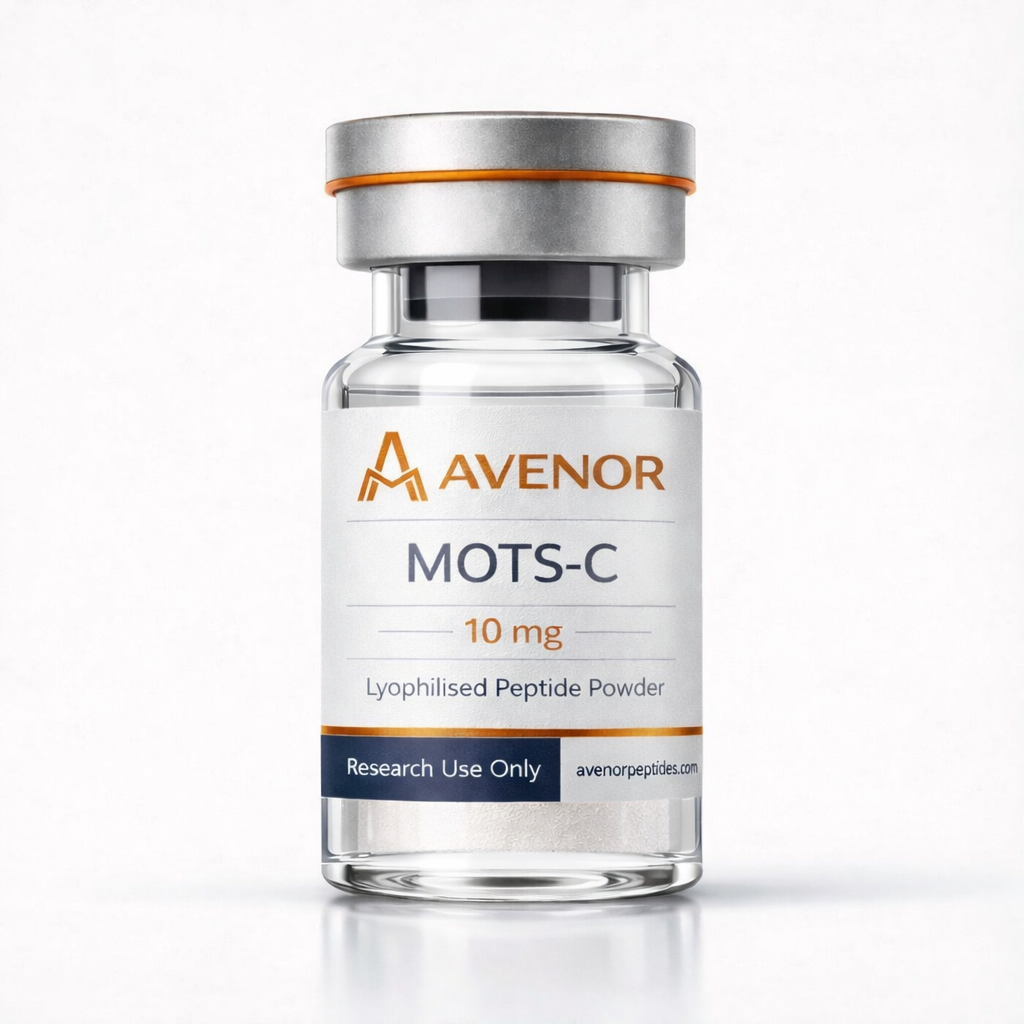
    MOTS-C 10 mg - Avenor Peptides

    Body composition

    MOTS-C

    Strength: 10 mg

    MOTS-C is a research-use catalogue item organized around product identity, SKU traceability and available documentation.

    €45,00
    In stock
    1

    The more products, the bigger the discount

    2 → −5%
    3 → −8%
    4 → −11%
    5+ → −15%
    across your whole basket, automatically
    Batch documentationShips from Greece

    Free shipping: Greece from €50, Cyprus and Bulgaria from €100, France, Germany, Italy, Belgium, Netherlands and Spain from €200. Details

    This product is intended exclusively for laboratory research use. It is not intended for human consumption, diagnosis, treatment, or prevention of disease.

    Product information

    FormResearch product
    Strength10 mg
    SKUAV-MOTSC-10MG
    Stock statusIn stock
    COA / BatchSee the documentation state below
    StorageIn powder form: freezer (−20°C).
    Packaging / shippingProtective professional shipping packaging with clear labelling.

    Documentation on request

    There is no published document for this specific SKU variant at the moment.

    Contact us about documentation

    Research overview

    Documentation & COA

    Batch documentation and COA, where available, are linked to the specific product batch and SKU.

    This product is intended exclusively for laboratory research use. It is not intended for human consumption, diagnosis, treatment, or prevention of disease.

    Product profile

    16

    amino acids — encoded by mitochondrial DNA

    12S rRNA

    the region of the mitochondrial genome it comes from

    2015

    year of discovery — Lee et al., Cell Metabolism

    ≥98%

    purity by HPLC

    Research context

    What it is

    MOTS-c is a small peptide, just 16 amino acids long.

    It is not made by the cell nucleus, the way almost all of our proteins are. It is encoded by the mitochondrion itself — the cell's power plant.

    It is, quite literally, a message the mitochondria send to the rest of the body.

    The technical detail

    A mitochondrial-derived peptide (MDP), encoded within the 12S rRNA gene of mitochondrial DNA.

    How it works

    Think of it as an internal exercise signal.

    When the body moves and is pushed metabolically, mitochondria release more MOTS-c.

    That switches on the cell's energy sensors, tells muscle to burn fuel, and helps the body shift easily between fat and sugar.

    The technical detail

    It activates the AMPK pathway and regulates nuclear genes tied to metabolism and proteostasis (Reynolds et al., Nat Commun, 2021).

    What the studies showed

    The landmark came in 2021, in mice of three different ages.

    Young, middle-aged, and old — physical performance improved in all three.

    16

    amino acids

    12S rRNA

    gene of origin

    3 ages

    performance gain, 2021

    In the same study, exercise raised MOTS-c levels in human muscle and blood — proof that the molecule is a natural signal of exercise.

    How it compares

    Classic peptides are written in the nucleus. MOTS-c is one of the very few written in the mitochondria.

    That is why it is often grouped with the 'exercise mimetics': molecules that copy some of the signals of a workout.

    Work from 2025 and 2026 extends its role to antioxidant protection of the heart and blood vessels, through the same energy pathways.

    The technical detail

    Reviews from 2025–2026 (Tero-Vescan et al.; Sivakumar et al.) place MOTS-c among exercise mimetics acting via AMPK, mTOR, and sirtuins; human administration data remain early.

    Laboratory use

    Used in a controlled laboratory setting for in vitro studies of the AMPK pathway in cell lines, for quantifying AMPK and ACC phosphorylation by western blot, for mitochondrial respiration and oxygen consumption assays, and for identity and purity confirmation by HPLC and mass spectrometry.

    Research Use Only. For laboratory research exclusively. Not intended for human or veterinary use, diagnosis, treatment, or disease prevention. No therapeutic, metabolic, or anti-ageing claim is made.

    Structural data

    Sequence
    Met-Arg-Trp-Gln-Glu-Met-Gly-Tyr-Ile-Phe-Tyr-Pro-Arg-Lys-Leu-Arg
    Sequence (single-letter)
    MRWQEMGYIFYPRKLR
    Molecular weight
    ≈2192.6 g/mol (average)
    Chain length
    16 amino acids
    Genetic origin
    An open reading frame within the 12S rRNA of mitochondrial DNA
    Class
    Mitochondrial-derived peptide (MDP)
    Product form
    Lyophilized powder in a vial, 10 mg
    Purity
    ≥98% (HPLC) — supplied with CoA

    Comparison

    Feature comparison

    FeatureMOTS-c (this product)SS-31SLU-PP-332
    Molecule type16-amino-acid peptideTetrapeptideSmall synthetic molecule (not a peptide)
    OriginEncoded by mitochondrial DNAFully syntheticFully synthetic
    Main molecular target in the literatureAMPK pathway, folate and purine metabolismCardiolipin of the inner mitochondrial membraneERR (estrogen-related receptors)
    Research focusMetabolic homeostasis, insulin sensitivity, agingMitochondrial structural integrity, oxidative stressExercise mimetic — mitochondrial biogenesis
    Communication with the nucleusDocumented translocation to the nucleus under metabolic stressNo such mechanism describedActs through nuclear receptors
    Catalog formLyophilized injectableLyophilized injectableDepends on formulation

    Storage & handling

    • Store the lyophilized (freeze-dried powder) vial frozen, preferably at -20 °C or below, protected from light.
    • For short transit or receiving periods the powder remains stable at room temperature; move it to the freezer as soon as it arrives.
    • Reconstitution is performed in the laboratory with an appropriate sterile diluent — typically bacteriostatic or sterile water — added slowly down the wall of the vial rather than directly onto the powder.
    • Swirl the vial gently until fully dissolved. Do not shake vigorously, as mechanical stress can denature the peptide.
    • Once reconstituted, keep refrigerated (2-8 °C) and protected from light; peptide solutions are markedly less stable than the lyophilized form.
    • Avoid repeated freeze-thaw cycles. For longer storage, split the reconstituted solution into small single-use aliquots.
    • Maintain aseptic technique at every handling step.
    • Keep away from children and out of food preparation areas.

    Documentation

    • Certificate of Analysis (CoA) per batch, with date and lot number.
    • Purity analysis by HPLC — specification ≥98%.
    • Identity and molecular weight confirmation by mass spectrometry.
    • Research Use Only (RUO) declaration on the packaging and accompanying documents.
    • Documents available on request for the specific batch you received.

    References

    References & documentation

    1. 1.Lee C. et al. (2015). The mitochondrial-derived peptide MOTS-c promotes metabolic homeostasis and reduces obesity and insulin resistance. Cell Metab, 21(3), 443-454.
    2. 2.Lee C., Kim K.H., Cohen P. (2016). MOTS-c: A novel mitochondrial-derived peptide regulating muscle and fat metabolism. Free Radic Biol Med, 100, 182-187.
    3. 3.Kim K.H. et al. (2018). The Mitochondrial-Encoded Peptide MOTS-c Translocates to the Nucleus to Regulate Nuclear Gene Expression in Response to Metabolic Stress. Cell Metab, 28(3), 516-524.e7.
    4. 4.Ramanjaneya M. et al. (2019). Lipids and insulin regulate mitochondrial-derived peptide (MOTS-c) in PCOS and healthy subjects. Clin Endocrinol (Oxf), 91(2), 278-287.
    5. 5.Zempo H. et al. (2021). A pro-diabetogenic mtDNA polymorphism in the mitochondrial-derived peptide, MOTS-c. Aging (Albany NY), 13(2), 1692-1717.
    6. 6.Yang B. et al. (2021). MOTS-c interacts synergistically with exercise intervention to regulate PGC-1α expression, attenuate insulin resistance and enhance glucose metabolism in mice via AMPK signaling pathway. Biochim Biophys Acta Mol Basis Dis, 1867(6), 166126.
    7. 7.Yu W.D. et al. (2021). The mitochondrial-derived peptide MOTS-c promotes homeostasis in aged human placenta-derived mesenchymal stem cells in vitro. Mitochondrion, 58, 135-146.
    8. 8.Zheng Y., Wei Z., Wang T. (2023). MOTS-c: A promising mitochondrial-derived peptide for therapeutic exploitation. Front Endocrinol (Lausanne), 14, 1120533.

    Product information

    Frequently asked questions

    What does it mean that MOTS-c comes from mitochondrial DNA?
    It means its recipe is not written in nuclear DNA, where nearly all our genes sit, but in the separate tiny genome that mitochondria carry. Mitochondria kept that DNA from the era when they were free-living bacteria, before being absorbed into cells. For decades it was assumed to encode only parts of the energy machinery — the 2015 discovery of MOTS-c showed it also encodes signalling molecules.
    Why is this considered scientifically significant?
    Because it overturns the one-way hierarchy of textbook cell biology. The nucleus was known to control the mitochondria; the work of Kim et al. (2018) showed MOTS-c travelling into the nucleus and influencing nuclear gene expression. The communication runs both ways — the two genomes cross-regulate each other.
    What is the AMPK pathway that keeps coming up?
    AMPK is an enzyme that acts as the cell's fuel gauge. When energy reserves fall it switches on and steers the cell toward burning energy rather than storing it. In the literature MOTS-c is described as activating this pathway indirectly, by interfering with the folate cycle and purine synthesis.
    What is the connection to exercise?
    In rodent models, Yang et al. (2021) found MOTS-c levels reduced in obese mice, and treadmill training raised them alongside markers of mitochondrial biogenesis. In humans the picture is less clean: Ramanjaneya et al. (2019) saw no change in baseline levels after eight weeks of moderate exercise training.
    What did the large genetic study of 27,527 participants show?
    Zempo et al. (2021) identified a mitochondrial variant that swaps one amino acid in MOTS-c. Male carriers showed a higher prevalence of type 2 diabetes, but only those in the lowest tier of physical activity. It is a rare example of a genetic variant that appears to matter mainly against a sedentary background.
    Is there human administration data?
    No completed controlled clinical trials. The human studies that exist are largely observational and measure circulating levels of the peptide rather than administering it. A 2023 review (Zheng et al.) concludes that no effective method of clinical application has yet been developed.
    How does it differ from SS-31 and SLU-PP-332 in the catalog?
    All three relate to mitochondria but from entirely different angles. SS-31 is a synthetic tetrapeptide studied for the structural integrity of the inner mitochondrial membrane. SLU-PP-332 is not even a peptide — it is a small synthetic molecule acting on ERR nuclear receptors. MOTS-c is the only one of the three encoded by mitochondrial DNA itself. See the comparison table.
    Can it be used by humans or animals?
    No. The product is supplied exclusively for laboratory research. It is not intended for human or veterinary use, nor for in vivo application outside a controlled laboratory setting.