
Free shipping — the threshold depends on the destination country, confirmed at checkout.

    Research Use Only (RUO). For laboratory research only. Not for human or veterinary use.

    Research Use Only (RUO):Research classification with product and batch documentation where available.
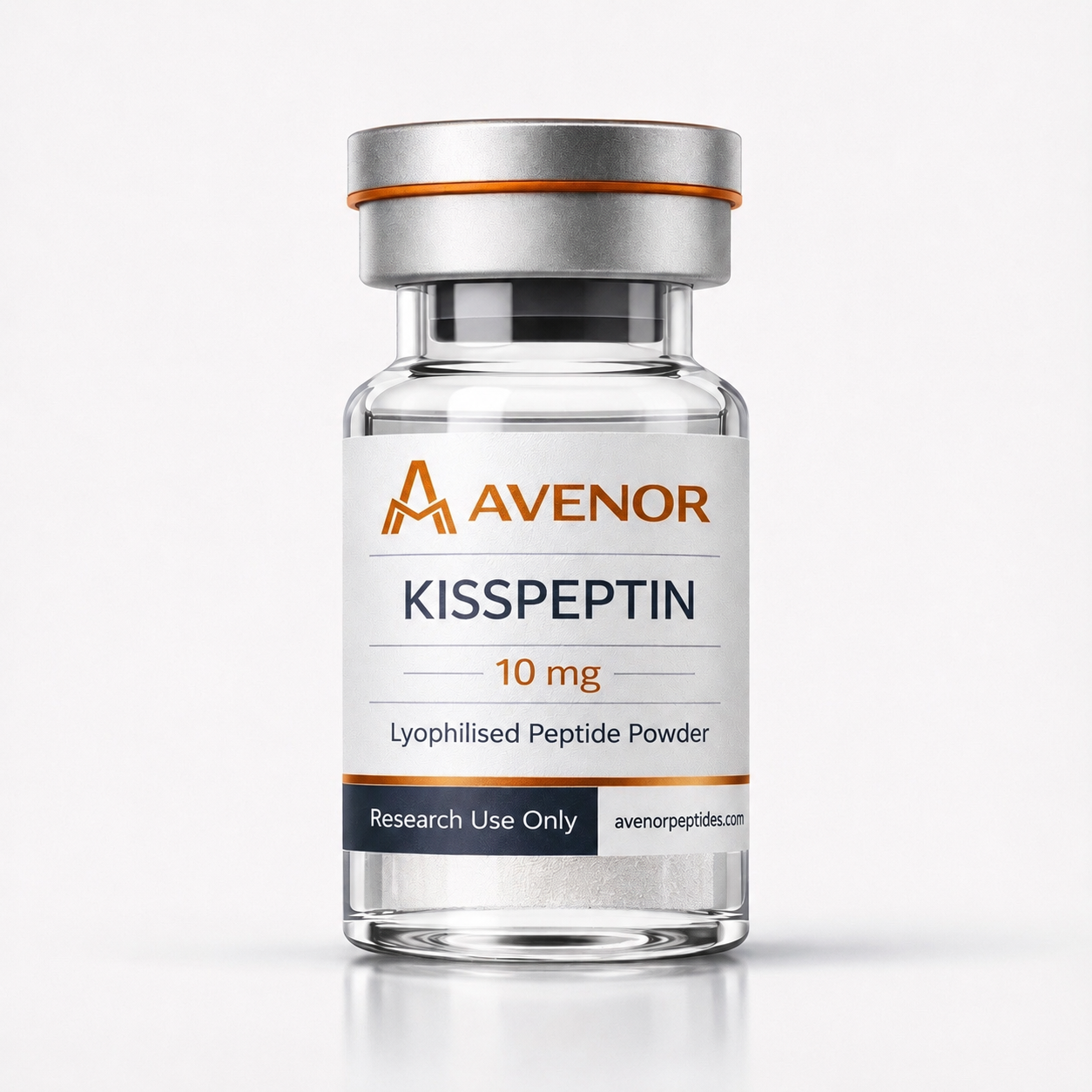
    Kisspeptin 10 mg - Avenor Peptides

    Body composition

    Kisspeptin

    Strength: 10 mg

    Kisspeptin is a research-use catalogue item organized around product identity, SKU traceability and available documentation.

    €50,00
    In stock
    1

    The more products, the bigger the discount

    2 → −5%
    3 → −8%
    4 → −11%
    5+ → −15%
    across your whole basket, automatically
    Batch documentationShips from Greece

    Free shipping: Greece from €50, Cyprus and Bulgaria from €100, France, Germany, Italy, Belgium, Netherlands and Spain from €200. Details

    This product is intended exclusively for laboratory research use. It is not intended for human consumption, diagnosis, treatment, or prevention of disease.

    Product information

    FormResearch product
    Strength10 mg
    SKUAV-KISS-10MG
    Stock statusIn stock
    COA / BatchSee the documentation state below
    StorageRefer to the label and available documentation details.
    Packaging / shippingControlled shipping preparation according to the available SKU variant.

    Documentation on request

    There is no published document for this specific SKU variant at the moment.

    Contact us about documentation

    Research overview

    Documentation & COA

    Batch documentation and COA, where available, are linked to the specific product batch and SKU.

    This product is intended exclusively for laboratory research use. It is not intended for human consumption, diagnosis, treatment, or prevention of disease.

    Product profile

    10

    amino acids — the shortest active fragment of the molecule

    1996 → 2003

    from anti-metastasis gene to regulator of reproduction

    19p13

    chromosome 19 locus of the GPR54 receptor gene

    ≥98%

    purity by HPLC

    Research context

    What it is

    Kisspeptin-10 is a decapeptide — a chain of ten amino acids.

    It is the shortest active fragment of a natural hormone, kisspeptin, that sits at the very top of the reproductive cascade.

    A small molecule, but at the start of the line.

    The technical detail

    Kisspeptin-10 is the C-terminal decapeptide of the KISS1 precursor and an agonist of the KISS1R receptor (GPR54); the longer kisspeptin-54 arises from the same precursor.

    How it works

    Picture the master switch above all the reproductive hormones.

    Kisspeptin gives the first signal to the hypothalamus. It releases GnRH, which in turn drives the hormones of the pituitary and the gonads.

    It replaces no hormone. It presses the switch that starts them all.

    The technical detail

    It stimulates GnRH neurons in the hypothalamus, activating the hypothalamic–pituitary–gonadal axis.

    What the studies showed

    In 2022, a randomised trial in women with low sexual desire looked at what kisspeptin does to the brain.

    It used functional brain imaging, in a crossover design against placebo.

    10

    amino acids

    40

    women, randomised

    32

    completed, JAMA 2022

    Kisspeptin altered brain processing of sexual and erotic cues, and correlated with reduced sexual aversion. It was well tolerated, with no reported adverse effects.

    How it compares

    Most related molecules act low in the chain — replacing or mimicking end hormones.

    Kisspeptin acts at the top. It is the natural trigger, not a substitute.

    Experimental work in 2024 showed kisspeptin raising sexual behaviour even independently of testosterone — pointing to a second, neural pathway of desire.

    The technical detail

    Yamamoto et al., 2024: increased precopulatory behaviour in male rats independent of the testosterone axis; the 2022 human imaging trial used kisspeptin-54.

    Laboratory use

    Used in a controlled laboratory setting for in vitro binding and activation studies at the KISS1R/GPR54 receptor, for analysis of Gq/11 pathway signalling, for comparative work against longer kisspeptin fragments such as kisspeptin-54, for structure-activity relationship studies on peptide analogues, and for identity and purity confirmation by HPLC and mass spectrometry.

    Research Use Only. For laboratory research exclusively. Not intended for human or veterinary use, nor for the diagnosis, treatment, prevention or mitigation of any disease or condition. No fertility, hormonal or reproductive indication is claimed. The research and clinical data referenced come from published studies conducted under strictly controlled research conditions, largely concern a different form of the peptide (kisspeptin-54), and do not transfer to research-grade material nor constitute an indication for use.

    Structural data

    Class
    Peptide agonist at the kisspeptin receptor (KISS1R, formerly GPR54)
    Chain length
    10 amino acids — the shortest kisspeptin fragment that retains full activity at the receptor
    Sequence
    Tyr-Asn-Trp-Asn-Ser-Phe-Gly-Leu-Arg-Phe (YNWNSFGLRF), C-terminally amidated
    Origin
    The final ten amino acids of the natural human peptide encoded by the KISS1 gene
    Parent gene
    KISS1 — first described as a metastasis suppressor gene (Lee et al., 1996)
    Receptor
    KISS1R / GPR54 — a G protein-coupled receptor signalling through the Gq/11 pathway
    Receptor gene locus
    Chromosome 19, region 19p13 (de Roux et al., 2003)
    Molecular formula
    C63H83N17O14
    Molecular weight
    ≈1302.4 g/mol
    Earlier names in the literature
    Metastin, KiSS-1 (112-121)
    Product form
    Lyophilized powder in a sealed vial
    Purity
    ≥98% (HPLC) — supplied with CoA

    Comparison

    Feature comparison

    FeatureKisspeptin-10 (this product)HCG
    Type of moleculeSmall synthetic 10-amino-acid peptideLarge natural glycoprotein hormone — two chains carrying attached sugars
    ReceptorKISS1R / GPR54LH/choriogonadotropin receptor (LHCGR)
    Point of action on the axisHypothalamus — upstream, at the neurons that release GnRHGonads — downstream, bypassing hypothalamus and pituitary
    How the system is movedEngages the natural GnRH → pituitary → gonad cascadeDirectly mimics luteinizing hormone action at the gonad
    Time spent in circulationVery short — measured in minutesExtended — measured in hours
    TachyphylaxisRecorded with prolonged kisspeptin-54 administration in one study (Jayasena et al., 2009)Not the same mechanism — it acts below the level of the hypothalamus
    Product formLyophilized powderLyophilized powder

    Storage & handling

    • The sealed vial of lyophilized powder is stored frozen, protected from light and moisture.
    • Before opening, allow the vial to reach room temperature so that moisture does not condense onto the powder.
    • After reconstitution the solution is kept refrigerated and used within a short window — small peptides in solution are less stable than the lyophilized form.
    • Avoid repeated freeze–thaw cycles, which degrade peptide integrity.
    • Avoid vigorous shaking during reconstitution; swirl the vial gently instead.
    • Avoid prolonged exposure to room temperature and to direct sunlight.
    • Handle using aseptic technique, standard laboratory practice and appropriate personal protective equipment.
    • Keep away from children and out of food preparation areas.

    Documentation

    • Certificate of Analysis (CoA) per batch, with date and lot number.
    • Purity analysis by HPLC — specification ≥98%.
    • Identity and molecular weight confirmation by mass spectrometry.
    • Research Use Only (RUO) declaration on the packaging.
    • Documents available on request for the specific batch you received.

    References

    References & documentation

    1. 1.Lee J.H. et al. (1996). KiSS-1, a novel human malignant melanoma metastasis-suppressor gene. J Natl Cancer Inst, 88(23), 1731-1737.
    2. 2.Ohtaki T. et al. (2001). Metastasis suppressor gene KiSS-1 encodes peptide ligand of a G-protein-coupled receptor. Nature, 411(6837), 613-617.
    3. 3.Hori A. et al. (2001). Metastin suppresses the motility and growth of CHO cells transfected with its receptor. Biochem Biophys Res Commun, 286(5), 958-963.
    4. 4.de Roux N. et al. (2003). Hypogonadotropic hypogonadism due to loss of function of the KiSS1-derived peptide receptor GPR54. Proc Natl Acad Sci USA, 100(19), 10972-10976.
    5. 5.Seminara S.B. et al. (2003). The GPR54 gene as a regulator of puberty. N Engl J Med, 349(17), 1614-1627.
    6. 6.Dhillo W.S. et al. (2007). Kisspeptin-54 stimulates gonadotropin release most potently during the preovulatory phase of the menstrual cycle in women. J Clin Endocrinol Metab, 92(10), 3958-3966.
    7. 7.Jayasena C.N. et al. (2009). Subcutaneous injection of kisspeptin-54 acutely stimulates gonadotropin secretion in women with hypothalamic amenorrhea, but chronic administration causes tachyphylaxis. J Clin Endocrinol Metab, 94(11), 4315-4323.
    8. 8.Kirby H.R. et al. (2010). International Union of Basic and Clinical Pharmacology. LXXVII. Kisspeptin receptor nomenclature, distribution, and function. Pharmacol Rev, 62(4), 565-578.
    9. 9.Jayasena C.N. et al. (2013). A single injection of kisspeptin-54 temporarily increases luteinizing hormone pulsatility in healthy women. Clin Endocrinol (Oxf), 79(4), 558-563.
    10. 10.Abbara A. et al. (2015). Efficacy of Kisspeptin-54 to Trigger Oocyte Maturation in Women at High Risk of Ovarian Hyperstimulation Syndrome (OHSS) During In Vitro Fertilization (IVF) Therapy. J Clin Endocrinol Metab, 100(9), 3322-3331.
    11. 11.Narayanaswamy S. et al. (2016). Investigating the KNDy Hypothesis in Humans by Coadministration of Kisspeptin, Neurokinin B, and Naltrexone in Men. J Clin Endocrinol Metab, 101(9), 3429-3436.
    12. 12.Hu K.L. et al. (2019). Potential roles for the kisspeptin/kisspeptin receptor system in implantation and placentation. Hum Reprod Update, 25(3), 326-343.
    13. 13.Torres E. et al. (2024). Kisspeptin signaling in astrocytes modulates the reproductive axis. J Clin Invest, 134(15), e172908.

    Product information

    Frequently asked questions

    Why is it called "kisspeptin"?
    The name has nothing to do with what the molecule does. The gene was discovered in 1996 by researchers in Hershey, Pennsylvania — the town where Hershey's Kisses are made — and was named KiSS-1 in their honour, the second element pointing to "suppressor sequence". When the peptide it encodes was later identified, it inherited the name.
    How did an oncology gene become a reproductive molecule?
    Lee and colleagues (1996) described KiSS-1 as a gene that suppresses metastasis in melanoma cells. In 2001 Ohtaki and colleagues reported in Nature that the same gene encodes the ligand of an orphan receptor, GPR54. In 2003 two independent groups — de Roux and Seminara — showed that when this receptor does not work, the reproductive axis never activates. Seven years from oncology to endocrinology.
    What does "master switch of the reproductive axis" mean?
    The axis starts with hypothalamic neurons that release the hormone GnRH, which in turn drives the pituitary and then the gonads. Those neurons carry the KISS1R receptor, and kisspeptin is the signal that switches them on. The IUPHAR review (Kirby et al., 2010) formally established the system's role as a central regulator.
    What is the difference between kisspeptin-10 and kisspeptin-54?
    They are fragments of the same parent peptide. Kisspeptin-10 consists of the final ten amino acids and is the shortest fragment that retains full activity at the receptor, while kisspeptin-54 is the longer form and persists considerably longer in circulation. Most published human data concern kisspeptin-54.
    How does it differ from HCG?
    They act at completely different points on the same axis. Kisspeptin acts upstream, in the hypothalamus, engaging the natural GnRH cascade. HCG is a large glycoprotein hormone acting downstream, directly at the gonads through the LHCGR receptor, bypassing hypothalamus and pituitary. See the comparison table above.
    Are there negative or contested findings?
    Yes. In the study by Jayasena and colleagues (2009), acute kisspeptin-54 administration in women with hypothalamic amenorrhoea stimulated gonadotropin secretion, but chronic administration produced tachyphylaxis — the system stopped responding on repetition. It is an important finding because it shows the response is not linear.
    What are the most recent research questions?
    The field is still widening. Torres and colleagues (2024) showed that kisspeptin signalling in astrocytes — brain support cells rather than neurons — also modulates the axis. Hu and colleagues (2019) reviewed potential roles for the system in implantation and placentation.
    Can it be used by humans or animals?
    No. The product is supplied exclusively for laboratory research. It is not intended for human or veterinary use, nor for in vivo application outside a controlled laboratory setting. No administration or dosing guidance is provided, and no fertility, hormonal or reproductive indication is claimed.
    Do I receive a certificate of analysis?
    Yes. Every batch is accompanied by a CoA with HPLC analysis and mass spectrometry identity confirmation. It is available on request for the specific batch you received.