Batch documentationShips from GreeceVerified purity
Free shipping: Greece from €50, Cyprus and Bulgaria from €100, France, Germany, Italy, Belgium, Netherlands and Spain from €200. Details
This product is intended exclusively for laboratory research use. It is not intended for human consumption, diagnosis, treatment, or prevention of disease.
Batch documentation and COA, where available, are linked to the specific product batch and SKU.
This product is intended exclusively for laboratory research use. It is not intended for human consumption, diagnosis, treatment, or prevention of disease.
Product profile
3
amino acids — a tripeptide (Gly-His-Lys)
1973
year of discovery in human albumin
4,000+
human genes it modulates, per review
≥98%
purity by HPLC
Research context
01
What it is
GHK-Cu is a molecule the human body makes on its own.
Three amino acids bound to a single copper ion.
It occurs naturally in blood, saliva and urine.
The technical detail
Glycyl-L-histidyl-L-lysine in a complex with copper (Gly-His-Lys–Cu). A naturally occurring tripeptide (Ogórek et al., Molecules, 2025).
02
How it works
Copper is the key. The peptide carries it to where repair is needed.
In skin, it activates fibroblasts — the cells that make collagen — and helps remodel the supporting matrix.
At the same time it lowers inflammatory signals.
So the same molecule both builds and calms at once.
The technical detail
It promotes angiogenesis, fibroblast activity and extracellular matrix remodeling (Rahman et al., 2026). It reduces TNF-α-dependent IL-6 secretion in dermal fibroblasts (Gruchlik et al.).
03
The delivery question
The main question is not whether it works, but whether it reaches deep enough.
It is a hydrophilic molecule and passes poorly through the skin surface.
That is why newer research cares less about what it does than about how to get it in.
The technical detail
Liposomal and other carriers are being studied to improve penetration through the stratum corneum (Dymek et al., Pharmaceutics, 2023; Ogórek et al., 2025).
04
What the studies showed
Recent studies focus on skin and wound healing.
3
amino acids (Gly-His-Lys)
2025
copper hydrogel for healing
2026
repair-peptide review
In 2025, a tripeptide-copper self-healing hydrogel sped up the healing of infected wounds — showing that, once it reaches the target, the molecule works.
05
The 2 mg capsule form
Same molecule, different form — a capsule rather than a vial.
Not a third strength; a different route of administration.
No published study exists of oral GHK administration.
Does not require freezing, unlike the vial.
The technical detail
The intestine has the PepT1 transporter (SLC15A1) for intact dietary di- and tripeptides (Wang et al., 2017). GHK is a tripeptide — the absorption question is open, not answered.
Laboratory use
Used in a controlled laboratory setting for complexation and copper-binding affinity studies, for identity and purity confirmation by HPLC and mass spectrometry, for spectroscopic characterization of the metal oxidation state, and for in vitro research in fibroblast and macrophage cultures on markers of oxidative stress, inflammation and extracellular matrix synthesis.
Research Use Only. For laboratory research exclusively. Not intended for human or veterinary use, nor as a cosmetic or dermatological preparation. No therapeutic or aesthetic claim is made.
Structural data
Sequence
Gly-L-His-L-Lys (glycine–histidine–lysine)
Molecular formula (free GHK peptide)
C14H24N6O4
Molecular weight (free GHK peptide)
340.4 g/mol
CAS number (GHK)
49557-75-7
Molecular formula (GHK-Cu complex)
C14H22CuN6O4
Molecular weight (GHK-Cu complex)
≈401.9 g/mol
CAS number (GHK-Cu)
89030-95-5
Binding stoichiometry
1 peptide molecule to 1 copper ion (1:1)
Copper oxidation state
Cu(II) — confirmed spectroscopically (XANES)
Origin
A natural fragment of human albumin; detected in plasma, saliva and urine
Store the lyophilized vial frozen, ideally at -20 °C, in its original sealed packaging.
For short-term storage before reconstitution, 2-8 °C refrigeration is acceptable; avoid repeated freeze-thaw cycles.
Protect from light: copper complexes are photosensitive and can degrade under prolonged exposure. Keep the vial in its opaque carton or wrapped in foil.
Reconstitute with bacteriostatic or sterile water, running the diluent slowly down the vial wall rather than directly onto the powder.
Do not shake vigorously. Swirl the vial gently until fully dissolved so the peptide is not stressed.
After reconstitution, store refrigerated at 2-8 °C, protected from light; solution stability is considerably shorter than that of the powder.
Avoid contact with metal implements or chelating agents that could compete for copper binding.
Keep away from children and out of food preparation areas.
The 2 mg capsule is stored at room temperature, in a dry place, in its original sealed packaging — no refrigeration or freezing required.
The freezing instructions above apply only to the 50 mg and 100 mg lyophilised vials.
Documentation
Certificate of Analysis (CoA) per batch, with date and lot number.
Purity analysis by HPLC — specification ≥98%.
Identity confirmation by mass spectrometry.
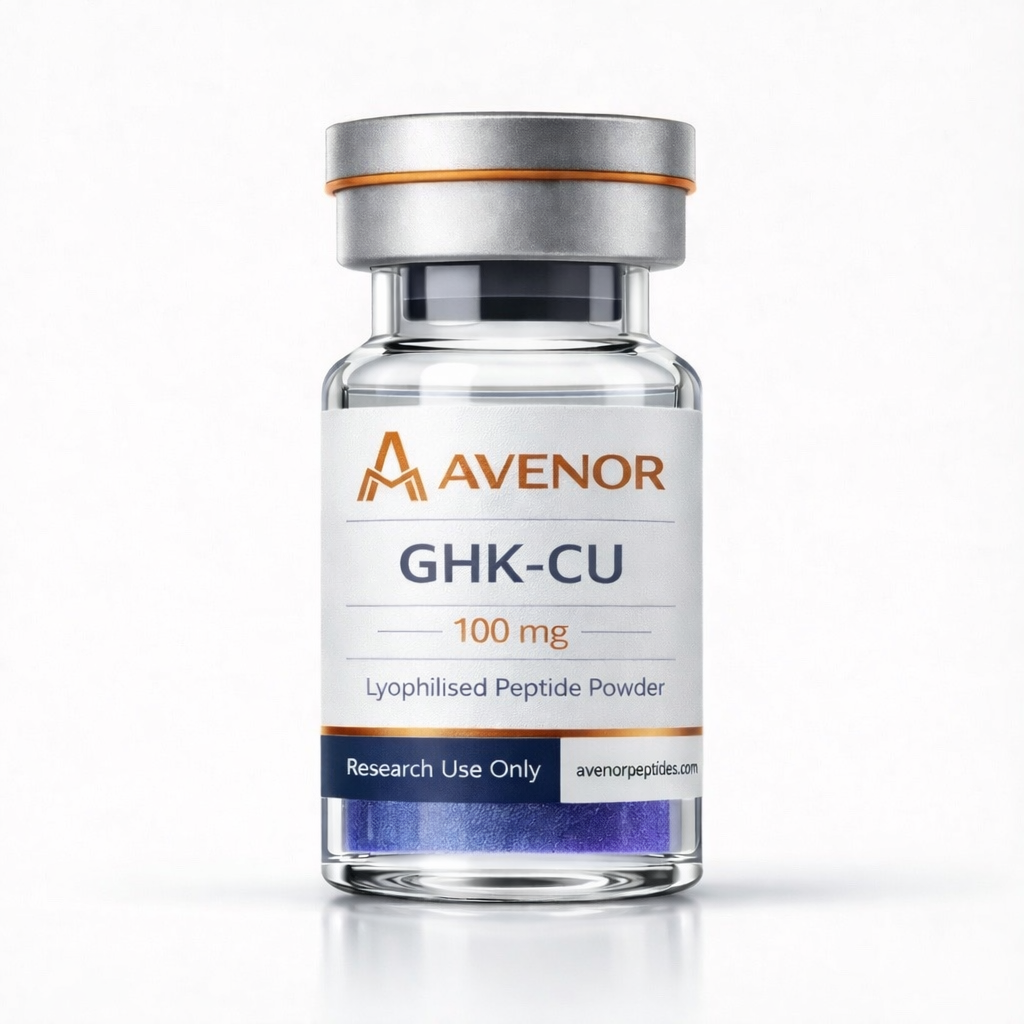
Peptide content confirmation and declared 100 mg quantity per vial.
Research Use Only (RUO) declaration on the packaging.
Documents available on request for the specific batch you received.
It is a three-amino-acid tripeptide — glycine, histidine, lysine — bound to a Cu(II) copper ion. The peptide itself is not a synthetic invention: it was discovered in 1973 as a fragment of human albumin and occurs naturally in plasma, saliva and urine.
Why does the copper matter in this molecule?
Copper is an essential cofactor for enzymes that cross-link collagen and for antioxidant defenses, yet in free form it is toxic. GHK binds copper one-to-one with high affinity, acting as a controlled carrier. In a zebrafish study, the complex reduced the toxicity caused by free copper.
Is it true that its levels fall with age?
Yes — this is stated consistently across the review literature (Pickart et al., 2015; Pickart and Margolina, 2018). It is precisely why the molecule is studied in the context of tissue aging: it is a substance the body produces and gradually loses.
What does it mean that it modulates 4,000 genes?
A 2015 review, based on analyses using the Broad Institute's Connectivity Map database, reports that GHK can up- or downregulate at least 4,000 human genes. This is a computational analysis of gene expression patterns, not a measurement of clinical outcome.
Has a specific molecular target been identified?
Yes. A 2024 study in a silicosis model identified peroxiredoxin 6 (PRDX6), an antioxidant enzyme, as a direct binding target of GHK-Cu. That matters because it supplies a concrete mechanism rather than a general description of activity.
Are there negative findings in the literature?
Yes, and they deserve mention. In a rat ACL reconstruction model the benefit appeared at 6 weeks but did not persist at 12 (Fu et al., 2015). In another controlled study, topical application to irradiated tissue showed no significant difference from control (Parker et al., 2013).
How does it differ from BPC-157 and TB-500 in the catalog?
It is the only one of the three that carries a metal ion in its structure, and the smallest, at just three amino acids. The mechanisms described in the literature also differ — gene expression regulation and copper binding, versus angiogenesis for BPC-157 and actin binding for TB-500. See the comparison table above.
Why does it need light protection when other peptides do not?
Because it is a copper complex. Metal complexes are generally more photosensitive than plain peptides and can degrade under prolonged light exposure. Keep the vial in its opaque carton or wrapped in foil.
Can it be used by humans or animals?
No. The product is supplied exclusively for laboratory research. It is not intended for human or veterinary use, nor for cosmetic application, nor for in vivo use outside a controlled laboratory setting.
How does the 2 mg capsule differ from the vials?
It is the same molecule in a different product form. The 50 and 100 mg are lyophilised powder in a vial, for reconstitution. The 2 mg is a capsule. The difference is not only practical: the existing literature concerns topical and injected administration, not oral.
Are there studies on oral intake?
No. A systematic literature search using terms covering oral administration, the gastrointestinal route and bioavailability finds no study of oral GHK administration, in humans or in animals. No absorption data exist.
Why is it available as a capsule then?
Because the question is open and reasonable. The gut has the PepT1 transporter, which carries thousands of dietary tripeptides intact, and GHK is a tripeptide. That does not prove absorption, but it makes the question worth studying. It is supplied as research material, not as an evidenced solution.
Does the capsule need freezing?
No. Store at room temperature, in a dry place, in its original sealed packaging. The freezing instructions apply only to the lyophilised vials.